
Affiliate Disclosure
Some links on this page are affiliate links. As an Amazon Associate, we earn from qualifying purchases — at no extra cost to you. We do not buy, test, or physically handle the products we cover; our rankings come from aggregated owner reviews, ratings and expert consensus. Commissions never change our verdicts. How we rank & full disclosure.
Short version: You cannot deodorize your way out of a smell you have not found. Every lasting car odor has a physical source — a spill, mildew, smoke residue, a pet accident, a clogged AC. The reliable method is: find the source, remove or neutralize it, treat the air if the smell has spread, and only then add a scent. Skip the hunt and you are just spraying perfume on a problem.
Odor work is detective work. I have chased smells to a forgotten juice box under a seat, a damp gym towel in the trunk, and — more than once — a cabin filter that had turned into a science experiment. The satisfying part is that once you find the source, the fix is usually simple. Like diagnosing a rattle before a track day, the trick is isolating what is actually wrong before you throw parts at it.
Step 1: Find the source
Before any product, investigate. Get the car warm — heat brings smells out — then work through the cabin methodically. Check under and between the seats, in the seat tracks, the door pockets, the trunk, the spare-tire well, and the cupholders. Look for spills, food, damp fabric, or anything organic. Pull the floor mats and check the carpet underneath; liquids love to hide there.
If the smell is strongest with the vents running, suspect the AC and cabin filter. If it is worst when the car is closed up and hot, suspect something soaked into the carpet or seats. Nailing down where and when the smell is worst tells you which fix to reach for.
Step 2: Remove and clean the source
Once you find it, remove it. Toss the trash, pull out the soaked mat, extract the spill. Then clean the affected surface properly. For anything organic — food, drink, sweat, biological accidents — an enzymatic cleaner is the tool, because enzymes actually digest the odor-causing compounds instead of just wetting them. A normal surfactant may lift the stain but leave the smell.
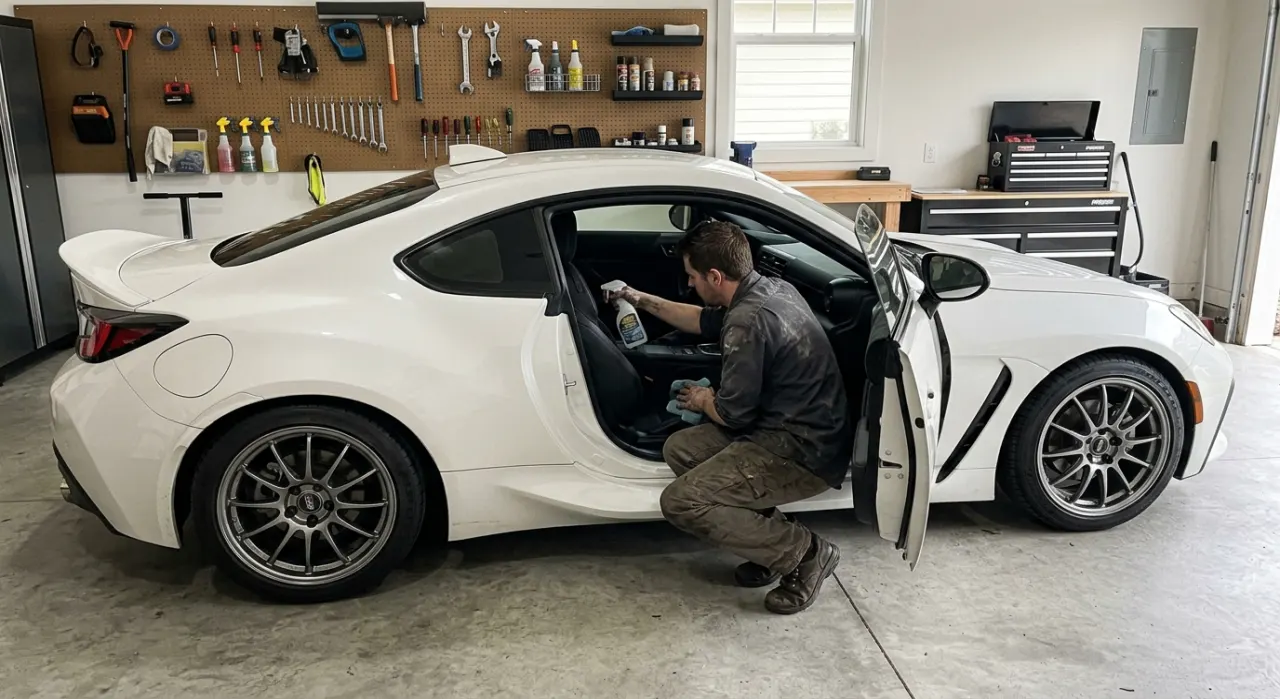
Fabric and carpet need care here. Clean them, but do not soak them — trapped moisture in the foam is itself a source of musty smell. The right technique is covered in our upholstery cleaner guide, which walks through cleaning and extracting without over-wetting. This whole step also slots into the wider routine; our full interior detailing walkthrough shows where odor work fits in the overall order.
Step 3: Tackle mildew and the AC
That damp, musty, "old basement" smell almost always traces to moisture. It could be a wet carpet from a leaking seal or a spilled drink, or it could be the AC evaporator, which stays cold and wet and grows mildew in the dark. If the smell blows in stronger when you turn the fan on, the AC is your suspect.
Fixes, in order of effort: replace the cabin air filter (cheap, often the whole answer), run the blower on high with the AC off for a few minutes at the end of drives to dry the system, and if it persists, use an AC evaporator cleaner sprayed into the fresh-air intake. Dry carpet the same way you would after any wet job — airflow, sun, patience.
Step 4: Treat the air for smells that spread
Some odors — cigarette smoke especially — do not live in one spot. They coat every surface and soak into the headliner, which you cannot really clean. For these, you treat the air itself:
- Enzyme foggers disperse a fine enzymatic mist that reaches into vents and fabric a towel cannot.
- Chlorine-dioxide bombs (the "smoke bomb" style) release a gas that neutralizes odor molecules throughout the cabin — safe and effective for most household smells.
- Ozone treatment is the heavy artillery for smoke and stubborn stink. It oxidizes odor molecules aggressively, but ozone is harmful to breathe — the car must be empty of people and pets, and aired out fully afterward before you drive it.
Air treatment is a second pass, not a first one. Do it after you have physically removed the source, or the smell will simply return.
Step 5: Now, and only now, add scent
Once the source is gone and the air is clean, a fresh scent is maintenance, not a cover-up — and that is the right way to use it. Choose something subtle; an overpowering freshener is almost as unpleasant as the smell it replaced, and it can trigger headaches on a long drive. Vent clips, gels, and light sprays all work, and the right pick depends on how strong and how long-lasting you want it. Our best car air freshener guide breaks down the formats and which last without becoming cloying.
Keeping the smell from coming back
Prevention is easier than any of the above. Deal with spills the day they happen, before they reach the padding. Do not leave damp towels, gym gear, or wet umbrellas in the car. Keep a small trash bin so food and wrappers do not decompose under a seat. Crack the windows on hot days if you can do it safely, and run the AC fan dry at the end of drives to stop the evaporator staying wet.
Do that, and odor becomes a non-issue instead of a recurring project. If a stubborn smell keeps coming back despite a clean source, it is worth re-checking the AC and the carpet under the mats — those are the two hiding spots people miss most. For the full cabin picture, from stains to glass to deodorizing, the interior detailing hub ties every step together.
Recommended Products
Best for neutralizing smoke and lingering smells rather than masking them
- Neutralizes odor-causing particles, not just covers them
- A long-time favourite for smoke and pet smells
- A couple of sprays treats a whole cabin
- Light, clean scent once it settles
Why buy it: the pick that actually removes a smell — Ozium attacks the odor itself, which is why detailers reach for it on smoke and stubborn cabin smells.

Best for removing the source of the smell from carpet and upholstery
- All-purpose interior cleaner for carpet, cloth and plastic
- Lifts spills and grime that cause smells in the first place
- One of the most-reviewed interior cleaners we track
- Dilutable, so a bottle lasts
Why buy it: the honest first step — most car odor comes from something spilled or ground into the seats, and cleaning that out beats any spray at fixing it for good.
Best for refreshing a freshly cleaned interior
- Odor eliminator plus a new-car scent
- Large 32 oz bottle for repeat use
- Good on fabric and hard surfaces
- Popular finishing touch after a detail
Why buy it: the finishing spray — once the cabin is clean, this both neutralizes and adds that new-car scent, which is why it is a common last step in a detail.
Best for keeping a clean car smelling fresh day to day
- Clips onto a dash vent for continuous freshening
- Adjustable intensity dial
- Five-pack lasts months
- Light, non-overpowering scent
Why buy it: the low-effort maintainer — once the odor is gone, a vent clip keeps the cabin pleasant without the heavy air-freshener smell.
Best for a strong, enthusiast-favourite scent that lasts
- Refillable cartridge design
- The cult "Squash" scent popular in car culture
- Adjustable vent to control strength
- Lasts noticeably longer than paper trees
Why buy it: the enthusiast pick for scent — a long-lasting refillable cartridge, best used after the odor source is cleaned rather than to hide it.
Prices are pulled from Amazon and were accurate as of Aug 22, 2026, 6:54 PM EDT. Product prices and availability are subject to change — the live price is shown on Amazon.