
Affiliate Disclosure
Some links on this page are affiliate links. As an Amazon Associate, we earn from qualifying purchases — at no extra cost to you. We do not buy, test, or physically handle the products we cover; our rankings come from aggregated owner reviews, ratings and expert consensus. Commissions never change our verdicts. How we rank & full disclosure.
Checking your engine oil takes about two minutes and can save you thousands — yet most people skip it or do it wrong and get a misleading reading. This guide covers the right technique, what the marks mean, how to decode what the oil is telling you, and what to do if your car has no dipstick. It's part of our DIY oil change hub.
Two Non-Negotiable Rules
Level ground: even a few degrees of slope shifts the oil and gives a false reading. Cold vs warm: a cold check (engine not run today, oil all drained back) is the clearest and what most manufacturers specify. A warm check works too, but wait 10–15 minutes after switching off — never check immediately (you'll get a low reading and a burnt hand). When in doubt, cold is safest.
Before You Start: What You Actually Need
Checking oil needs almost nothing, which is exactly why there's no excuse to skip it. Keep a clean lint-free rag or paper towel handy — a fluffy cloth sheds fibers onto the stick that then read like debris — plus a flashlight for dark engine bays, and, if you're topping up, a funnel and a quart of the correct grade. That's the whole kit. Give the engine time to settle before you dip: cold first thing in the morning is ideal, or at least 10–15 minutes after switching off so the oil drains back to the oil pan. Park on flat ground, set the parking brake, and make sure the engine is off — never reach into a running engine bay. If you stash a spare quart of your exact oil in the trunk, a low reading on a road trip becomes a two-minute fix instead of a gamble on whatever brand the gas station happens to stock; our oil grade guide helps you pin down the right one, and the tools you need guide covers the rest when you graduate to doing the full change.
How to Check, Step by Step
- Pop the hood and find the dipstick (usually a bright yellow/orange handle).
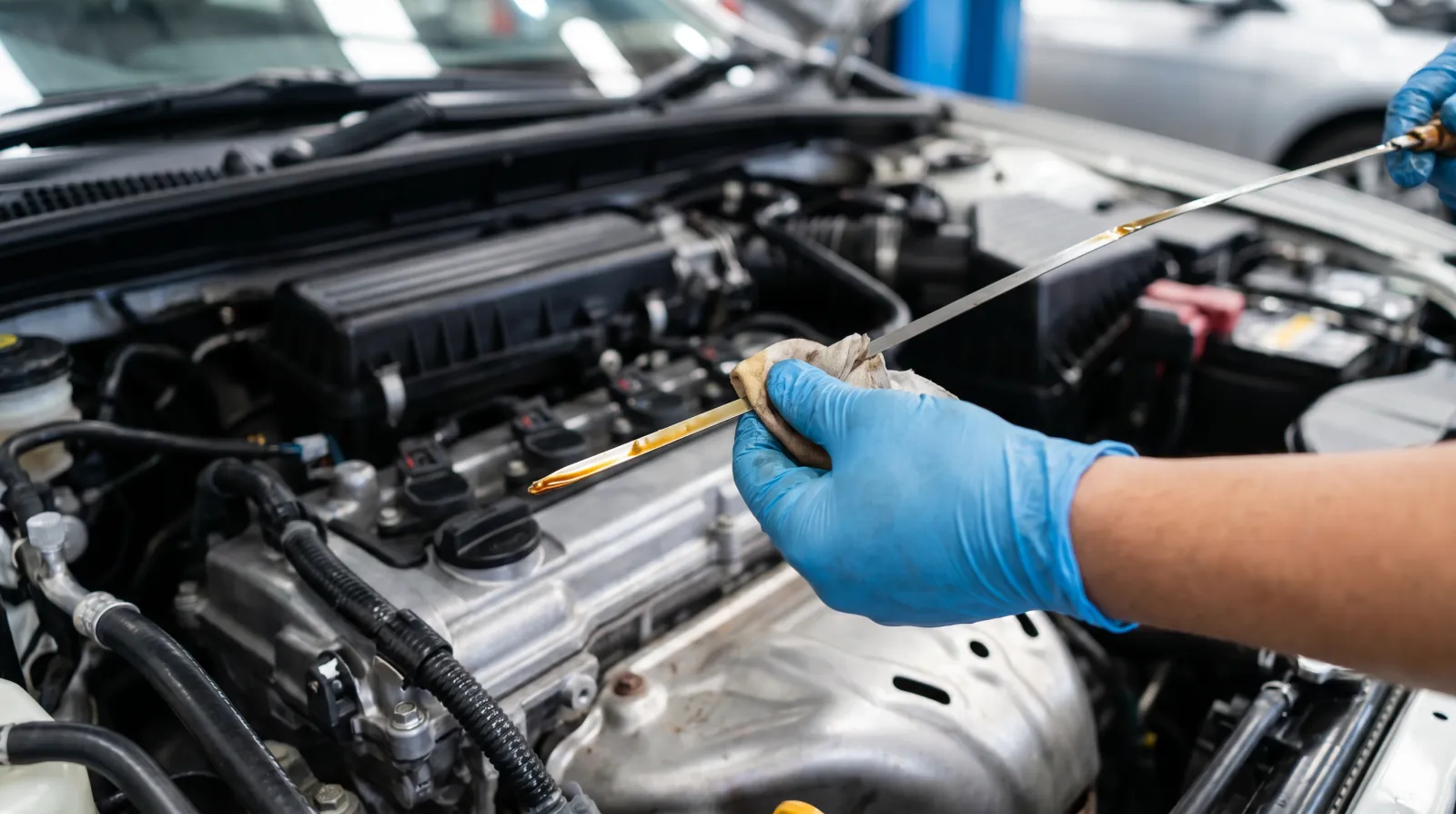
- Pull it out fully and wipe it clean — the reading means nothing until you wipe and re-dip.
- Push it all the way back in, seated firmly.
- Pull it out again slowly, holding it horizontally so oil doesn't run along it.
- Read the level against the min and max marks.
Common Mistakes That Give a False Reading
Most bad readings come down to technique, not a sick engine. Skipping the wipe on the first pull is the classic one — oil splashes up the tube while the engine runs, so the first dip always sits high; wipe, re-seat fully, and read the second pull. Checking on a slope can shift the level a whole zone on some cars, which is why level ground matters so much. Reading hot, straight after a drive leaves oil clinging to the top end and shows low, tempting you into an overfill you'll regret. Not seating the stick all the way — if it snags on the tube, the film lands wherever it stopped, not where the oil actually is. And twirling the stick as you draw it out smears oil across both faces so you can't tell where the true line ends; hold it flat and read the side with the crisp, unbroken edge. Do all five right and the reading is trustworthy every time.
Understanding the Min/Max Marks
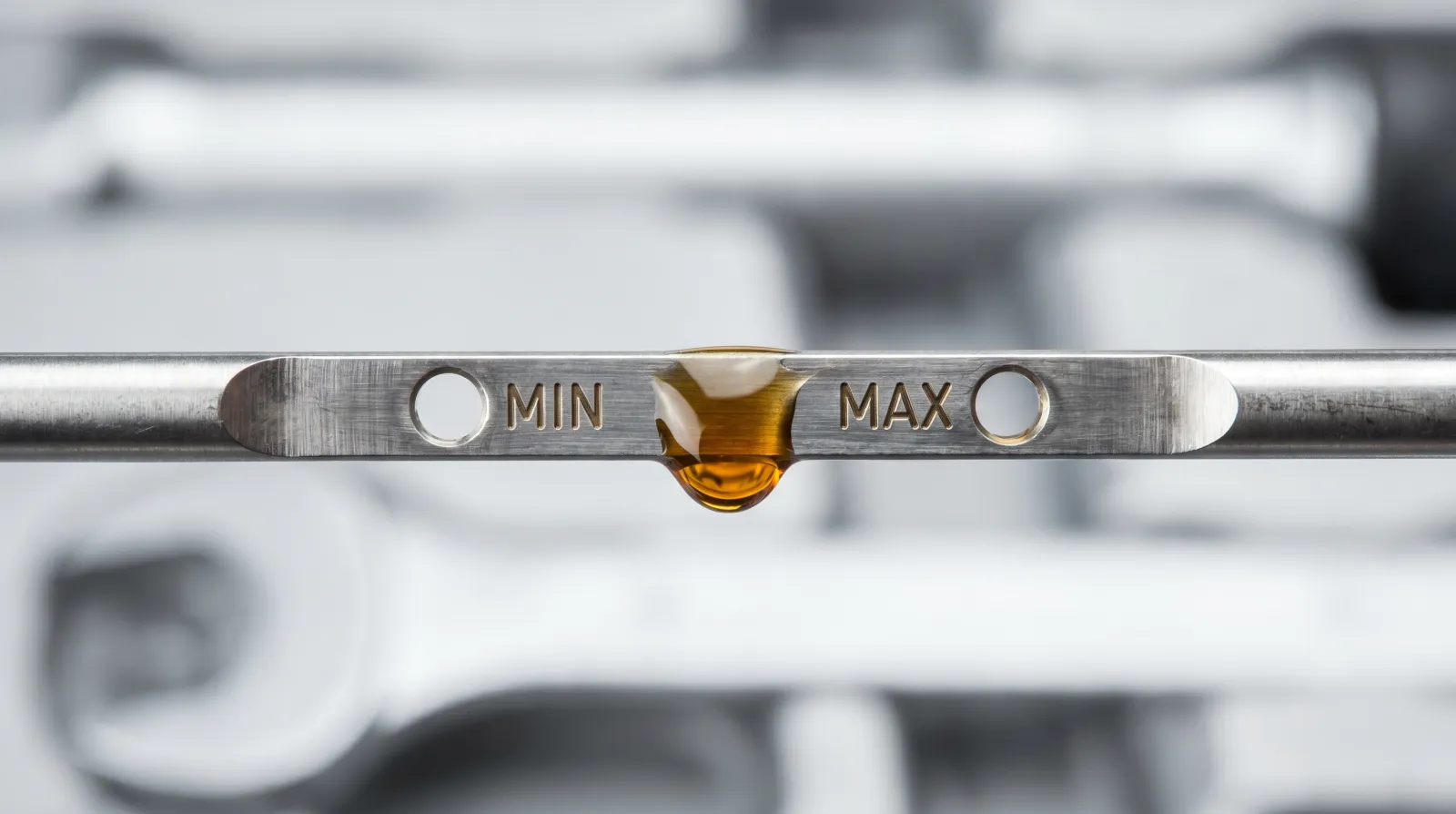
The oil film should sit between the two marks (MIN/MAX, L/H, or a crosshatched zone). At or above MAX: don't add oil — overfilling forces oil past seals into the combustion chamber, causing blue smoke and fouled plugs; drain some if significantly over. Between MIN and MAX: the safe zone. At or below MIN: top up before driving further — running at minimum risks oil starvation under cornering. The gap between MIN and MAX typically represents 0.5 to 1.0 quarts, so add 8–16 oz at a time, wait, and re-check rather than going MIN-to-MAX in one pour.
Topping Up vs a Full Oil Change
A top-up restores volume; an oil change flushes degraded, contaminated oil and replaces it with the filter. If your level drops consistently between services, investigate separately — our burning and leaking oil guide covers it. Topping up is valid between changes, as long as you add the right oil.
How Much Oil Loss Is Actually Normal?
Every engine uses a little oil — it is not a sealed system, and a small amount burns off past the rings and valve guides by design. As a rough guide, many manufacturers treat up to 1 quart per 600–900 miles as within spec, and a healthy modern engine typically uses far less. What actually matters is the trend, not the absolute number. A car that has held its level for years and then suddenly starts dropping half a quart a month is telling you something changed. Turbocharged engines, high-revving fours and anything with big miles tend to sip more, and for them that is simply normal — know your own car's baseline and you'll spot a real problem early. If you find yourself topping up more often than you'd like, the cause is almost always burning or leaking; our burning and leaking oil guide helps you work out which, and stretched service intervals make consumption worse too, so it's worth sanity-checking yours against our oil change intervals page.
Choosing the Right Grade to Top Up With
Never pour in whatever's lying around. Match the viscosity already in the engine (e.g. 5W-30 — on the filler cap, manual, or original container), match the specification (API SN, ACEA C3, dexos1), and stay within the same base type where possible. Not sure? Our oil grade guide walks you through it.
Reading Oil Color and Condition
Clean amber/honey — fresh, healthy oil. Dark brown or black — normal (especially diesels); the detergents are doing their job. Smell and feel it: smooth means it's still working, gritty and strongly burnt means it's past its service life. Gritty/metallic feel — stop and investigate; usually bearing wear. Milky/creamy/foamy — take seriously: coolant has entered the oil (head gasket, cracked head), which destroys lubrication fast. Don't drive — get a proper diagnosis, and check the coolant reservoir for brown oily contamination too.
What If Your Car Has No Dipstick?
Many modern European cars (BMW, Mercedes, Audi from the mid-2010s) use an electronic oil-level sensor in the oil pan, displayed in the instrument cluster or infotainment menu — the reading is usually taken with the engine off and stationary on level ground. They measure by resistance/capacitance, not sight, so they can read falsely on an incline or with a fouled sensor, and you can't assess oil condition visually without draining a sample. If the system shows low, top up through the filler cap with the same add-a-little, check-again method — the sensor takes a few minutes to update.
How Often Should You Check?
Once a month is a solid habit for most daily drivers, and before any long trip. Turbocharged, older or hard-driven cars: every two weeks. Catching a half-quart drop early is a five-minute fix; catching it after the warning light is a gamble. For service schedules and full changes, head back to the DIY oil change hub.
Recommended Products
When your dipstick reads low, top up with the exact grade your manual calls for. These are the full-synthetic 5W-30 oils owners rate highest across large review bases — always confirm the viscosity and specification match your engine before you pour.

Best for the widest OEM approval list and long drain intervals
- API SP / ILSAC GF-6 rated
- Meets GM dexos1 Gen 3, many OEM approvals
- Rated for extended (up to 20k-mile) intervals
- Strong LSPI and timing-chain-wear protection
Why buy it: the synthetic owners reach for most because it carries a huge approval list — the right pick for the majority of modern engines, provided the grade matches your manual.

Best for a fully-approved synthetic for the lowest price per quart
- API SN Plus / dexos1 Gen 2 licensed
- Genuine full synthetic base
- Lowest cost-per-quart of the group
- Same spec compliance as name brands
Why buy it: proof that spec beats badge: a licensed, fully-approved synthetic that meets the same standards as the premium jugs for noticeably less money.

Best for engine cleanliness from a gas-to-liquid base oil
- PurePlus gas-to-liquid base oil
- API SP / ILSAC GF-6, dexos1 Gen 3
- Excellent for keeping pistons clean
- Backed by a mileage protection program
Why buy it: owners who care about keeping deposits off pistons like the ultra-clean GTL base — a genuinely premium synthetic that still meets mainstream specs.

Best for turbocharged and hard-driven engines
- Fluid Titanium film strength additives
- API SP / dexos1 Gen 3
- Holds up under high heat and load
- Strong wear protection at the film
Why buy it: the pick owners of turbo and performance engines lean on for film strength under heat — as always, only if 5W-30 is the grade your engine calls for.

Best for engines past 75,000 miles that seep or burn a little
- Added seal conditioners
- API SP / ILSAC GF-6
- Targets minor leaks and oil burn
- Full-synthetic protection for older engines
Why buy it: the high-mileage formula owners of older engines credit with quieting minor seepage — the seal conditioners are the reason to choose it over standard synthetic.
Prices are pulled from Amazon and were accurate as of Aug 22, 2026, 6:54 PM EDT. Product prices and availability are subject to change — the live price is shown on Amazon.