

Affiliate Disclosure
Some links on this page are affiliate links. As an Amazon Associate, we earn from qualifying purchases — at no extra cost to you. We do not buy, test, or physically handle the products we cover; our rankings come from aggregated owner reviews, ratings and expert consensus. Commissions never change our verdicts. How we rank & full disclosure.
Your first DIY oil change feels like a win — until the engine doesn't sound right, or the oil light stays on. Most first-time mistakes are completely fixable, but a couple can take out an engine in under a minute. This list covers the ten most common, roughly from "annoying" to "catastrophic." Work through it before you turn a wrench. If you haven't done your first change yet, start with our step-by-step guide; everything's in the DIY oil change hub.
Before You Turn a Wrench: The 60-Second Parts Check
Most of the mistakes below are prevented before the car ever goes up on the ramps — at the parts counter and on the bench. Before you drain anything, lay out the new filter, the oil, and a fresh crush washer, and check them against the car, not the box. Confirm the filter part number actually cross-references to your engine — a filter that threads on is not proof it's the right one, because bypass-valve pressure and the anti-drainback valve differ between applications. Confirm the oil grade on the jug matches the filler cap. Count that you have enough oil for the engine's full capacity plus a little to spare, so you're not stranded a half-quart short with the drain plug already out. Dry-fit the filter wrench and the drain-plug socket so you know they fit before your hands are slick with oil — the right kit is in tools you need. Sixty seconds here quietly deletes half of what follows.
1. Double-Gasketing the Oil Filter
When you remove the old filter, its rubber O-ring sometimes sticks to the block. Fit a new filter over it and you've got two O-rings stacked — the seal never seats, and oil leaks immediately, sometimes dumping the whole supply at highway RPM. Fix: run your finger around the filter mating surface before fitting the new filter; peel off any old ring. Every time.
2. Forgetting to Refill Before Starting
Drained, filter swapped, plug torqued — and you turn the key on an engine with no oil. Five to ten seconds of dry running scores bearings. Fix: make refilling your next physical action after the plug and filter are tight. Funnel in, pour, check the dipstick, then start.
3. Overfilling the Engine Oil
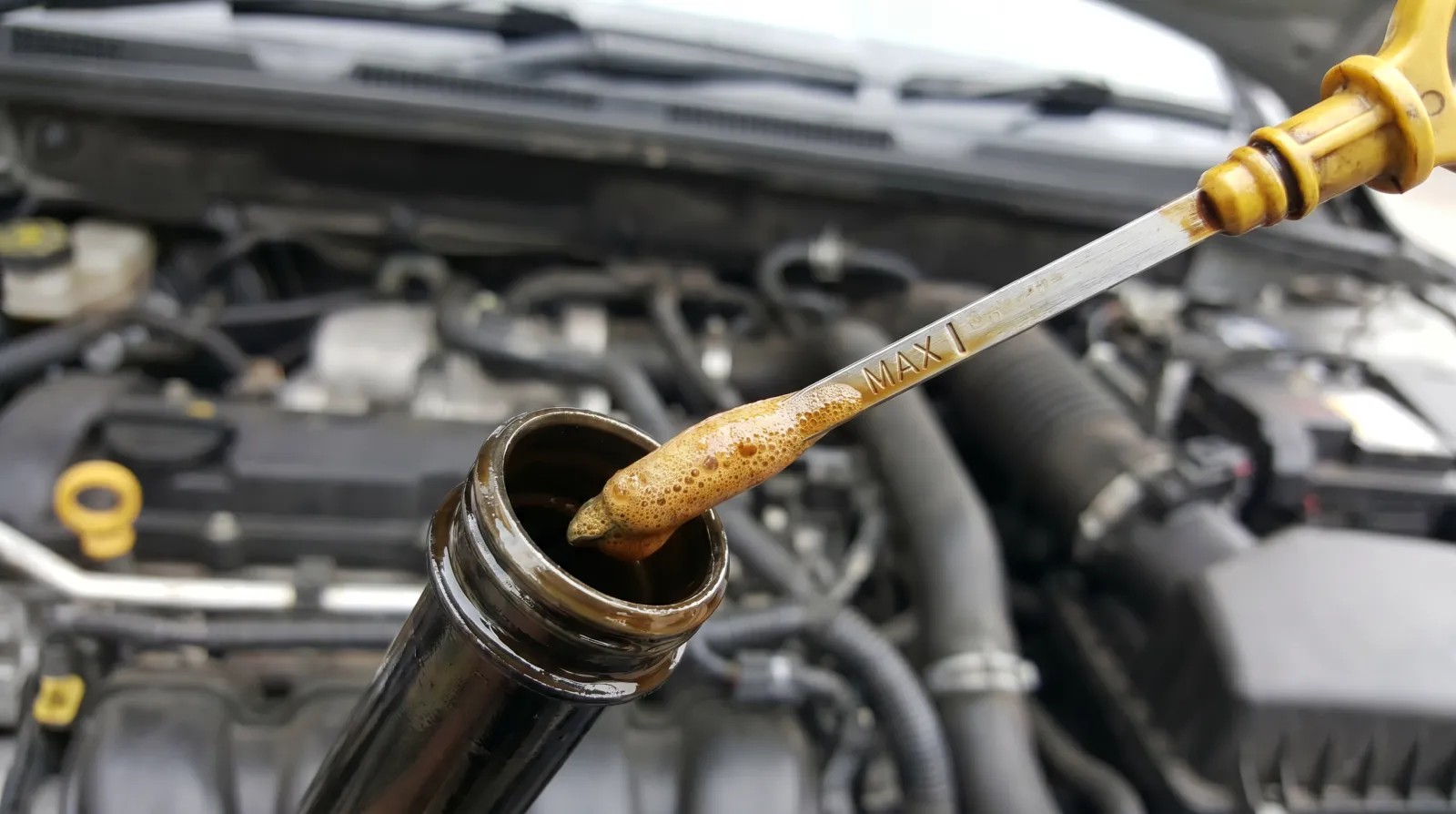
More oil isn't safer. Overfilling causes white/blue exhaust smoke and foaming on the dipstick — aerated oil runs on bubbles instead of film, and pressure forces oil past seals. Fix: add in half-quart increments, checking the dipstick each time, and stop between MIN and MAX. Drain or pump out any excess. More in checking and topping up oil.
4. Under- or Over-Torquing the Drain Plug
Hand-tight plus a guess is not a torque spec. Under-torqued plugs weep or back out on the highway; over-torqued plugs strip the oil pan — expensive on aluminum. Fix: look up the figure (usually 25–35 Nm, but verify) and use a torque wrench. See torque specs.
5. Reusing the Crush Washer
Crush washers deform once to seal and don't re-seal reliably the second time. Fix: buy a pack when you buy the oil and filter — a dollar or two each, the cheapest insurance in the job.
6. Using the Wrong Viscosity or Grade
The wrong viscosity won't flow properly through modern tolerances at cold start (too thick) or hold pressure at temperature (too thin). Fix: check the filler cap, manual or door-jamb sticker. The grade is not a suggestion, and synthetic vs conventional aren't always interchangeable.
7. Draining the Wrong Plug
On RWD cars, pickups and 4WDs the oil pan, transmission, transfer case and diff all have drain plugs that look similar. Drain the transmission by mistake, refill the oil pan, and you run the transmission dry while overfilling the engine. Fix: identify each plug with a flashlight first — the oil pan drain is typically the lowest, central point under the block.
8. Skipping the Funnel
Pouring straight from a 5-quart jug coats the intake and exhaust in oil that then smokes for days. Fix: use a funnel. They're $3.
9. Not Warming the Oil First
Cold oil drains slowly and incompletely; hot oil straight off a drive burns. Fix: run the engine three to five minutes, or let it sit 20 minutes after a drive, so the oil is warm but not scalding.
10. Not Resetting the Oil-Life Monitor
The monitor calculates the next change from driving conditions, not a simple counter — skip the reset and it nags you or gives false security. Fix: look up the reset (usually a button sequence with the ignition on) before you finish, while you're still thinking about it.
A Few More Traps for Your Second and Third Change
Once the basics are muscle memory, these are the ones that still catch people. Not seating the new filter's O-ring with a film of oil — a dry gasket grabs, tears or won't seal, so smear a fingertip of fresh oil around it before you spin it on. Cranking a spin-on filter tight with a wrench when the instructions say hand-tight plus about three-quarters of a turn — over-tightened filters weld themselves on and crush the gasket. Leaving the old drain-plug washer stuck to the pan and fitting a new one on top of it. Not wiping spilled oil off the exhaust or subframe, then panicking at the smoke when it burns off on the first drive. And on cartridge-filter engines, forgetting to replace the housing O-rings that come in the filter kit — the oil filter guide spells out the difference between spin-on and cartridge setups. None of these will kill an engine on its own, but each one turns a clean job into a comeback.
If You've Already Slipped Up
Made one of these? Don't panic-start the engine and hope — diagnose it first. If you overfilled, drain or pump the excess back down to the MAX mark before running it any further. If you suspect a double-gasket or a loose filter, the tell is oil pouring from the filter area within seconds of start-up — shut down, pull the filter, and check for the stacked ring. If you started it dry for a moment, shut off immediately, fill to the correct level, restart and listen: a clean idle with the oil light out is a good sign, while knocking or a light that stays lit means stop and get it looked at. The single habit that saves you every time is the one in the next section — a slow, deliberate check before and after you start.
One Final Check
With the oil in and the plug and filter tight, start the engine and idle 60 seconds while you watch underneath for drips and confirm the oil-pressure light goes out within a couple of seconds. Then shut off, wait, and check the dipstick once more. That routine catches almost every mistake on this list. Do it right from the start with our complete how-to, and bookmark the torque specs for your car.
Recommended Products

Best for the widest OEM approval list and long drain intervals
- API SP / ILSAC GF-6 rated
- Meets GM dexos1 Gen 3, many OEM approvals
- Rated for extended (up to 20k-mile) intervals
- Strong LSPI and timing-chain-wear protection
Why buy it: the synthetic owners reach for most because it carries a huge approval list — the right pick for the majority of modern engines, provided the grade matches your manual.

Best for a fully-approved synthetic for the lowest price per quart
- API SN Plus / dexos1 Gen 2 licensed
- Genuine full synthetic base
- Lowest cost-per-quart of the group
- Same spec compliance as name brands
Why buy it: proof that spec beats badge: a licensed, fully-approved synthetic that meets the same standards as the premium jugs for noticeably less money.

Best for engine cleanliness from a gas-to-liquid base oil
- PurePlus gas-to-liquid base oil
- API SP / ILSAC GF-6, dexos1 Gen 3
- Excellent for keeping pistons clean
- Backed by a mileage protection program
Why buy it: owners who care about keeping deposits off pistons like the ultra-clean GTL base — a genuinely premium synthetic that still meets mainstream specs.
Best for high efficiency and long intervals with synthetic oil
- Dual-layer synthetic media, 99%+ efficient
- Wire-backed media, silicone anti-drainback valve
- Rated up to 20,000 miles
- SureGrip textured shell for easy install
Why buy it: the synthetic-media filter owners rate top for efficiency and long intervals — confirm the exact part number for your vehicle, since XG7317 fits specific models.

Best for pairing with extended-interval synthetic oil
- High-efficiency synthetic-blend media
- Silicone anti-drainback valve
- Rated up to 20,000 miles
- Widely stocked everywhere
Why buy it: the easy-to-find filter owners pair with extended-drain synthetic oil — a proven, long-interval filter, so long as you buy the number that fits your car.

Best for full-synthetic media with strong dirt capacity
- SmartFUSION full-synthetic media
- 99%+ dirt removal, reinforced backing
- Silicone anti-drainback valve
- Built for demanding conditions
Why buy it: the premium synthetic-media filter owners choose for demanding use — high capacity and efficiency, again in the specific part number for your application.
Prices are pulled from Amazon and were accurate as of Aug 22, 2026, 6:54 PM EDT. Product prices and availability are subject to change — the live price is shown on Amazon.