
Affiliate Disclosure
Some links on this page are affiliate links. As an Amazon Associate, we earn from qualifying purchases — at no extra cost to you. We do not buy, test, or physically handle the products we cover; our rankings come from aggregated owner reviews, ratings and expert consensus. Commissions never change our verdicts. How we rank & full disclosure.
The short version: for painting cars you want refinish-grade automotive masking tape — crepe tape engineered to hold a sharp line, resist solvent bleed, and peel clean, unlike household painters tape. Ranked across aggregated owner reviews, our #1 pick is 3M Automotive Refinish Masking Tape (06656): the yellow crepe body shops rely on for crisp edges and clean removal. For the sharpest lines around curves, the green Scotch 233+ is the upgrade.
Masking is the prep step that decides how professional a paint edge looks — see where it fits in our scratch & paint repair hub. Pair the right tape with the right paper and the right paint from our touch-up paint guide for a clean two-tone or spot repair.
Top Picks at a Glance
Our #1 Pick: 3M Automotive Refinish Tape (06656)
3M's 06656 refinish tape tops the list because it is the tape that quietly does the whole job right. The yellow automotive crepe holds a sharp paint edge, resists the solvent bleed that ruins a two-tone line, and — the part that matters most — peels away clean without leaving adhesive on the finish. Owners and body shops use it as the default for a reason: it is forgiving to lay down, conforms well enough for most edges, and takes booth heat. For general automotive masking, it is the roll the reviews back most.
Best Automotive Masking Tapes 2026: The Ranked Field

Best for crisp paint lines and clean removal on refinish jobs
- Yellow crepe, refinish-grade
- Resists bleed-through and lifting
- Clean removal, no residue
- Handles bake-cycle heat
Why buy it: the tape body shops actually use — the yellow crepe holds a sharp paint edge, resists solvent bleed, and peels clean without leaving adhesive, which is the whole job of masking tape.

Best for the same pro tape in a narrower, cheaper roll
- 36 mm width for general masking
- Refinish-grade crepe backing
- Moisture and heat resistant
- Everyday body-shop workhorse
Why buy it: the value width owners keep on the bench — identical refinish-grade adhesive and crepe in a slimmer roll that covers most general masking for less money.

Best for the sharpest lines around curves and contours
- High-performance green crepe
- Superb conformability on curves
- Very sharp, bleed-free edge
- Painter and detailer favorite
Why buy it: the tape pros reach for on the fussy stuff — the green 233+ conforms around curves and moldings and pulls the crispest, most bleed-free line of anything here.

Best for a versatile all-round refinish tape
- 388N multi-purpose grade
- 48 mm yellow crepe
- Moisture resistant
- Holds paper and plastic sheeting
Why buy it: the do-everything roll owners like for holding masking paper and plastic as well as edging — a versatile refinish tape that does the whole booth job, not just the lines.

Best for higher bake temperatures and longer holds
- Performance-grade heat resistance
- 48 mm width
- Clean removal after baking
- For hotter cure cycles
Why buy it: the tape for hotter cure schedules — it takes more heat before the adhesive bakes on, so it still peels clean after a warm bake that would leave cheaper tape gummy.
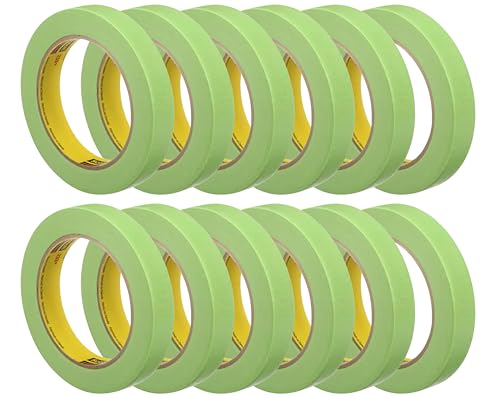
Best for tight fine-line work and two-tone edges
- Narrow 0.75 in green crepe
- Bends around tight radii
- Sharp two-tone edges
- High-performance adhesive
Why buy it: the narrow green roll for detail edges — it bends around tight curves for two-tone lines and graphics where a wide tape simply cannot follow the shape.
Tape Colors: Yellow Crepe, Green Performance and White
Automotive tape colors are not just cosmetic — they signal grade. Yellow crepe is the standard refinish tape most body shops prefer for general painting and edging: good adhesive, solvent-resistant, clean pull. Green high-performance tape (Scotch 233+) conforms around curves and pulls the crispest line, so it is the choice for two-tone and detail work. White and tan crepe show up on general-purpose rolls. Some detailers also like brands such as CarPro for specific jobs. Pick the color to the task — yellow for bulk, green for the fussy edges.
Sharp Lines: Resisting Bleed and Lifting
The whole point of good tape is a sharp, bleed-free edge, and two properties deliver it. First, an adhesive that seals the edge so basecoat cannot creep under — that is what gives clean paint lines. Second, a backing and glue that resists the solvents and heat of curing without softening, wrinkling or lifting mid-job. Refinish-grade crepe is engineered for exactly this, which is why it holds where household tape fails. When owners praise a tape's performance, this is what they mean: it stays put through the spray and peels away clean afterward.
Painters Tape Widths, Inch by Inch
Automotive painters tape is usually sold in millimeters, but the common sizes map to familiar inch widths. A 48 mm roll is roughly 2 inch, 36 mm about 1.5 inch, and fine-line green comes as narrow as 6 mm (about a quarter inch). Wide rolls hold masking paper and cover long straight lines; narrow fine-line rolls bend around curves for two-tone edges. Keeping one wide refinish roll and one narrow fine-line roll on the bench covers almost every job, and you spend on the fine-line where any bleed would show.
Quick Comparison
3M Automotive Refinish Masking Tape (06656, 48 mm)
Best for crisp paint lines and clean removal on refinish jobs
Best Value
3M Automotive Refinish Masking Tape (06654, 36 mm)
Check Price on Amazon
Best Premium
Scotch Performance Green Masking Tape 233+ (1.5 in)
Check Price on Amazon
Best Multi-Purpose
3M Automotive Refinish Masking Tape 388N (06656)
Check Price on Amazon
Best High-Temp
3M Automotive Performance Masking Tape (03435, 48 mm)
Check Price on Amazon
Best Fine-Line
3M Performance Green Masking Tape 233+ (0.75 in)
Check Price on Amazon
How We Rank
We do not run our own paint booth — we rank by aggregated owner ratings, review volume, and the themes owners repeat across real jobs. We weigh four things. Line sharpness — whether the tape gives a crisp, bleed-free paint edge. Clean removal — peeling away without lifting paint or leaving residue, even after some heat. Conformability — how well it follows curves and moldings without wrinkling. And value — length and width per dollar for the masking you actually do. Prices were current at the time of writing.
Why Automotive Tape, Not Household Tape
This is the whole reason to read a roundup instead of grabbing the blue roll from the garage. Household painters tape is built for walls — it is not formulated for automotive solvents or the heat of paint curing. Hit its edge with basecoat and clear and it can let paint bleed under, wrinkle or lift when the solvent softens the adhesive, or bake on and leave residue. Automotive refinish crepe is engineered for exactly those conditions: sharp edge, solvent resistance, heat tolerance, clean pull. The difference costs a couple of dollars and shows up as the single most visible detail of the job — the paint line.
Masking a Clean Line
Good tape only pays off with good technique. Start on a clean, degreased, dry surface — tape will not seal over wax or dust. Lay it in a smooth continuous run, then press the paint edge firmly with a fingernail or plastic squeegee so there is no gap for paint to creep under. Use a narrow fine-line tape for curves so it bends without lifting. Spray light coats instead of one flooding pass at the edge. And pull the tape while the paint is still fresh per the paint's instructions, back on itself at a low angle — that gives the cleanest break and avoids chipping a fully-hardened edge.
How to Choose Masking Tape
Buy for the two jobs masking actually involves. For bulk masking — holding paper and plastic, long straight edges — a wide refinish roll (3M 06656 or the value 06654) is efficient and cheap. For the paint edges themselves, especially curves and two-tone lines, a narrow fine-line green tape (233+ in 0.75 in) lays the crispest line and bends around tight radii. If your job goes through a warm bake, step up to a high-temp performance tape so nothing bakes on. Most DIY paint jobs are covered by one wide refinish roll plus one fine-line roll — spend the money on the fine-line, because that is where any bleed shows.
The Rest of the Paint Job
Tape is one piece of a clean repair. Level and prep the surface first with a pick from our best sandpaper for car paint guide, match your color with our touch-up paint roundup, and if you are filling a dent first, see our body filler picks. Once painted, protect the fresh finish with a good wax or a ceramic coating. The full sequence lives in the scratch & paint repair hub.
The Verdict
For crisp paint lines and clean removal on any refinish job, 3M Automotive Refinish Masking Tape (06656) is the roll owners rate above the rest. Chasing the sharpest edge around curves? Step up to the green Scotch Performance 233+. And whatever you buy, use real automotive tape — household painters tape bleeds and lifts under solvents, and the paint line is the one detail everyone sees. Check Price on Amazon →