
Affiliate Disclosure
Some links on this page are affiliate links. As an Amazon Associate, we earn from qualifying purchases — at no extra cost to you. We do not buy, test, or physically handle the products we cover; our rankings come from aggregated owner reviews, ratings and expert consensus. Commissions never change our verdicts. How we rank & full disclosure.
Short version: a paint pen is the easiest DIY paint tool there is, perfect for quick chip fixes, but it lives and dies on two things: color match and dosing. Get an OEM-coded pen matched to your door-jamb paint code, then apply it in thin, light layers instead of one heavy pass. Do that and a small chip nearly vanishes. Grab a generic shade and glob it on, and you've made the chip more obvious, not less. The pen isn't magic; the technique is everything.
What a Paint Pen Is Good For
Paint pens shine at small, contained jobs: a rock chip, a thin scratch, a nick on an edge, the kind of damage that's reached the color or metal but is physically tiny. They're fast, portable, and forgiving enough that you can keep one in the glovebox and hit a fresh chip in a parking lot before it rusts. That speed is their whole appeal.
Where they're not the right tool is anything large, a whole scuffed corner, a long deep gouge, or a keyed panel. There you want a bottle-and-brush kit for control, or you're honestly into full touch-up territory and maybe a shop. And a pen does nothing for a clear-coat scratch that shows no color, that's a polishing job, not a paint job, covered in fixing a clear-coat scratch. Confirm your damage actually needs paint (nail catches, color shows) using the severity guide before you reach for a pen at all.
Color Match Is Non-Negotiable
The single biggest reason paint-pen repairs look bad is a wrong color, and it's entirely avoidable. Your car has a paint code on a sticker in the driver's door jamb (sometimes the glovebox or under the hood), a short alphanumeric code near a 'C', 'PNT', or 'COLOR' label. Order a pen matched to that exact code, plus your make and year, from an OEM-match supplier. That's how you get a shade that actually disappears.
Generic 'gloss black' or 'white' pens from a parts-store rack are a trap on anything visible. Even solid colors vary between manufacturers, and metallics and pearls are hopeless to match generically, the flake and tint have to be exact or the repair flashes a different color as the light moves. A generic pen is fine for a hidden spot inside a wheel well; on a panel you'll actually look at, it's worse than the chip. Spend the extra couple of dollars on the coded pen.
Prep the Spot First
Paint only bonds to a clean, dry, wax-free surface. Wash the area, dry it, and wipe it with isopropyl alcohol to strip wax and grease, skip this and the paint lifts within weeks. If the chip has gone to bare metal, deal with any rust and prime it first, exactly as in rock chip repair, because a pen over rust just seals the corrosion in to keep spreading. Prep is boring and it's where most pen repairs are quietly won or lost.
The Technique: Thin Layers, Light Hand
Here's the skill, and it's mostly about restraint. First, prime the pen on a scrap surface, cardboard, tape, anything, so the tip isn't over-loaded and gushing when you touch the paint. An over-loaded pen dumps too much at once, and that's the classic mess.
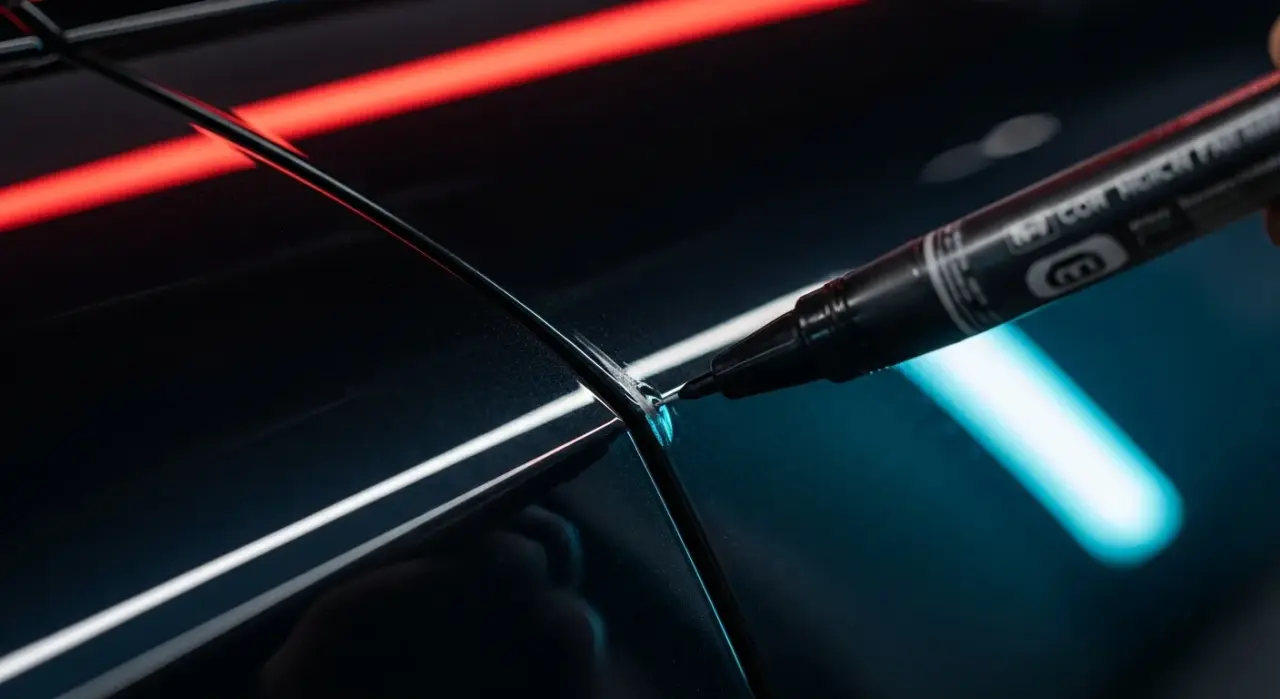
Then apply the color in thin layers, not one heavy stroke. Dab or draw lightly into the damage, let it dry, and add another light layer, building the color up gradually until it sits just slightly proud of the surface. Chips take a few dabs; a thin scratch takes a careful light pass or two. The instinct is to press hard and fill it in one go, resist that. A single heavy application dries as a raised, glossy lump that catches the eye far more than the original chip did. Light and patient wins every time.
Clear Coat and Cure
Some pens are two-in-one with a separate clear tip, others are color only. Either way, a visible repair needs clear over the cured color, because factory paint is color plus clear, and a color-only fix reads as a dull flat patch on glossy paint even when the shade is dead-on. Apply the clear (from the pen or a separate bottle) once the color has dried, in a thin layer.
Then leave it alone. Touch-up paint keeps hardening for days, so don't wash, wax, or level the spot for about two weeks. On a small chip you can usually just leave the slightly-proud repair as is. If you want it perfectly flush, wait out the cure, then gently level and polish it, the same leveling process we detail in how to fix touch-up paint.
The Pens Worth Buying
- OEM-matched pens (ordered to your door-jamb code) are the top choice for any visible repair. Usually $10-20, and the match is what makes them worth it over a generic pen.
- Two-in-one color-plus-clear pens are convenient for quick jobs, one tool, color and gloss in a couple of steps. Handy for the glovebox.
- Dr. ColorChip and similar blob-and-blend systems, while not strictly pens, are the better call if you've got lots of chips to do; the blending solution levels the excess for you. Great for a peppered hood.
Skip the bargain generic-color pens for anything you'll see. They're only worth it for genuinely hidden spots where the match doesn't matter.
The Mistakes That Ruin a Pen Repair
- Wrong color. A generic shade on a visible panel stands out worse than the damage. Use the coded pen.
- Over-loading and globbing. Too much paint at once dries as a raised lump. Prime the pen, dose lightly.
- Painting over wax or rust. The paint lifts, or the rust keeps spreading underneath. Always degrease and de-rust first.
- Skipping clear coat. Leaves a dull patch even when the color's perfect.
- Not letting it cure. Washing or leveling too soon mars the fresh repair.
The Verdict
A paint pen is the fastest, easiest way to fix a small chip or thin scratch, as long as you get an OEM-coded color and apply it in thin, light layers. Prep the spot, prime the pen, build the color gradually, clear-coat it, and let it cure. For a single glovebox 'stop the rust' fix, a pen is ideal; for a careful near-invisible repair on a panel you'll scrutinize, a bottle-and-brush kit gives more control, and for lots of chips, a blob-and-blend system wins. If your damage shows no color, it's a clear-coat polishing job instead. For the color-matched paints, pens, and kits reviewers rate highest, see our top picks in the scratch remover roundup.
Recommended Products
Best for a hood or bumper peppered with small rock chips
- Blob-and-blend method: dab color on, then level the excess with the squeegee
- SealAct blending solution forgives a shaky hand across many chips
- Kit is mixed to your exact OEM code — order by make, model and year
- Far faster than a fine brush when you have a field of little chips
Why buy it: the owner favourite for scattered chips — the squeegee-and-blend approach levels the paint flush for you, which is why it keeps getting recommended over a plain brush for a chip-covered hood.
Best for a visible panel where the match has to be exact
- Mixed to your carmaker's own factory formula, base plus clear coat
- Built-in brush and agitator ball for a consistent mix
- The closest match you can get on a metallic or pearl
- Sold per make and paint code — this is an example listing; order your colour
Why buy it: the closest-match option — a genuine factory-mixed pen blends nearly invisibly on the metallics and pearls where a generic bottle flashes a different shade in the light.
Best for a quick exact-match fix you can grab off the shelf
- Three tools in one: pen tip, brush and prep applicator
- Exact-match colours plus a universal option for hidden spots
- Widely stocked, so replacements are easy to find
- The most affordable name-brand pick here
Why buy it: the sensible budget buy — a recognised brand with an exact-match range and a triple applicator, cheap enough to keep one in the glovebox for parking-lot chips.
Best for an older or rarer car whose colour isn't on a shelf
- Custom-mixed to order for any make, model and paint code
- Basecoat, primer and clear coat available to match your layer stack
- Fills the gap when big brands don't list your colour
- You supply the code from your door-jamb sticker or VIN
Why buy it: the answer for an odd colour — mixed to order from your code, so an older or uncommon paint that no shelf pen covers still gets a proper match.
Best for sealing a finished repair so it doesn't stay dull
- Lays down clear lacquer over cured colour for factory-style gloss
- Seals the chip against water and stops rust taking hold
- Pairs with any colour pen or bottle that skips clear coat
- Precision tip for spot-sized application
Why buy it: the finishing touch most people forget — a colour-only repair reads as a dull patch, and this clear pen is what makes the fix look glossy and finished instead of flat.
Best for filling a single deep stone chip to a level finish
- Brush-application version for controlled, spot-sized fills
- OEM-matched paint plus SealAct blending solution
- Better for one deep chip than a field of shallow ones
- Ordered by make, model and colour code
Why buy it: the precise option — the brush kit gives you real control building thin layers into a single deep chip, where the squeegee shines on scattered damage instead.