
Affiliate Disclosure
Some links on this page are affiliate links. As an Amazon Associate, we earn from qualifying purchases — at no extra cost to you. We do not buy, test, or physically handle the products we cover; our rankings come from aggregated owner reviews, ratings and expert consensus. Commissions never change our verdicts. How we rank & full disclosure.
Short version: Do not let your car air-dry — it leaves water spots that etch into your clear coat. Dry immediately with a large, plush microfiber towel, ideally after misting on a drying aid for lubrication. A blower handles mirrors, badges and panel gaps that towels miss. Blot and glide, never scrub, and never reuse a dropped towel. Drying is a wash step, so treat it with the same care.
Drying is the step people rush, and it is the step that quietly undoes a careful wash. You just spent half an hour keeping grit off your paint — and then you drag a rough towel across it, or worse, walk away and let it air-dry into a constellation of water spots. Drying done well protects everything you just did. Done badly, it swirls the paint and etches the glass. It is the cool-down lap, and it matters as much as the run itself.
Why you can't just walk away
Water is never pure. Your tap water carries dissolved minerals — calcium, magnesium and others — and when a droplet evaporates on your paint, those minerals stay behind as a chalky ring. That is a water spot. Leave the car to air-dry, especially in the sun, and you get hundreds of them. Worse, over time they can etch into the clear coat and become permanent, needing polishing to remove.
So drying is not just about avoiding a wet, streaky look — it is about removing the water before its minerals can settle and bake in. The faster you dry after the final rinse, the less chance any spot has to form. This is also why you wash and dry in the shade whenever possible.
The towel method
For most people, a big plush microfiber drying towel is the tool. There are two main types and both are excellent:
- Waffle-weave — a thin, grippy weave that holds a lot of water and is great on glass and flat panels.
- Twist-loop / plush — thick, deep-pile towels that soak up huge volumes of water and glide beautifully over paint. My go-to for the body.
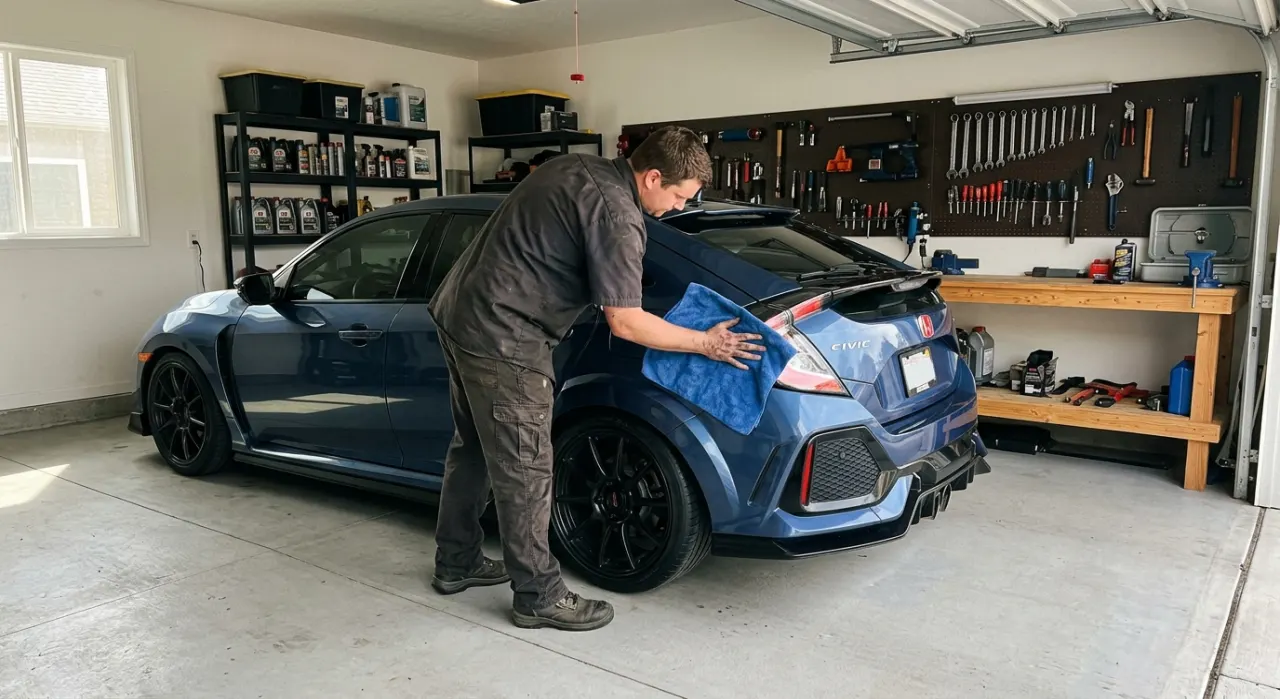
Technique matters as much as the towel. Lay the towel on the panel and gently pull it across, or blot, rather than scrubbing back and forth. Let the towel's absorbency do the work. Start at the top and move down, and flip to a dry section as it saturates. A single good drying towel handles a whole car if it is big and plush enough.
What you should never use on paint: a household bath towel (linty and not that safe) or an old cotton chamois. We settle the chamois debate honestly in rinseless vs waterless wash and elsewhere, but for drying, modern microfiber wins on both safety and speed.
The drying-aid trick
Here is the upgrade that makes drying noticeably safer: mist a drying aid onto the panel before you touch it with the towel. A drying aid — a quick detailer or a dedicated rinse-aid spray — adds lubrication so the towel glides instead of grabbing, which means any stray grit slides rather than scratches. Many also leave a little gloss and a thin layer of protection behind.
It is cheap, it takes seconds, and it directly reduces the risk of drying-induced swirls. If you have ever felt a towel drag or grab mid-dry, a drying aid fixes exactly that. I use one on every wash now and would not go back.
The blower method
The safest way to dry a car is to never touch it at all — and that is what a blower does. A dedicated car dryer, or even a clean leaf blower, pushes water off the paint and, crucially, out of all the places towels cannot reach: mirror housings, badges, grilles, emblems, panel gaps and door handles. Those trapped-water spots are the ones that dribble out and streak your freshly dried car ten minutes later.
The trade-offs are noise, cost and the fact that a blower alone is slow on big flat panels. Most people who use one do a hybrid: blow out the crevices and mirrors, then towel the flat surfaces. That combination is genuinely the fastest, safest way to dry, and it is what I reach for when I have the time.
Keep your towels separated
One habit that saves your paint: dedicate towels to jobs. A towel that dried the lower body or wheels has picked up grit, and using it on the hood or glass next drags that grit across a clean surface. Keep separate towels for paint, glass and wheels, and the moment a towel hits the ground, it is out of rotation until it is washed. A dropped towel is a scratch tool.
This is the same logic as the two-bucket wash — keep your clean things clean. The full washing sequence that drying finishes is laid out in how to wash a car, and drying is simply the final, careful step of it.
If spots already formed
Sometimes life gets in the way and the car half-dries before you get to it — sprinkler overspray, a surprise rinse, a rushed wash in the sun. Fresh, light water spots often wipe away with a quick detailer and a plush towel. Older, etched spots that resist a wipe have started to bond to the surface and need a dedicated water-spot remover or a light polish. The lesson, as always, is that prevention (drying promptly) is far easier than the cure.
Dry like it's part of the wash
The mindset shift that fixes most people's drying is simple: drying is not the end of the wash, it is part of the wash. Give it the same care you gave the contact stage. Use a plush microfiber towel, add a drying aid, work fast and in the shade, blow out the crevices if you can, and keep your towels clean and separated.
Do that and you finish every wash with spot-free, streak-free, swirl-free paint — which is the entire reason you washed carefully in the first place. If you want to make sure the rest of your routine is just as safe, the tool that matters most before drying is your mitt, and our top picks live on the best wash mitt roundup.
Recommended Products

Best for a plush, thirsty single towel that dries a whole sedan
- Large 22x30in plush pile drinks up water in a couple of passes
- Soft, silk-banded edges glide instead of grabbing on clear coat
- The most-reviewed dedicated drying towel by a wide margin
- Launders well and keeps its loft
Why buy it: the safe default plush dryer this guide recommends — big, forgiving, and the largest owner consensus of any towel here.
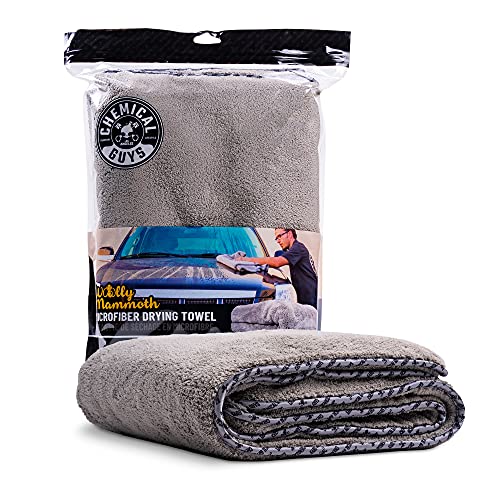
Best for big vehicles that soak a normal towel
- Oversized 36x25in ultra-plush pile covers big panels fast
- High capacity means fewer wrings on a truck or van
- Soft looped fibers lift water rather than dragging it
- Long-standing favorite for large vehicles
Why buy it: the big-vehicle pick — the extra size lets you dry an SUV or truck without fighting a saturated towel halfway through.

Best for streak-free glass and the final buff
- Edgeless 70/30 blend at 500 GSM — plush but controllable
- Four towels so you always have a clean, dry one
- Leaves glass clear with no lint or smearing
- Enthusiast default for low-drag towels
Why buy it: the finisher — dedicate one to glass and the last drips, exactly the separate-towels habit this page insists on.

Best for coated or delicate show-car finishes
- Extra-soft plush pile for delicate finishes
- Highest owner rating of any towel here
- Gentle enough to buff away drying aids
- Two towels so one stays reserved
Why buy it: the step-up pick — the plushest, lowest-risk feel, worth it on a ceramic-coated or dark car where every swirl shows.
Prices are pulled from Amazon and were accurate as of Aug 22, 2026, 6:54 PM EDT. Product prices and availability are subject to change — the live price is shown on Amazon.