
Affiliate Disclosure
Some links on this page are affiliate links. As an Amazon Associate, we earn from qualifying purchases — at no extra cost to you. We do not buy, test, or physically handle the products we cover; our rankings come from aggregated owner reviews, ratings and expert consensus. Commissions never change our verdicts. How we rank & full disclosure.
SiO2 (Silica) Coating
The established silicon-dioxide chemistry behind almost every ceramic coating and spray sold. It cures into a hard, glass-like film that is well understood, widely tested and available at every price point.
Best for: Anyone who wants proven, predictable protection with the widest product choice and best price competition
Coatings $50–$120 for 30–50 ml; SiO2 sprays $15–$30 per 16 oz
- The most tested and documented coating chemistry on the market
- Enormous product range from $15 sprays to installer-only tiers
- Hardest cured film of the two, which is what resists chemical etching
- Price competition is fierce, so cost per year of protection is the lowest
- Every professional installer knows how it behaves, so support is universal
- The harder, more brittle film is marginally less flexible on panel flex
- More prone to visible water spotting if hard water dries on the surface
- Marketing is saturated, making genuinely good products hard to identify
- No meaningful difference between many mid-tier bottles despite price gaps
Graphene Coating
A silica resin with a small percentage of reduced graphene oxide dispersed into it. The base chemistry is still SiO2 — the graphene is an additive, marketed for elasticity, heat dissipation and reduced water spotting.
Best for: Dark-colored cars parked outdoors in hard-water areas, where water spotting is the real annoyance
Coatings $60–$150 for 30–50 ml; graphene sprays $20–$35 per 16 oz
- Owners consistently report noticeably less water spotting on dark paint
- More flexible cured film, which resists micro-cracking on flexing panels
- Slightly slicker feel and very strong water sheeting behavior
- Manufacturer durability claims run at or above equivalent SiO2 products
- Application behavior is more forgiving on some formulas — longer flash window
- Typically under 1% actual graphene content — the base is still silica
- Independent third-party verification of the marketing claims is thin
- Costs 15–30% more than the equivalent SiO2 product from the same brand
- The "cooler paint" claim is not supported by any published measurement worth trusting
How they score, side by side
Scores reflect aggregated owner reviews and expert consensus — not our own bench testing.
- Chemical / etch resistance99
- Water spotting resistance78
- Gloss and depth88
- Verified durability87
- Value for money97
- Product range and availability107
- Marketing honesty75
Spec-by-spec comparison chart
| Factor | SiO2 (Silica) Coating | Graphene Coating |
|---|---|---|
| Base chemistry | Silicon dioxide (silica) resin | Silica resin + reduced graphene oxide |
| Typical graphene content | None | Usually well under 1% by weight |
| Cured film character | Harder, more rigid | Slightly more flexible, more elastic |
| Chemical / etch resistance | Excellent | Excellent — comparable |
| Water spotting resistance | Good | Better, per aggregated owner reports |
| Water behavior | Tight beading | Beading plus strong sheeting |
| Claimed durability | 2–5 years (coating), 6–12 mo (spray) | 2–7 years (coating), 6–12 mo (spray) |
| Reported real durability | 1–3 yr DIY, 3–5 yr pro | Comparable — no consistent advantage |
| Coating price, 30–50 ml | $50–$120 | $60–$150 |
| Spray price, 16 oz | $15–$30 | $20–$35 |
| Product choice available | Very wide | Narrower but growing fast |
Our Top 3 Picks
The three highest-rated options in this category, if you'd rather skip straight to a proven pick.

Best for the best DIY durability and gloss
- Graphene-infused hardness
- 2–5 year durability
- Slick, high-gloss finish
- Beginner-friendly kit
Why buy it: the best all-round DIY kit — long life and an easy application.

Best for maximum longevity
- Pro-grade hardness
- 2+ year protection
- Deep, warm gloss
Why buy it: a detailer favorite that survives years with proper prep.

Best for fast spray-on protection
- Spray-on / wipe-off
- SiO2 hydrophobic layer
- Great for beginners
Why buy it: spray-on ceramic protection in minutes with no cure fuss.
Prices are pulled from Amazon and were accurate as of Aug 22, 2026, 6:54 PM EDT. Product prices and availability are subject to change — the live price is shown on Amazon.
What SiO2 and graphene actually are
This comparison is unusual because the two options are not really parallel. One is a base chemistry; the other is an additive to that same base chemistry. Understanding that single fact defuses about 90 percent of the marketing you will encounter.
SiO2 is silicon dioxide — silica, the same compound as quartz and window glass. In a coating it arrives as a resin dissolved in a solvent carrier. When the carrier flashes off, the silica cross-links into a dense, glass-like network chemically bonded to the clear coat. That film is what produces the hardness, chemical resistance and hydrophobic behavior every ceramic product advertises. It has been the backbone of automotive coatings for well over a decade.
Graphene is a single-atom-thick sheet of carbon in a hexagonal lattice, and in its pure form it has genuinely extraordinary properties — extreme tensile strength and exceptional thermal conductivity. What goes into a coating bottle is not pure graphene, though. It is reduced graphene oxide (rGO), a cheaper, defect-laden derivative, dispersed into a conventional silica resin at concentrations that are typically well under one percent by weight. Manufacturers rarely publish the exact figure, which itself is informative.
So a graphene coating is a silica coating carrying a small carbon additive. That does not make it a gimmick — additives change material behavior at low concentrations all the time — but it does mean the honest expectation is a modest refinement, not a new category. The consensus among detailers who have used both extensively is exactly that. Our graphene coating vs ceramic coating comparison approaches the same question from the product side.
The graphene claims, examined one by one
Graphene marketing rests on four repeated claims. They deserve separate treatment, because they are not equally well supported.
- "Reduces water spotting." This is the claim with the most consistent support from aggregated owner reviews. Graphene formulas tend to sheet water off rather than hold it in tight beads, and fewer standing droplets means fewer mineral deposits left behind when they evaporate. On dark paint in a hard-water area this is a real, noticeable benefit.
- "More flexible, less brittle." Plausible and broadly accepted. A rigid silica film on a flexing panel can develop micro-cracks over years; a more elastic film should resist that. The effect is real in materials science, though nobody has published automotive-specific data showing how much it matters over a coating's actual service life.
- "Dissipates heat and keeps paint cooler." This is the weakest claim by a distance. Graphene is thermally conductive in bulk, but at sub-one-percent loading in a one-to-three-micron film, any effect on panel temperature is going to be far too small to measure with a consumer infrared thermometer, let alone feel. Treat this as marketing.
- "Lasts longer." Manufacturer claims run higher for graphene products — sometimes 7 years against 5 — but aggregated owner reports do not show a consistent durability advantage. What they do show is that prep quality and wash habits swamp the chemistry difference entirely.
Durability: what owners actually report
Strip away the label and both chemistries land in the same range, because the variables that actually govern coating life are not the additive. What owner reports converge on:
- DIY application: 1 to 3 years for both, with the spread driven almost entirely by whether the paint was properly corrected and wiped bare before coating.
- Professional application: 3 to 5 years for both, because the correction and controlled environment are doing the heavy lifting.
- Sprays of either type: 3 to 8 months, well short of the 6 to 12 months on the label.
The two things that genuinely change these numbers are wash chemistry and wash method. Strong alkaline soaps and degreasers strip the hydrophobic top layer of either coating chemically. Automatic brush washes abrade it mechanically. Owners who switch to pH-neutral soap and a two-bucket or touchless routine report both chemistries outlasting the estimates above, and owners running a coated car through a tunnel wash weekly lose beading inside a year regardless of which bottle they bought. That is the honest hierarchy: prep first, wash habits second, chemistry a distant third. Our ceramic coating guide covers the maintenance routine that actually protects your investment.
Water spotting — the one real advantage
If graphene has a genuine practical edge, this is it, and it is worth understanding why. A very hydrophobic silica coating produces tight, near-spherical beads that cling to the panel. Each bead is a little lens of water carrying dissolved calcium and magnesium. When it evaporates in the sun, those minerals stay behind as a ring — a water spot. On a coated car those spots can etch into the coating itself if left through repeated heat cycles.
Graphene formulas typically behave differently: lower surface tension produces more sheeting, where water runs off in a curtain rather than sitting in beads. Less standing water means less mineral deposit. Owners in hard-water regions with dark cars — where spotting is most visible and most annoying — consistently report this as the difference they actually notice after switching. It is not a dramatic transformation, but it is the claim that survives contact with real driveways.
Worth saying plainly: this is a maintenance-convenience advantage, not a protection advantage. Neither chemistry stops rock chips, and neither stops swirl marks from a bad wash mitt. If impact protection is the goal, that is a paint protection film question and a different budget entirely.
The price gap and whether it is justified
Within the same brand, graphene versions typically carry a 15 to 30 percent premium: a $70 SiO2 coating with a $90 graphene sibling, or a $20 SiO2 spray next to a $28 graphene one. That is a small enough gap that it rarely decides a purchase on its own, and if the water-spotting behavior matters to you, it is money reasonably spent.
What is not reasonable is paying a graphene premium across brand tiers. A well-formulated $80 SiO2 coating from a reputable manufacturer will comfortably outperform a $60 graphene coating from a brand you have never heard of, because the base resin quality, solids content and cross-link density matter far more than a sub-one-percent additive. The word "graphene" on a label carries no minimum standard — there is no regulated threshold for how much has to be in there, and no requirement to disclose it.
The practical buying rule that falls out of this: choose the brand and product tier first, then take whichever version of it fits your situation. Reputation, published solids content, verified owner reviews and installer feedback are all better signals than the additive named on the front of the bottle.
Common myths and mistakes
"Graphene is a completely different technology from ceramic." It is not. Graphene coatings are silica coatings with a carbon additive. The marketing implies a generational leap; the chemistry describes an incremental one.
"Graphene coatings keep your paint cooler." At the concentrations used in a film one to three microns thick, any thermal effect is far below what you could measure or feel. This claim is the least defensible in the entire category.
"Graphene is harder, so it resists scratches better." If anything the cured film is slightly softer and more flexible — that is the point of the additive. Neither chemistry resists wash-induced swirls meaningfully; the "9H" pencil-hardness figure both categories advertise does not translate to swirl resistance at all.
"A graphene spray equals a graphene coating." No, and this is the same trap as with silica products. A spray carries a fraction of the solids and lasts months rather than years. If you are weighing the lighter-commitment route, our ceramic spray vs ceramic coating comparison breaks down that trade-off properly.
Which should you buy — and how to decide
There is no winner here, and anyone telling you otherwise is selling something. The two chemistries perform within a few percent of each other on everything that matters, and the variables that genuinely determine your outcome — correction quality, panel wipe, application technique, wash routine — are identical for both.
Buy the SiO2 product if you want maximum choice and the best price per year of protection, if you are shopping in the budget or mid tier where competition is fiercest, or if you want a chemistry that every professional installer knows how to work with and top up. It is the safe, well-documented default, and it is what the overwhelming majority of coated cars on the road are wearing.
Buy the graphene product if you have dark paint, park outdoors, and live somewhere with hard water — water spotting is the one area where owner reports consistently favor it, and the 15 to 30 percent premium within the same brand is a fair price for that. It is also a reasonable pick if you like the sheeting behavior aesthetically.
Ignore the label entirely if the choice is between a respected brand's silica product and an unknown brand's graphene one. Take the respected brand. Then spend your real effort on the part that actually decides the result: correct the paint, wipe it bare, apply thin and level it properly, and wash it with pH-neutral soap afterward. Our exterior protection guide sets out where each option fits in the wider protection ladder.
Recommended Products
Our top picks in this category, ranked on aggregated owner reviews.
Best for the best DIY durability and gloss
- Graphene-infused hardness
- 2–5 year durability
- Slick, high-gloss finish
- Beginner-friendly kit
Why buy it: the best all-round DIY kit — long life and an easy application.
Best for maximum longevity
- Pro-grade hardness
- 2+ year protection
- Deep, warm gloss
Why buy it: a detailer favorite that survives years with proper prep.
Best for fast spray-on protection
- Spray-on / wipe-off
- SiO2 hydrophobic layer
- Great for beginners
Why buy it: spray-on ceramic protection in minutes with no cure fuss.

Best for the closest thing to a pro coating
- Near-professional hardness
- 5+ year durability
- Superb chemical resistance
Why buy it: pro-tier protection you can still apply at home.
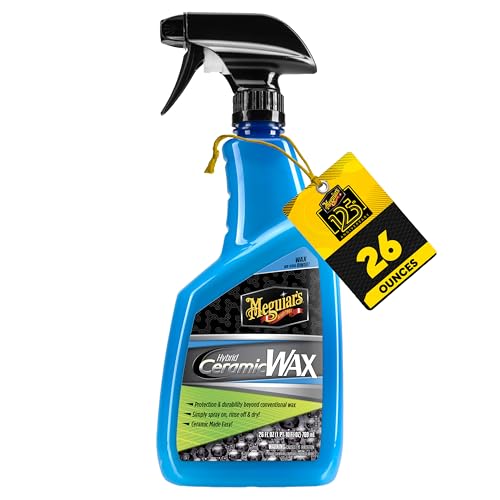
Best for cheap ceramic beading
- Spray on wet or dry
- Strong water beading
- Cheapest per use
Why buy it: the cheapest way to get ceramic-style beading fast.

Best for a complete beginner bundle
- Coating + applicators included
- Simple instructions
- Widely available
Why buy it: an all-in-one beginner bundle with everything you need.
Prices are pulled from Amazon and were accurate as of Aug 22, 2026, 6:54 PM EDT. Product prices and availability are subject to change — the live price is shown on Amazon.