
Affiliate Disclosure
Some links on this page are affiliate links. As an Amazon Associate, we earn from qualifying purchases — at no extra cost to you. We do not buy, test, or physically handle the products we cover; our rankings come from aggregated owner reviews, ratings and expert consensus. Commissions never change our verdicts. How we rank & full disclosure.
Short version: Interior glass hazes because plastics off-gas in the heat and condense a greasy film on the cool glass — plus overspray from shiny dash dressings. Clearing it is about technique, not muscle: use an ammonia-free automotive glass cleaner, work in the shade, mist lightly, and use two clean towels — one to clean, one to buff dry. That is the whole streak-free secret.
Interior glass is the surface most people clean last and worst. It is awkward to reach, it smears if you rush, and it fogs back up in a way exterior glass never does. But get the method right and the payoff is huge — night driving in particular is transformed when there is no film scattering every oncoming headlight into a starburst. Clear glass is a safety upgrade as much as a cosmetic one, and it is the last, satisfying step of a good detail.
Why the inside fogs and hazes
The film on the inside of your windshield is not just breath and grime. The biggest culprit is off-gassing: the vinyl, plastics, and dashboard treatments in your cabin slowly evaporate chemicals in the heat, which then condense on the coolest surface in the car — the glass. Over weeks it builds a thin, greasy haze that you do not notice until low sun or oncoming headlights hit it at the right angle and the whole windshield lights up milky.
The second culprit is self-inflicted: overspray from glossy dashboard dressings. Every time you mist a shiny dressing onto the dash, some of it drifts onto the glass. This is one more reason detailers use matte dash products — our dashboard cleaner guide covers why a matte finish protects both your visibility and your glass. Fix the dash product and you slow the haze at its source.
Choose the right cleaner — ammonia-free
The single most important product rule: use an ammonia-free glass cleaner. Ammonia — present in many household glass sprays — degrades window tint film over time, causing it to discolor purple and bubble at the edges. Even if you think your windows are not tinted, an automotive ammonia-free cleaner removes all doubt and is formulated for the plastics and films inside a car.
You do not need much. A dedicated automotive glass cleaner is inexpensive and lasts a long time because the whole technique relies on a light mist, not a soaking. Avoid anything with added dressing or "shine" — you want the glass clean and nothing else on it.
The two-towel method
This is the technique that kills streaks for good:
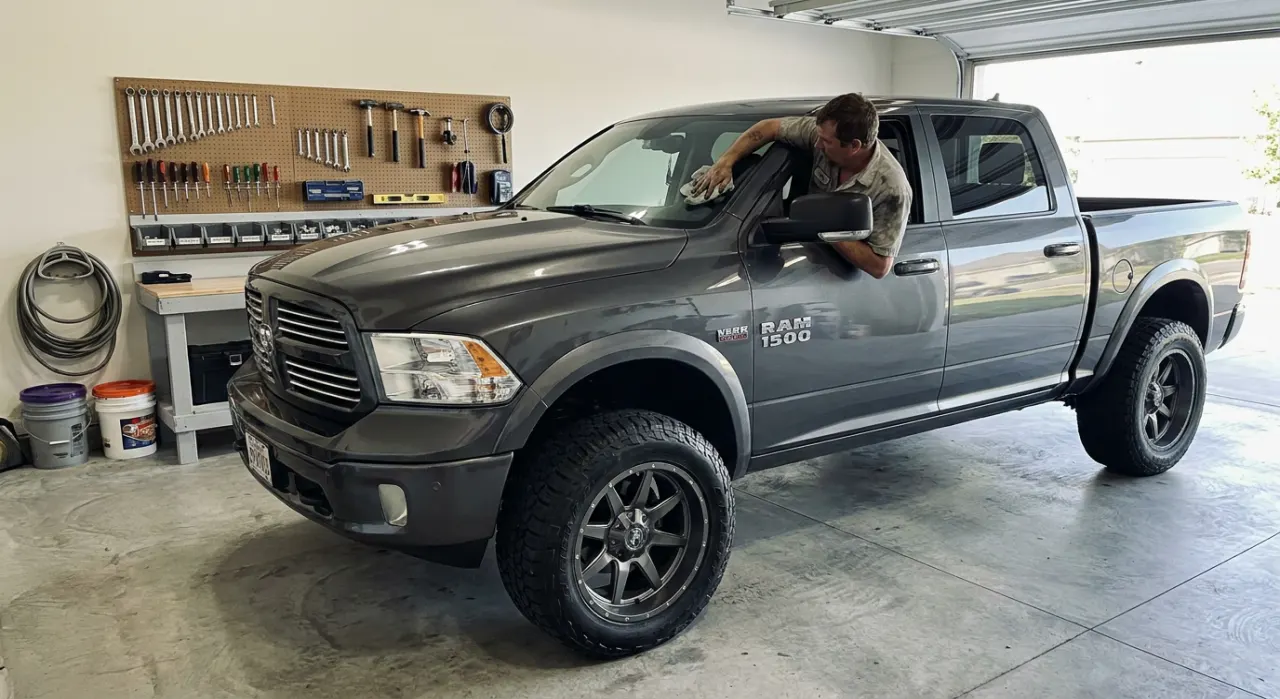
- Work in the shade, on cool glass. In direct sun the cleaner flashes off before you can buff it, and that instant evaporation is what leaves streaks. Move to shade or do it in the garage.
- Use two clean microfiber towels. One damp with cleaner to do the cleaning, one clean and dry to buff. Dedicate these towels to glass only — a towel with wax or dressing residue will smear the glass every time.
- Mist lightly. Spray the cleaner onto the towel or lightly onto the glass. Too much product is a leading cause of streaking. Less is genuinely more here.
- Clean, then buff dry immediately. Wipe the section with the damp towel, then follow right behind with the dry towel to buff it clear before it can air-dry into streaks.
- Finish with a directional pass. A common pro trick: wipe the inside glass horizontally and the outside vertically (or vice versa). If a streak shows up, you instantly know which side it is on.
Reaching the deep corners
The base of the windshield — where the glass meets the top of the dash — is the hardest spot to reach and the most commonly missed. Your hand simply will not fit into that shallow gap, so people leave a smeared, hazy strip at the very bottom of their view. The fix is to wrap a clean microfiber around a flat tool: a plastic spatula, a paint stick, or a dedicated glass-reach tool. That lets you press the towel into the corner and wipe the strip you would otherwise miss entirely.
The same trick helps on steeply raked rear windows and the corners of side glass. A little reach tool turns the frustrating spots into easy ones.
Do glass last, always
Glass is the final step of an interior detail for a simple reason: everything you do before it — cleaning surfaces, applying dressing, your own fingerprints — ends up on the windows. Clean the glass first and you will just dirty it again. Clean it last and it stays clear. This is baked into the order in our full interior detailing walkthrough, which runs the whole cabin in the right sequence with glass as the finishing move.
One more sequencing note: if your cabin has an odor as well as hazy glass, treat the smell earlier in the process, because odor and off-gassing often share a source. Our guide to removing car odors covers finding and killing that source.
Keeping it clear
Once your interior glass is genuinely clean, keeping it that way is easy. Switch to matte dash products so you stop adding overspray, crack the windows occasionally to vent off-gassing on hot days, and give the glass a quick two-towel pass whenever you notice the first hint of film — it is far faster to maintain clear glass than to rescue badly hazed glass.
Do that and night driving stays sharp, low-sun glare disappears, and the whole cabin feels finished. Clear glass is the detail that people feel more than they see, and it is worth the ten minutes. For every interior step in one place — from vacuuming to conditioning to this final glass pass — head to the interior detailing hub.
Recommended Products

Best for anyone who wants streak-free interior glass with zero fuss
- Ammonia-free and tint-safe
- No dyes, scents or soapy residue
- Fine mist covers evenly
- Works on glass and mirrors
Why buy it: an ammonia-free formula with no dyes or fragrance, so it wipes to a genuinely clear finish — the closest thing to foolproof streak-free glass in a bottle.

Best for cutting through the baked-on film that hazes an inside windshield
- Ammonia-free formula
- Cuts through baked-on film
- Clings well to vertical glass
- Trusted detailing brand
Why buy it: more cleaning bite than most for the oily off-gassing film on interior glass, while staying tint-safe — strong everyday performance from a name detailers trust.

Best for stocking the garage without spending much
- Leaves a light water-repellent trace
- Cheap and widely available
- Good all-round cleaner
- Big-bottle value
Why buy it: solid cleaning at a rock-bottom price — the cheapest bottle here that still does the job well on everyday interior glass.
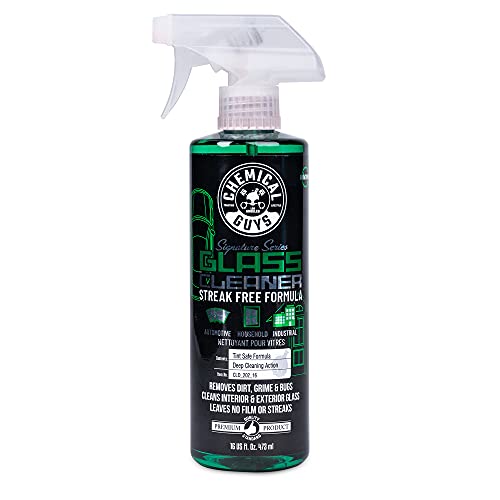
Best for tinted windows where an ammonia cleaner can damage the film
- 100% ammonia-free, tint-safe
- Pleasant light scent
- No-streak, no-haze finish
- Enthusiast favorite
Why buy it: a proudly ammonia-free formula built to be safe on window film and mirrors — the one to grab if protecting your tint is the priority.

Best for the inside of a raked windshield where liquid cleaners run down the dash
- Clinging foam, no drips
- Great for inside glass
- Fast-wiping formula
- Cult-favorite value
Why buy it: a thick foam that clings to vertical and overhead glass instead of running onto the dash — unbeatable for the inside of a windshield. Note: it contains ammonia, so keep it off tint.
Prices are pulled from Amazon and were accurate as of Aug 22, 2026, 6:54 PM EDT. Product prices and availability are subject to change — the live price is shown on Amazon.