
Affiliate Disclosure
Some links on this page are affiliate links. As an Amazon Associate, we earn from qualifying purchases — at no extra cost to you. We do not buy, test, or physically handle the products we cover; our rankings come from aggregated owner reviews, ratings and expert consensus. Commissions never change our verdicts. How we rank & full disclosure.
Short version: A vacuum alone will never win against embedded pet hair — the barbed fibers hook into the weave and suction glides right over them. The method that works is friction first, suction second: use a rubber tool (brush, squeegee, or damp glove) to physically dislodge and ball up the hair, then vacuum up what you have loosened. Cheap rubber beats expensive gadgets almost every time.
Anyone whose car has hosted a shedding pet knows the lesson never changes: this is a fight you win with friction, not horsepower. Pet hair is built to cling — that is literally why it stays on your animal. Beating it is about understanding that, then attacking it the right way. Like getting grip on a cold tire, the trick is generating friction before you expect traction.
Why pet hair defeats a normal vacuum
Dog and cat hair has microscopic barbs along its length, and it carries a static charge. Together, those two things anchor each strand down into the fabric weave and cling it to the fibers. Your vacuum moves air across the surface, but the hair is hooked below that surface, so the airflow passes over the top and leaves the hair exactly where it was. You can vacuum for twenty minutes and barely make a dent.
The fix is to break that anchor mechanically. Once hair is dislodged from the weave and rolled into loose clumps sitting on top, suction picks it up easily. So every effective method comes down to the same two-step logic: dislodge, then remove.
The tools that actually work
In rough order of how well they perform:
- Rubber pet-hair brush — the champion. The rubber bristles generate static and friction that drag barbed hair up out of the weave and gather it into ropes you can lift by hand. Cheap and effective.
- Rubber squeegee — the window kind. Drag it firmly across a seat and it scrapes hair into rows. Works brilliantly on flat cloth surfaces and seat bases.
- Damp rubber glove — free if you already own dish gloves. Lightly dampen it and run your hand across the fabric; the hair balls up on the rubber. Great for curved bolsters a brush cannot reach flatly.
- Pumice or fabric stone — a stone bar rubbed lightly over carpet lifts ground-in hair. Effective but use a light touch so you do not abrade delicate fabric.
- Vacuum with a rubber-tipped upholstery tool — the finisher, and only truly effective after you have loosened the hair with one of the above.
Notice what is missing: no expensive electronic gadget outperforms a few dollars of rubber. Save your money.
The step-by-step method
Do it in this order and it goes fast:
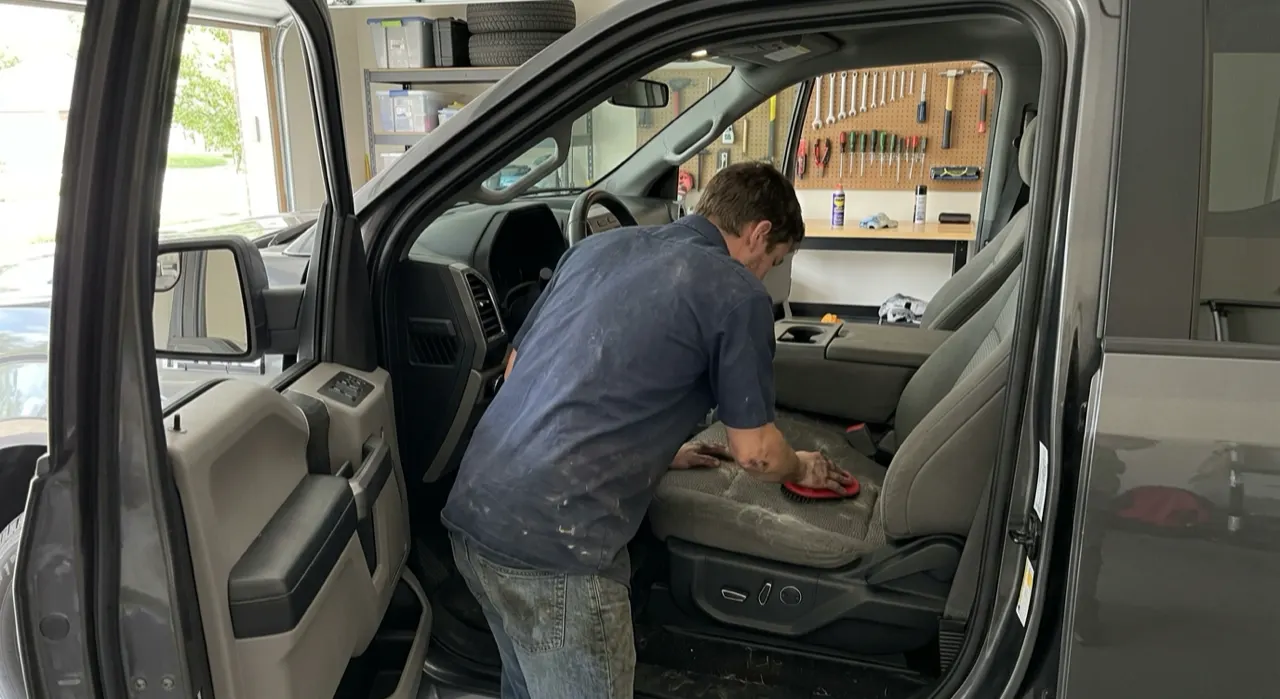
- Dry pass first. Take your rubber brush or squeegee and work one section at a time, always dragging in the same direction. You will see hair start to lift and gather into ropes and clumps.
- Add a little moisture if it is stubborn. A light mist of water or a lightly damp glove knocks down static and helps the rubber grab. Damp, not soaked.
- Gather and pull. Once hair balls up, grab the clumps by hand and pull them out. This gets the bulk of it before the vacuum ever runs.
- Vacuum the loosened hair. Now run the vacuum with an upholstery or rubber-tipped tool to collect what you dislodged. This is where suction finally works, because the hair is no longer anchored.
- Detail the crevices. Seat seams, the gap beside the console, and seat tracks trap hair — a crevice tool and a stiff brush clear them out.
Doing this before you introduce any wet cleaning matters. Wet hair is far harder to remove, so get it out while everything is dry — which is also why hair removal comes right after the initial vacuum in the overall routine. Our full interior detailing walkthrough shows exactly where this fits in the sequence.
Mind the fabric underneath
Once the hair is out, the seats often need a proper clean too — pet hair usually comes with dander, dirt, and sometimes odor worked into the fabric. Clean cloth seats without soaking them, using the extraction-focused technique in our upholstery cleaner guide. And because pets bring smell as much as hair, a lingering "dog car" odor may need its own treatment — our guide to removing car odors covers killing the source with an enzymatic cleaner rather than masking it.
Stop fighting it: prevention
The owners who never struggle with pet hair are the ones who stopped letting it embed. The single biggest win is a washable seat cover or a back-seat hammock — it catches nearly all the hair and goes straight in the laundry, so it never reaches the fabric weave at all. Beyond that: brush your pet before car trips, keep a rubber brush in the door pocket for a quick pass after each outing, and deal with hair the same day rather than after weeks of buildup.
It is also worth thinking about where the hair collects most. The seat base where you and your pet sit, the seam between the base and backrest, and the rear cargo area on wagons and SUVs are the worst offenders. Hitting those high-traffic zones with a rubber brush every week or two stops the slow buildup that eventually becomes an embedded mat. A minute of maintenance beats an hour of rescue every time.
Recommended Products
Friction lifts the hair; a vacuum with real suction and a brush tool is what finishes the job. These are the car vacuums owners rate highest — strong enough to pull embedded pet hair out of carpet, in corded, cordless and 12V forms to suit how you clean.

Best for the best all-round car vacuum for pet hair
- Strong wet & dry suction
- Car-sized and portable
- Crevice + brush tools included
- Long cord reaches the whole car
Why buy it: the ideal balance of real suction and car-friendly size and tools — the brush attachment lifts embedded hair the crevice tool leaves behind.

Best for heavily furred interiors and stubborn hair
- Powerful suction
- Handles wet spills
- Big capacity
Why buy it: the most power for genuinely hairy interiors — the raw airflow that finally pulls dog hair out of carpet weave.

Best for quick, convenient hair clean-ups
- Cordless and light
- Grab-and-go convenient
- Good for regular upkeep
Why buy it: the grab-anytime handheld for staying on top of shedding between deep cleans.

Best for the strongest cordless performance
- Class-leading suction
- Long cordless runtime
- Great attachments
Why buy it: the best cordless suction there is — the motorized brush head is a genuine weapon against pet hair if the budget allows.

Best for a cheap 12V plug-in
- Plugs into 12V socket
- Compact, stores in the car
- Cheap and popular
Why buy it: a cheap 12V vac that lives in the trunk for quick hair pick-ups on the go.
Prices are pulled from Amazon and were accurate as of Aug 22, 2026, 6:54 PM EDT. Product prices and availability are subject to change — the live price is shown on Amazon.
Prevention turns a two-hour ordeal into a thirty-second habit. But when it has already embedded, the friction-first method above is the reliable way out. For the complete cabin process — hair, stains, odor, glass, and more — the interior detailing hub ties every step together.