
Affiliate Disclosure
Some links on this page are affiliate links. As an Amazon Associate, we earn from qualifying purchases — at no extra cost to you. We do not buy, test, or physically handle the products we cover; our rankings come from aggregated owner reviews, ratings and expert consensus. Commissions never change our verdicts. How we rank & full disclosure.
Short version: PSI gets all the marketing attention, but for washing a car GPM (flow) matters just as much or more. Pressure loosens and lifts dirt; flow — gallons per minute — flushes it away. A balanced machine (say, 1,800 PSI and 1.4 GPM) rinses a car faster and more thoroughly than a high-PSI, low-flow unit. Chase balance, not the biggest pressure number.
Every pressure washer box screams its PSI in giant font and buries the GPM in the fine print. That's marketing, not detailing wisdom. Once you understand what each number actually does at the panel, you'll shop completely differently — and probably stop paying for pressure you don't need. Let me explain. For the full rundown on picking a machine, the pressure washer guide pulls it all together.
What PSI and GPM each actually do
PSI (pounds per square inch) is pressure — the force of the water hitting the surface. Pressure is what breaks the grip of dirt, road film and dried foam so they let go of the paint. Think of it as the loosening force.
GPM (gallons per minute) is flow — how much water the machine moves. Flow is what physically carries the loosened dirt and foam off the car and down to the ground. Think of it as the rinsing force.
Here's the mental model I use: pressure is the crowbar that pops the grime loose; flow is the river that washes it away. You need both. A crowbar with no river leaves loosened dirt sitting on the panel. A river with no crowbar can't break the grip in the first place. Balance is everything.
Why flow is the underrated hero for cars
Cars are a rinsing job as much as a cleaning job. You foam the car, let it dwell, then you need to flush all that foam and suspended grit off cleanly — the more water moving, the faster and more completely that happens, and the less soap residue and grit gets left behind to be dragged around later.
This is why detailers who've used both a high-PSI/low-flow machine and a balanced one almost always prefer the balanced one for cars. The extra pressure of a 3,000 PSI unit doesn't rinse foam any better than a 2,000 PSI machine — but more GPM absolutely does. And since a car doesn't want extreme pressure anyway (see what PSI is safe for a car), flow is where the real usable improvement lives.
The numbers to look for
For car washing, here's my rough guide:
- GPM under 1.0: Workable but slow to rinse. You'll be dragging the wash out longer than you'd like.
- GPM 1.2 to 1.5: The comfortable home range. Enough to rinse well and run a foam cannon. Most good electric units live here.
- GPM 1.5 to 2.0+: Excellent. Fast, thorough rinsing. Common on gas and prosumer machines.
Pair that with a paint-safe 1,500 to 2,000 PSI and you've got the ideal car-washing balance. Notice I'm not telling you to maximize either number — a 4,000 PSI machine with poor flow is worse for cars than a modest, balanced unit.
Flow and the foam cannon connection
If you run a foam cannon — and you should — flow matters even more. The cannon draws soap through a metering system that depends on a steady water stream. Starve it of flow and it struggles to pull soap and produce thick foam. This is exactly why the common cannon requirement is "around 1,300 PSI and 1.2+ GPM" — both numbers, not just pressure. I cover the full foam setup, including how flow affects it, in pressure washer + foam cannon setup.
The gas vs electric angle
Gas machines generally out-flow electric ones, which is a real advantage for rinsing — but not a reason to buy gas if you only wash a car or two, because a good electric still has plenty of flow for the job. The noise, maintenance and fumes trade-offs usually outweigh the extra GPM for home detailers. I lay that whole decision out in gas vs electric for detailing.
How to shop with this in mind
When you compare machines, do this: look past the giant PSI number and find the GPM. Then judge the pair together. Between a 2,800 PSI / 1.1 GPM unit and a 2,000 PSI / 1.4 GPM unit, the second is the better car washer despite the smaller headline. Balanced beats lopsided every time for detailing.
And whatever the numbers, technique still governs safety — wide nozzle, distance, spray along panels. The specs get you a good rinse; the habits keep your paint intact. I've listed the ones to avoid in pressure washing mistakes.
Cleaning units: the honest way to compare two machines
There's a simple trick pros use to compare washers fairly instead of getting hypnotized by one big number: cleaning units, which is just PSI multiplied by GPM. It rolls pressure and flow into a single figure that reflects real-world cleaning capability far better than either spec alone.
Run the math on my earlier example. A 2,800 PSI / 1.1 GPM machine gives 3,080 cleaning units. A 2,000 PSI / 1.4 GPM machine gives 2,800 — close, and for a car the second is still the nicer tool because that extra flow rinses better and its pressure sits safely in the paint zone. Meanwhile a scary-looking 3,300 PSI / 1.0 GPM unit lands at 3,300 cleaning units but rinses a car worse than the balanced 2,800-unit machine, because a car can't use all that pressure. Cleaning units aren't a perfect measure, but they're a great BS-detector against a machine that's all pressure and no flow.
One thing that quietly caps your GPM
Worth knowing: a pressure washer can only push out as much water as it takes in. If your garden hose or spigot delivers a weak trickle, even a high-GPM machine gets starved and underperforms — it may cavitate or pulse. So before you blame the washer, check the supply. Use a good-diameter hose, keep it short, open the tap fully, and make sure the inlet filter is clean. A machine rated for 1.5 GPM can't hit that if the faucet only feeds it 1.0. It's the most overlooked reason a capable washer feels weak, and it costs nothing to fix.
Bottom line
PSI loosens, GPM rinses, and cars need both in balance. Don't get hypnotized by the biggest pressure number — a machine around 1,500 to 2,000 PSI paired with 1.2 GPM or more is the real sweet spot for washing and foaming a car quickly and safely.
For units that hit that balance and that I rate for cars, see my recommendations on the best pressure washer for cars page. Those are my top picks, chosen with exactly this GPM-and-PSI balance in mind.
Recommended Products
Machines that hit the balance this page argues for — paint-safe pressure paired with enough flow to rinse and feed a foam cannon, rather than the biggest PSI headline.
Best for the GPM-and-PSI balance a car actually wants
- ~1,800 PSI paired with real flow
- Enough GPM to rinse foam and feed a cannon
- Paint-safe pressure in the car sweet spot
- Hugely popular, well-supported, cheap
Why buy it: the value winner for cars — pressure in the safe zone and the flow to rinse quickly, which is exactly the balance this page argues for.
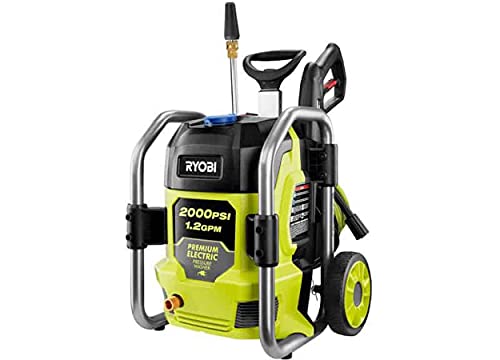
Best for a tidier build with car-friendly numbers
- 2,000 PSI at a sensible flow rate
- More compact than a full upright unit
- Onboard hose and cord storage
- Comfortable for regular car washing
Why buy it: the space-saver — the same paint-safe-pressure, decent-flow balance in a neater package.

Best for a quiet, cheap car-first machine
- 1,800 PSI — right in the car-safe band
- Flow enough for foam-cannon work
- Quieter than most electric units
- Low price for a capable washer
Why buy it: the budget balance — modest, paint-safe pressure with the flow to rinse, and no gimmicky high-PSI headline you cannot use on a car.

Best for a longer-lasting, quieter premium unit
- Water-cooled induction motor for longevity
- ~2,000 PSI with strong, steady flow
- Quieter, smoother running than universal motors
- Onboard reel and refined ergonomics
Why buy it: the buy-once option — premium build around the same car-friendly balance, if you want it to last and run quietly.

Best for a well-reviewed balanced alternative
- ~2,050 PSI at a car-appropriate flow
- Compact footprint, easy to store
- Detergent tank and quick-connect nozzles
- Strong owner ratings for the money
Why buy it: the alternative pick — the same paint-safe-PSI, enough-GPM formula from a well-rated machine, often at a keen price.
Prices are pulled from Amazon and were accurate as of Aug 22, 2026, 6:54 PM EDT. Product prices and availability are subject to change — the live price is shown on Amazon.