
Affiliate Disclosure
Some links on this page are affiliate links. As an Amazon Associate, we earn from qualifying purchases — at no extra cost to you. We do not buy, test, or physically handle the products we cover; our rankings come from aggregated owner reviews, ratings and expert consensus. Commissions never change our verdicts. How we rank & full disclosure.
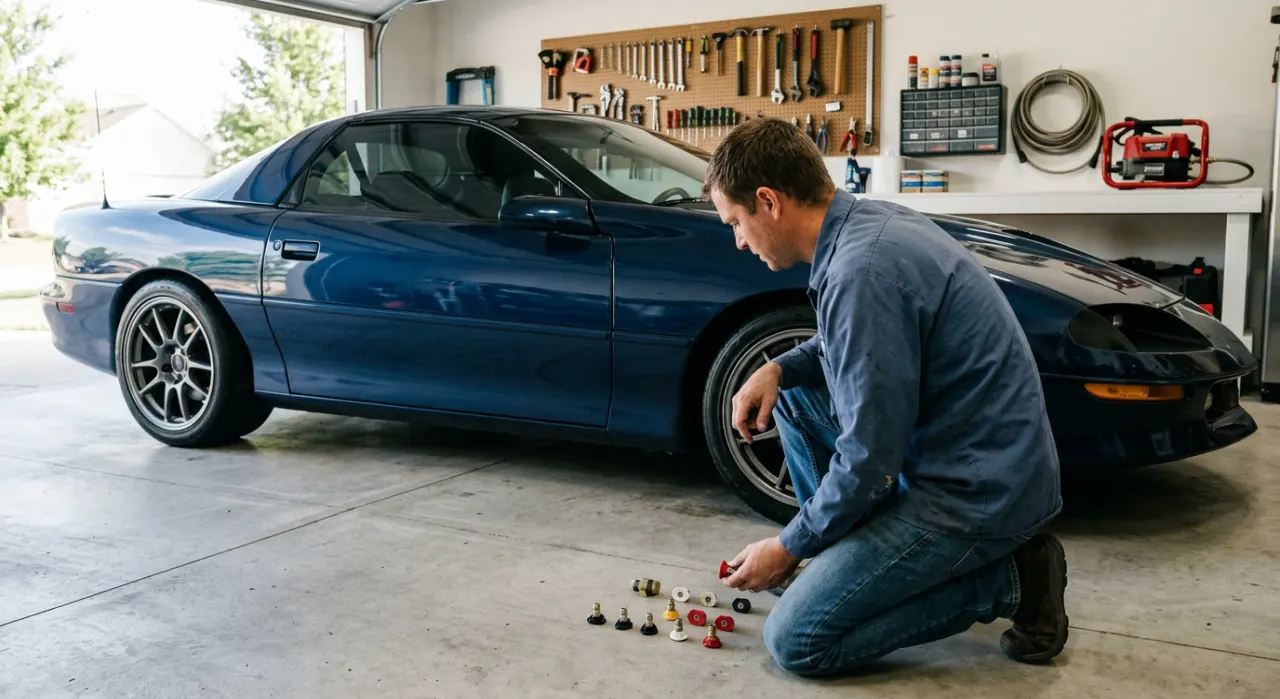
Short version: Use the white 40-degree nozzle on car paint — it spreads pressure into a wide, safe fan. The green 25-degree is fine for wheels and lower grime with distance. Never point the yellow 15-degree, red 0-degree, or a turbo nozzle at a car — those concentrate force and will chip, gouge or strip paint. The nozzle matters more for safety than the machine's PSI.
Most people obsess over their washer's pressure rating and completely ignore the little colored tips that ship in the box — which is backwards. The nozzle is your actual safety dial. Swap tips and the same machine goes from paint-safe to paint-destroyer in one click. Let me decode every one. For how nozzles fit into the wider picture of choosing and using a machine, see the full pressure washer guide.
The color-coded quick-connect nozzles
Nearly every pressure washer comes with a set of color-coded quick-connect tips. The number is the spray angle: the wider the angle, the more the pressure is spread out and the gentler it is on a surface.
- White — 40°: Wide, soft fan. This is your car nozzle. Cleans and rinses paint safely. Use it for panels, glass and the whole body.
- Green — 25°: A tighter general-purpose fan. Okay for wheels, arches and stubborn lower-body road film if you keep some distance. I wouldn't use it on the roof or hood.
- Yellow — 15°: Narrow and harsh. This is for stripping paint from decks and cleaning concrete. Never on a car.
- Red — 0°: A pinpoint jet — all the machine's force in one tiny spot. Built to cut through set-in grime on hard surfaces. Absolutely never on a car. It can chip paint, slice trim and dent thin panels in an instant.
- Black — soap/low-pressure: Widens spray and drops pressure so the washer can siphon detergent. Gentle by design.
The rule of thumb: on a car, wider is always safer. When in doubt, reach for white.
Why narrow nozzles wreck paint
Here's the physics in plain terms. Your machine puts out a fixed amount of force. A wide nozzle spreads that force across a broad sheet of water, so any single point on the paint feels only a fraction of it. A narrow nozzle crams that same force into a tiny area — so the pressure at the surface multiplies dramatically.
That's why a modest 1,600 PSI machine with a red tip can do more damage than a 2,800 PSI machine with a white one. The rated PSI isn't the whole story — the nozzle decides how concentrated that pressure lands. I break down that relationship fully in what PSI is safe for a car.
The turbo / rotary nozzle
Some washers include or offer a turbo nozzle — a 0-degree jet that spins rapidly in a small cone. It combines the cutting power of a zero-degree tip with a bit of coverage, and it's fantastic for concrete, brick and heavily soiled hard surfaces. On a car, it's a nightmare. All that spinning concentrated force will mar and strip paint. Keep it in the toolbox for the driveway, never the vehicle.
Adjustable and 3-in-1 nozzles
Many electric washers now ship with a single twist-to-adjust nozzle instead of separate color tips — you rotate the head from a fine jet to a wide fan. These are convenient, but the trap is easy: it's tempting to nudge toward a narrower setting to blast a stubborn spot. Resist that on paint. Keep it at its widest fan for the car and only tighten it for wheels or ground-in lower grime, always with distance.
The soap nozzle vs a foam cannon
The black low-pressure tip lets the washer draw detergent from its onboard tank and spray it gently. It works, but it's weak sauce compared to a foam cannon, which forces soap and air through a mesh for a thick clinging blanket. If you're serious about foam, skip the soap nozzle and set up a proper cannon — I cover the whole pairing in pressure washer + foam cannon setup.
Nozzle technique on a car
Even with the right white tip, technique still matters. Keep the wand 18 to 24 inches from the panel, angle the spray along the surface rather than driving it into seams, trim and door edges, and keep it moving. Concentrating even a wide fan on one spot up close, or blasting straight into a gap, invites trouble. These are the exact habits that cause damage — I've collected the full list in pressure washing mistakes.
Quick-connect fittings and keeping tips organized
The color tips attach via a standard quick-connect coupler: pull back the collar, push the tip in, release, and it locks. To swap, pull the collar back and the tip pops out. Two practical notes. First, always release the trigger and, ideally, kill the machine before swapping tips — pressure trapped in the wand can shoot a tip out. Second, these little nozzles are easy to lose in gravel or grass; a cheap holder or a magnetic strip in the garage saves you the annoyance of hunting for the white tip mid-wash.
If you own a machine with a proprietary fitting (some brands don't use the universal quick-connect), aftermarket tips still exist but you'll want to confirm compatibility before buying. It's the same brand-adapter headache that comes up with foam cannons — worth checking once so you're never stuck.
A note on wheels and lower body
The one place I'll step up from the white 40-degree tip is wheels, arches and the very bottom of the doors and rockers, where baked-on brake dust and road film are heavier and there's no delicate finish to worry about. The green 25-degree does a better job there — but I still keep distance and never let it drift up onto the painted panels above. Think of the car as two zones: paint gets the wide white fan, and the grimy lower structural bits can take the slightly tighter green with care. That mental split keeps you fast on the dirty stuff without ever risking the finish that shows.
Bottom line
The nozzle is the most important — and most ignored — part of pressure washing a car safely. Live by this: white 40-degree on paint, green 25-degree only for wheels and low grime with distance, and never yellow, red or turbo anywhere near the car. Get the tip right and even a powerful machine stays gentle.
Once your nozzle discipline is sorted, the machines I rate for car work — every one paint-safe with the right tip — are on the best pressure washer for cars page. Those are my top picks.
Recommended Foam Cannons
The color-coded tips come in the box, so the nozzle actually worth buying is a foam cannon — it replaces the weak black soap tip and lays down the thick, clinging foam that lets you wash with less contact. We aggregate owner ratings rather than testing these; all use the standard 1/4" quick-connect, so confirm your washer isn’t a proprietary fitting first.

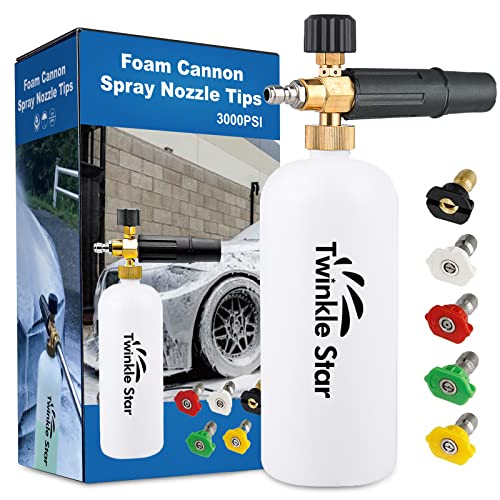
Best for the foam cannon most owners land on
- Standard 1/4" quick-connect fitting
- Adjustable spray and foam-thickness dials
- 1-litre bottle with five nozzle tips
- By far the most-reviewed cannon here
Why buy it: the low-pressure black soap tip does the same job badly — this replaces it, and it’s the cannon the largest owner base keeps recommending for thick, clingy foam.
Best for thick foam on a budget
- 1/4" quick-connect coupler
- Adjustable spray pattern and soap ratio
- 1-litre wide-mouth bottle
- Brass tip resists wear
Why buy it: the value pick — near-identical results to pricier cannons for a few dollars less, and the same universal fitting so it clicks onto most electric washers.
Best for a proven, widely-owned option
- 1/4" quick connector
- Adjustable foam and spray dials
- 1-litre bottle
- Long-standing, heavily-reviewed model
Why buy it: a long-time favorite with a big owner base — proof that a good foam cannon is more about dilution and soap than paying for a premium badge.
Best for a buy-it-once brass cannon
- Heavy brass body and internals
- Wide-mouth 1-litre bottle
- Precise foam and fan adjustment
- The enthusiast standard for durability
Why buy it: the pick for owners who wash constantly — brass internals outlast the plastic bargain cannons, which is where your extra money actually goes.
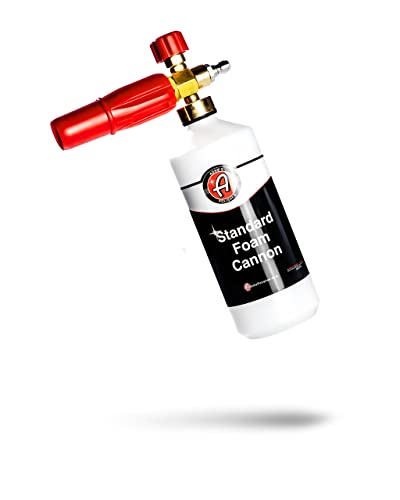
Best for pairing with the Adam’s detailing range
- 1/4" quick-connect fitting
- Tuned for Adam’s foaming soaps
- Adjustable foam and spray
- Solid build with a known brand behind it
Why buy it: the natural choice if you already run Adam’s soaps — a well-rated cannon dialed in for their foam, with brand parts support behind it.
Prices are pulled from Amazon and were accurate as of Aug 22, 2026, 6:54 PM EDT. Product prices and availability are subject to change — the live price is shown on Amazon.