
Affiliate Disclosure
Some links on this page are affiliate links. As an Amazon Associate, we earn from qualifying purchases — at no extra cost to you. We do not buy, test, or physically handle the products we cover; our rankings come from aggregated owner reviews, ratings and expert consensus. Commissions never change our verdicts. How we rank & full disclosure.
The short version: a golf cart charger is not a general-purpose battery charger, and buying one is really three decisions made in order. Pack voltage — 36V or 48V, which you determine by counting batteries and reading their labels, not by the badge on the cart. Connector — Powerwise D-plug, Club Car round three-pin, Yamaha two-pin or SB50 Anderson. And chemistry — flooded lead-acid or LiFePO4, which is the one people get wrong and the one that genuinely matters, because a lead-acid charger on a lithium pack can damage cells or start a fire. Ranked across thousands of owner reviews, our #1 is the Abakoo 48V 15A Club Car charger: the right voltage and connector for the most common cart on the market, 15 amps, and an IP67 sealed case that survives life in a cart shed.
If your cart has been converted to lithium, skip straight to the FORM and KAISAL picks below. Nothing else on this page is safe on a LiFePO4 pack.
Top Picks at a Glance

Why the Abakoo 48V 15A Club Car Charger Is Our #1
The 48V Club Car Precedent and DS are the most common carts in American driveways, and this is the charger their owners keep buying when the factory unit dies. It gets the three fundamentals right without any drama: 48 volts, the Club Car round three-pin plug so it mates with the factory receptacle without an adapter, and 15 amps, which brings a typical 48V lead-acid pack from a normal day of use back to full in roughly four to six hours.
The part owners actually talk about is the build. It is a sealed IP67 aluminum housing with a fan, rather than the vented plastic box that dominates this price bracket, and carts overwhelmingly live in sheds, carports and barns rather than climate-controlled garages. The most common failure story in this whole category is a charger that quit in its second summer after dust and damp got into it, and a sealed case is the single best defense. It runs an automatic multi-stage cycle with a proper shut-off and float, so leaving it connected overnight is fine, and it carries reverse-polarity and over-temperature protection.
The honest limits. It is a lead-acid charger — flooded, AGM and gel only. Do not use it on a lithium conversion under any circumstances. Some older Club Cars with an onboard computer require an OBC bypass for aftermarket chargers to work, which is a known quirk rather than a defect, so check your cart before ordering. The fan is audible. And at 15 amps a badly depleted pack is still an overnight job rather than an afternoon one.
Best Golf Cart Battery Chargers 2026: The Ranked Field

Best for 48V Club Car Precedent and DS lead-acid packs
- 48V, 15A, Club Car 3-pin round plug
- IP67 sealed aluminum housing with fan
- Automatic float when the cycle completes
- Reverse-polarity and over-temp protection
Why buy it: the replacement most Club Car owners land on — right connector, right voltage, right current, and a sealed case that survives a cart shed rather than a garage.
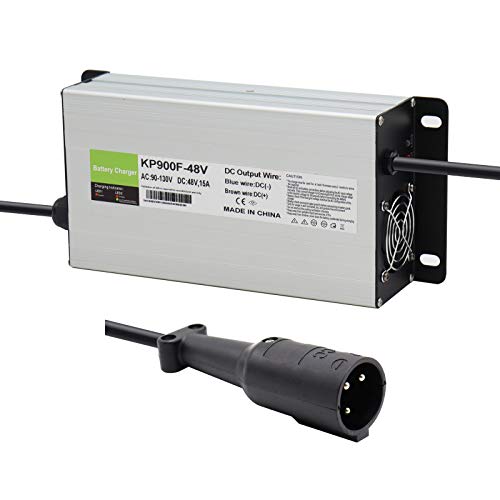
Best for a cheap like-for-like replacement on a 48V cart
- 48V 15A output, Club Car round plug
- Automatic shut-off and trickle stage
- Cooling fan and thermal protection
- Typical 4–6 hour full charge
Why buy it: the sensible budget answer when the factory charger died — same plug, same output, and enough owner history to trust it will not cook the pack.

Best for 36V EZGO TXT carts worth doing properly
- 36V 15A with EZGO D-style plug
- Aluminum case, quiet fan, long lead
- Automatic multi-stage charge and shut-off
- Backed by a real brand warranty
Why buy it: the one 36V charger owners describe as feeling like equipment rather than a commodity box — quieter, better built, and actually supported if it fails.
Best for 1996-and-up EZGO TXT 36V lead-acid packs
- 36V 18A with Powerwise D-style plug
- Suits 36V packs up to about 144Ah
- Automatic three-stage charging
- Aluminum housing with cooling fan
Why buy it: eighteen amps is a genuinely quick charge for a six-battery 36V pack, and the D-plug means it works with the factory receptacle without an adapter.
Best for 48V (51.2V) LiFePO4 lithium conversions
- 58.4V charge voltage for 16S LiFePO4
- 15A output with ring-terminal leads
- IP67 sealed, fan cooled
- No desulfation or equalization pulse
Why buy it: a true lithium profile rather than a lead-acid charger with a lithium sticker — 58.4 volts is what a 16S LiFePO4 pack wants, and a 48V lead-acid charger is not that.
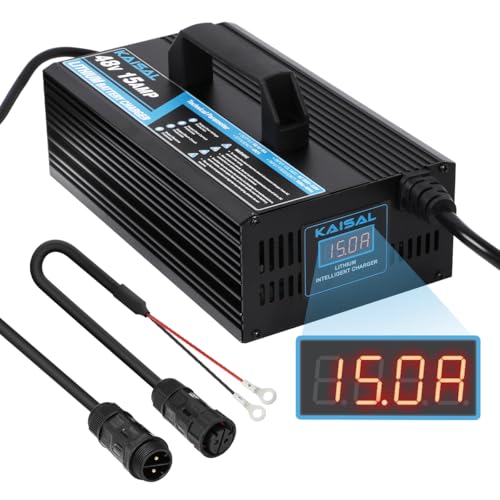
Best for carts and utility vehicles that live outdoors
- IP68 waterproof with sealed plug
- 58.4V 15A for 48V LiFePO4 packs
- 16ft cable for awkward charging spots
- Onboard mounting hardware included
Why buy it: built to be mounted on the cart and rained on, which is the honest reality for carts that live under a carport rather than in a garage.
Prices are pulled from Amazon and were accurate as of Aug 22, 2026, 6:44 PM EDT. Product prices and availability are subject to change — the live price is shown on Amazon.
36V vs 48V: Work It Out Before You Buy
Golf carts are series-wired packs of individual batteries, and the pack voltage is simply the sum. Count them and read the label on one:
Six 6V batteries makes a 36V pack — the classic EZGO TXT and older Club Car DS arrangement. Six 8V batteries, eight 6V batteries, or four 12V batteries all make a 48V pack, and 48V has been the standard on new carts for years because it moves the same cart with less current and less heat.
Mismatching voltage is not a minor error. A 48V charger on a 36V pack drives six batteries far past their safe voltage, gassing flooded cells violently and permanently venting sealed ones. A 36V charger on a 48V pack simply never finishes, leaving the pack chronically undercharged so lead sulfate hardens on the plates cycle after cycle. The connectors usually prevent the first mistake by being physically incompatible, which is a safety feature — do not defeat it with an adapter.
Lead-Acid vs Lithium: The Split That Actually Matters
This is the most consequential thing on the page, and it catches people out because a lithium conversion often reuses the same connector.
A 48V lead-acid pack is charged to somewhere around 57 to 59 volts, and lead-acid chargers typically include an equalization or desulfation phase that deliberately pushes voltage high to break sulfate crystals off flooded plates. That phase is useful on flooded batteries, harmful on AGM, and genuinely dangerous on lithium.
A 48V LiFePO4 pack is really a 51.2V, 16-cell-in-series pack. It wants a hard ceiling of 58.4 volts (3.65V per cell), a clean termination when it gets there, and no indefinite float afterwards. It does not want equalization, it does not want pulsing, and it does not want to be held at a lead-acid maintenance voltage for weeks. Applying a lead-acid profile can drive individual cells outside their safe operating window; the pack BMS is a last-resort protection device, not a substitute for a correct charger. Charging lithium on a lead-acid profile can damage the pack or cause a fire.
The same rule that governs car batteries applies here: never apply a desulfation or repair pulse to an AGM or lithium battery. AGM is sealed, so anything it vents is gone permanently. Lithium is worse. If you convert your cart to lithium, replace the charger in the same job — the underlying chemistry rules are laid out in best lithium (LiFePO4) battery charger and best AGM battery charger.
Connectors, and the OBC Question
Four connectors cover almost every cart. The Powerwise D-plug — a flat D-shaped receptacle — is EZGO TXT from roughly 1996 onward. The Club Car round three-pin, sometimes called a Crow's Foot, is the 48V Precedent and DS standard. Yamaha two-pin connectors show up on G-series and Drive carts. And the grey rectangular SB50 Anderson is the common choice on lithium conversions, utility vehicles and aftermarket packs, with adapters available in both directions.
One extra wrinkle: many Club Car models have an onboard computer (OBC) that gates the charging circuit. Some aftermarket chargers work with it, some need an OBC bypass, and a charger that appears dead on arrival is quite often an OBC issue rather than a faulty unit. Check what your specific model year needs before you assume the charger failed.
Keeping a Cart Pack Alive
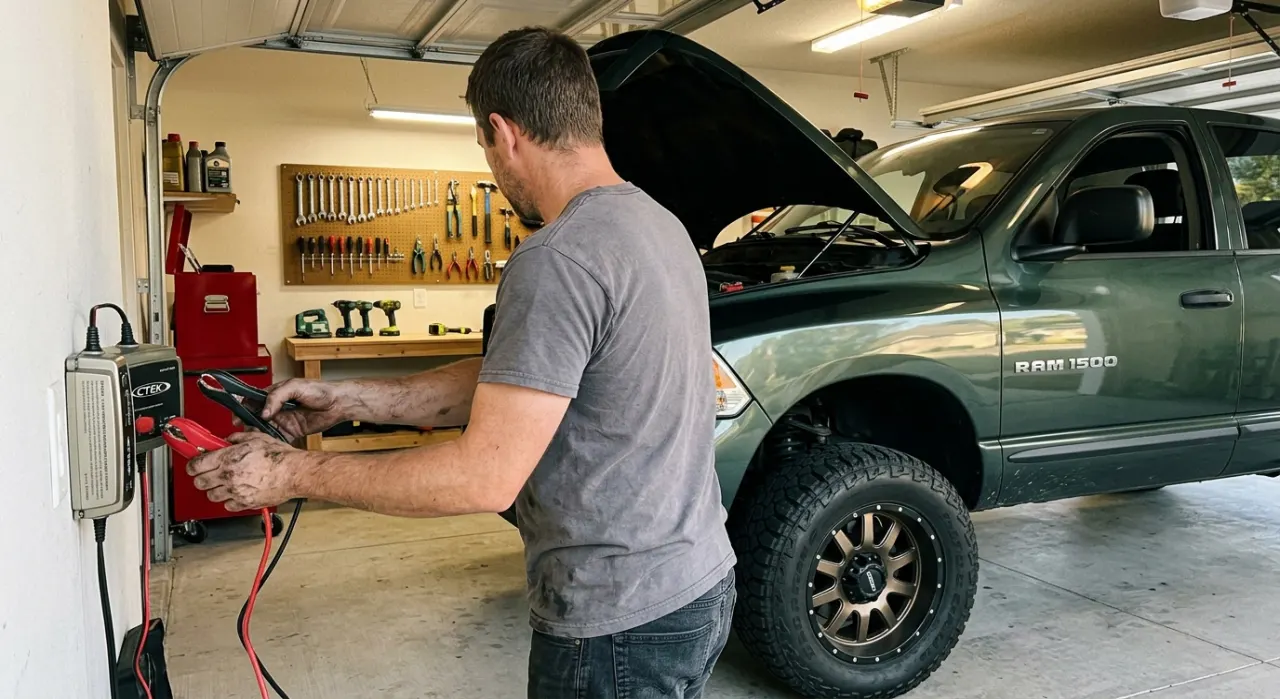
Flooded golf cart batteries are the highest-maintenance batteries most people own. Water them with distilled water after charging, not before, and only to just above the plates — overfilling pushes acid out during charging and corrodes everything nearby. Charge after every use rather than when the cart feels slow, because leaving lead-acid partially discharged is what sulfates it. Keep the terminals clean, since corroded connections are the most common cause of a pack that will not take a full charge. And over winter, either leave an automatic charger connected or charge fully before storage and top up monthly — the reasoning is in chargers for winter storage.
Lithium packs need none of the watering and tolerate partial charge far better, but they should not be stored at 100 percent for months either — around 50 to 60 percent is kinder to the cells.
Common Mistakes
Buying by cart brand instead of pack voltage. Both EZGO and Club Car built 36V and 48V carts. Count the batteries.
Reusing the lead-acid charger after a lithium conversion. Wrong ceiling, wrong termination, and any equalization pulse is a genuine hazard.
Assuming a dead charger means a dead charger. On many Club Cars it is the onboard computer refusing to open the circuit.
Charging only when the cart feels slow. Lead-acid wants charging after every use, not when it complains.
Watering before charging. Electrolyte expands as it charges. Fill after, or you will spill acid across the tray.
How We Rank
We have no lab and we do not bench-test chargers ourselves. We rank by aggregating owner ratings, review volume and the recurring themes cart owners report over years of ownership, weighed against published specifications and manufacturer charging guidance. This category is unusually full of near-identical listings from small brands, so we lean hard on long-term owner reports — fans that seize, cases that crack, units that die in their second season — rather than on spec sheets that all say the same thing. To be listed a charger must clearly state its pack voltage, connector type and supported chemistry. We favor sealed housings because carts live outdoors, we favor a genuine automatic shut-off and float so the charger can be left connected overnight, and we treat lead-acid and lithium as separate categories that must never be substituted for one another. Prices were current at the time of writing.
The Verdict
For a 48V lead-acid Club Car, the Abakoo 48V 15A is the replacement owners rate highest — correct connector, sensible current and a sealed case that lasts. If the factory unit has just died and budget is the priority, the 48V 15A round-plug replacement does the same job for less. EZGO TXT owners on 36V should take the Abakoo 36V 18A Powerwise for speed, or the MODZ Max36 if they would rather buy once from a brand that answers the phone. And if the cart runs LiFePO4, the only safe answers here are the FORM 58.4V 15A or, for a cart that lives outdoors, the IP68 KAISAL.
Related reading: the battery chargers hub, deep cycle chargers for the individual batteries inside a cart pack, solar maintainers for carts stored away from power, and garage tools for the rest of the setup.
Quick Comparison
Abakoo 48V 15A Club Car Charger (3-Pin Round)
Best for 48V Club Car Precedent and DS lead-acid packs
Best Value
48V 15A Club Car Replacement Charger (Round 3-Pin)
Check Price on Amazon
Best Premium
MODZ Max36 15A EZGO TXT Charger (36V)
$299.95 · Check Price on Amazon
Best for 36V EZGO
Abakoo 36V 18A EZGO TXT Charger (Powerwise D-Plug)
Check Price on Amazon
Best for Lithium Carts
FORM 48V LiFePO4 Golf Cart Charger (58.4V, 15A)
Check Price on Amazon
Best Waterproof
KAISAL 48V 58.4V 15A LiFePO4 Onboard Charger
$109.99 · Check Price on Amazon