

Affiliate Disclosure
Some links on this page are affiliate links. As an Amazon Associate, we earn from qualifying purchases — at no extra cost to you. We do not buy, test, or physically handle the products we cover; our rankings come from aggregated owner reviews, ratings and expert consensus. Commissions never change our verdicts. How we rank & full disclosure.
The short version, and it needs saying first: a solar battery maintainer maintains. It does not recover, revive or recharge a flat battery, and anyone telling you a 5 watt panel will bring a dead car back is selling something. What it genuinely does is cancel out the small, constant parasitic drain that kills batteries in vehicles nobody drives — the alarm, the clock, the body control module, the tracker. That is a real problem worth solving, and solar solves it in places with no outlet: a paddock, a marina, a storage yard, a driveway. Ranked across thousands of owner reviews, our #1 is the Battery Tender 5W Solar Panel Maintainer: enough output to offset a normal parasitic draw, a charge controller already built in, and the ring-terminal harness that makes it a permanent install rather than a fiddle.
If your battery is already flat, this is the wrong page — start with a mains charger from best 12V battery charger, get the battery to full, and then put a solar maintainer on it to keep it there.
Top Picks at a Glance
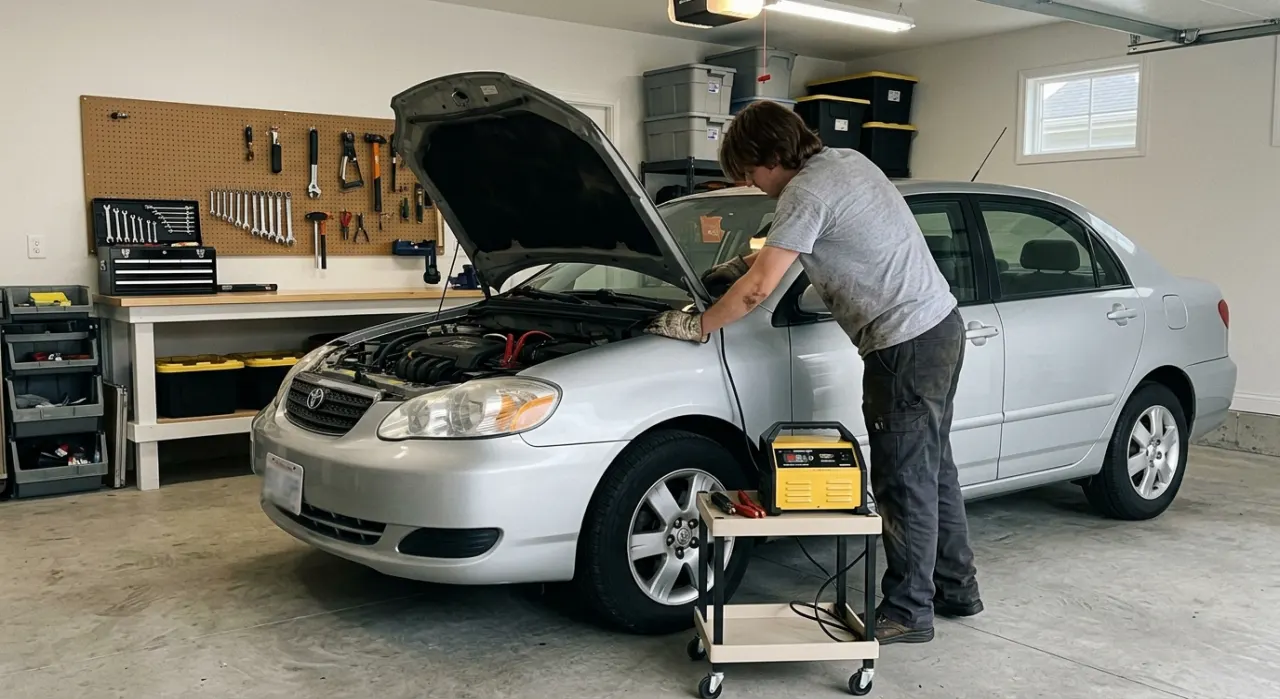
Why the Battery Tender 5W Solar Panel Is Our #1
Five watts sounds like nothing, and in absolute terms it is — perhaps 0.3 amps in strong direct sun, and realistically somewhere around 1 to 2 amp-hours over a good day once you account for panel angle, cloud and the hours the sun is actually usable. But measure that against what it has to beat rather than against a battery charger, and the picture changes. A parked modern vehicle typically draws 25 to 50 milliamps continuously, which is roughly 0.6 to 1.2 amp-hours a day. Five watts covers that with margin in most of the country, which is precisely the job.
What separates this panel from the crowd of near-identical listings is the details owners actually live with. The charge controller is integrated, so the panel cannot push a battery past its safe voltage during a long sunny spell, and it blocks reverse current at night rather than quietly draining the battery it is protecting. It ships with both alligator clips and a ring-terminal harness with a weatherproof quick-connect, which is how it should actually be installed on a stored vehicle — bolt the rings to the battery once, then plug and unplug the panel in two seconds. And the frame and lead survive being left outdoors, which is where most cheap panels fail after a season.
The honest limits. It is roughly twice the price of a generic 5 watt panel that will probably work. It is a genuinely marginal choice if the panel has to sit behind a tinted windshield or if you store the vehicle somewhere with short winter days — step up to 10 or 12 watts there. And it will do nothing for a battery that is already at 11.8 volts. Charge first, maintain second.
Best Solar Battery Maintainers 2026: The Ranked Field

Best for offsetting parasitic drain on a stored vehicle
- 5W panel with built-in charge controller
- Weather-resistant frame and 12ft lead
- Alligator clips plus ring terminal harness
- Reverse-current protection at night
Why buy it: the brand that owns the maintainer category applied sensibly to solar — enough output to cancel a typical parasitic draw, with the controller already built in so nothing gets overcharged.
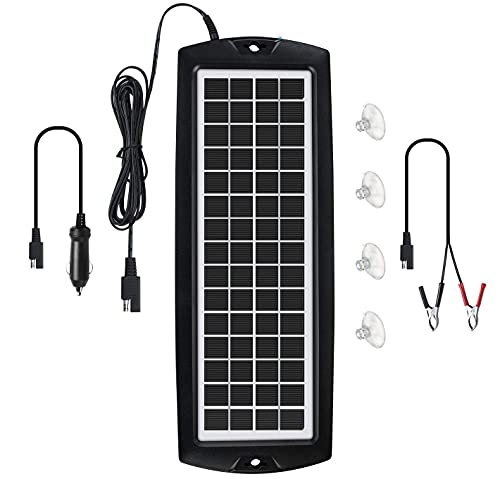
Best for a cheap panel for a car or bike left on a driveway
- 5W amorphous panel, 12V output
- Integrated blocking diode
- Cigarette-lighter plug and clip leads
- Suction mounts for windshield placement
Why buy it: the low-risk way to find out whether solar maintenance solves your problem — cheap, simple, and enough to stop a healthy battery sliding while the car sits.

Best for poor sun angles and northern winters
- 12W panel with MPPT charge controller
- Three-stage bulk, absorption and float
- IP65 waterproof housing and connectors
- Adjustable mounting bracket included
Why buy it: MPPT squeezes noticeably more usable current out of weak winter light than a basic PWM controller, which is the whole game when the sun is low and the days are short.

Best for trailers and RVs parked away from shore power
- 10W panel plus separate 10A controller
- Tilt-adjustable mounting bracket
- Expandable — controller handles more panels
- Battery cables and clips included
Why buy it: the controller is separate and rated well above the panel, so this is the kit to buy if you might add a second panel later rather than replace the whole thing.

Best for boats and marine batteries on a mooring or trailer
- 10W monocrystalline panel
- Built-in controller with reverse protection
- Lighter plug, clips and ring terminals
- Rated for flooded, AGM, gel and lithium
Why buy it: monocrystalline cells and a genuinely marine-tolerant build — the panel most boat owners end up with when a cheap amorphous one delaminates after a season.
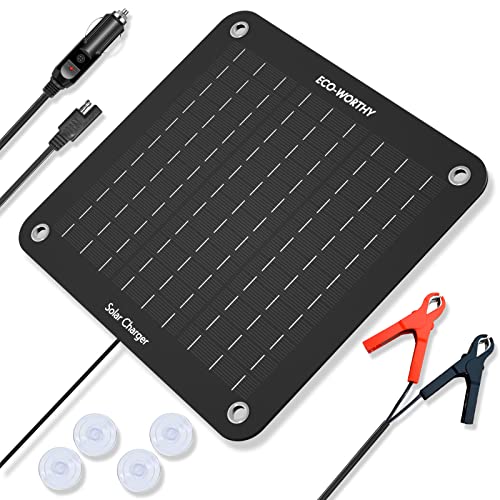
Best for mowers, tractors and equipment that sits all winter
- 10W panel, waterproof and shatterproof
- Integrated controller and blocking diode
- Alligator clips and lighter adapter
- Works down to low winter temperatures
Why buy it: a genuinely rugged panel for equipment stored outdoors, where the battery is small, the drain is tiny, and 10 watts is more than enough to hold the line.
Prices are pulled from Amazon and were accurate as of Aug 22, 2026, 6:44 PM EDT. Product prices and availability are subject to change — the live price is shown on Amazon.
What Solar Maintainers Cannot Do
It is worth being blunt about the arithmetic, because the marketing in this category is worse than in almost any other. A 5 watt panel at 12 volts is producing about 0.4 amps at its theoretical peak, and real-world average output over a day is a fraction of that. A discharged 60Ah car battery at 50 percent needs about 30 amp-hours returned. At two genuinely useful sun-hours a day, you are looking at something on the order of a month — and that assumes the battery is not self-discharging and the vehicle is drawing nothing, neither of which is true. In practice the panel and the drain reach a stalemate somewhere below full and the battery sulfates there.
The rule that follows is simple. Charge with mains, maintain with solar. Bring the battery to a genuine 100 percent with a proper multi-stage charger first, then let the panel hold it. Used that way, a solar maintainer is excellent. Used as a recovery device, it is a slow disappointment.
The other thing solar cannot do is start your engine. A maintainer is not a charger and neither is a jump starter — the three products solve three different problems, which battery charger vs maintainer untangles properly, and the starting-power side lives in the jump starters hub.
The Charge Controller Is Not Optional
A 12V nominal solar panel does not produce 12 volts. Open circuit it typically sits somewhere around 18 to 21 volts, and it will happily keep pushing that at a battery for as long as the sun shines. A 12V lead-acid battery should never see more than about 14.7 volts during absorption and about 13.6 in float. Connect a bare panel directly and, over weeks of good weather, you boil electrolyte out of a flooded battery or permanently vent a sealed AGM — and AGM cannot be refilled, so that capacity is gone for good.
A controller does three things: it caps the voltage, it steps the charge down to float once the battery is full, and it blocks reverse current at night, when an unprotected panel behaves as a small load discharging the battery. Every pick on this page has one, either built into the junction box or supplied separately. If a listing is vague about it, that is your answer.
PWM controllers are the common, cheap kind and they work fine. MPPT controllers convert surplus panel voltage into extra charging current and typically extract 10 to 25 percent more energy, with the biggest advantage in weak, cold or partly shaded light — which is exactly the condition a winter-stored vehicle lives in.

Chemistry Still Matters, Even at 5 Watts
Low current does not make chemistry irrelevant. A controller set for flooded lead-acid holds a float voltage that is slightly high for a sealed AGM battery, and held high for months that is enough to dry the mat out. LiFePO4 is the bigger issue: lithium does not want to sit at a lead-acid float voltage indefinitely, and a solar controller with no lithium setting will simply hold it there. If the vehicle has a lithium battery, buy a panel whose controller explicitly supports LiFePO4, or use a mains charger with a proper lithium profile instead.
And the rule that applies everywhere in this category applies here too: never apply a desulfation or repair pulse to an AGM or lithium battery. Solar controllers rarely offer one, which is a mercy, but some combination units do. Leave it off. The full picture is in best AGM battery charger and best lithium battery charger.
Common Mistakes
Expecting recovery instead of maintenance. The headline mistake. Charge to full first, then let solar hold it.
Leaving the panel flat on a dashboard. A panel lying horizontal behind tinted glass in winter can lose most of its output. Angle it toward the low sun and put it outside the glass where you can.
Skipping the controller to save ten dollars. Unregulated panels overcharge batteries and drain them at night. It is not a corner worth cutting.
Using the lighter socket on a car that switches it off. Many vehicles cut power to the accessory socket with the ignition, which means the panel is connected to nothing. Wire to the battery with the ring harness.
Assuming the panel proves the battery is fine. A maintainer masks a failing battery for a while. If it keeps dropping, test it — how to test a car battery and signs of a dying battery cover it.

How We Rank
We have no lab and we do not test solar panels. We rank by aggregating owner ratings, review volume and the themes buyers repeat across seasons of outdoor use, weighed against published specifications and against straightforward solar arithmetic. Wattage claims are the least trustworthy figure in this category, so long-term owner reports carry unusual weight here — specifically reports about panels delaminating, junction boxes filling with water, connectors corroding and controllers dying after a year outdoors. To be listed at all, a product must have a stated charge controller or blocking protection. We favor monocrystalline cells over amorphous for output per square inch, we favor sealed weatherproof construction and a ring-terminal harness, and we actively mark down anything marketed as able to recharge a discharged battery, because at these wattages that claim is not true. Prices were current at the time of writing.
The Verdict
For a car, truck or bike stored where there is no outlet, the Battery Tender 5W Solar Panel Maintainer is the one owners rate highest — the right output for a normal parasitic draw, a controller built in, and a harness designed for permanent installation. If you want to test the idea cheaply, the Sunway Solar 5W costs half as much and works. Anyone storing a vehicle through a northern winter should skip straight to the SUNER POWER 12W MPPT, because weak light is exactly where MPPT pays. RV and trailer owners are better off with the expandable Topsolar 10W kit, boat owners with the Renogy 10W, and anyone maintaining a mower or tractor left outdoors with the rugged ECO-WORTHY 10W.
Related reading: the battery chargers hub, best trickle charger for the mains equivalent, chargers for winter storage, RV battery chargers, and trickle charger vs battery tender.
Quick Comparison
Battery Tender 5W Solar Panel Maintainer
Best for offsetting parasitic drain on a stored vehicle
Best Value
Sunway Solar 5W 12V Trickle Charger
$32.39 · Check Price on Amazon
Best Premium
SUNER POWER 12W 12V Solar Maintainer Pro (MPPT)
$53.99 · Check Price on Amazon
Best for RVs & Trailers
Topsolar 10W 12V Kit with 10A PWM Controller
Check Price on Amazon
Best for Boats
Renogy 10W Solar Trickle Charger
$25.99 · Check Price on Amazon
Best for Tractors & Mowers
ECO-WORTHY 10W Solar Battery Maintainer
$29.99 · Check Price on Amazon