
Affiliate Disclosure
Some links on this page are affiliate links. As an Amazon Associate, we earn from qualifying purchases — at no extra cost to you. We do not buy, test, or physically handle the products we cover; our rankings come from aggregated owner reviews, ratings and expert consensus. Commissions never change our verdicts. How we rank & full disclosure.
The short version: batteries very rarely fail on the road. They fail in a driveway, over a winter, in a vehicle nobody drove. A parked modern car draws 25 to 50 milliamps continuously for its alarm, clock and control modules, and once a lead-acid battery drifts below about 12.4 volts, lead sulfate starts hardening on the plates and permanently removing capacity. A maintainer plugged in for the season prevents essentially all of that for the price of a tank of gas. Ranked across tens of thousands of owner reviews, our #1 is the Battery Tender Plus: 1.25 amps, a genuine float stage it holds indefinitely, and the longest reliability record in the category. Below is the full ranked field, the storage routine that actually works, and an honest account of what cold does and does not do.
Worth being clear about the distinction first: for winter storage you want a maintainer, not a big charger. A charger refills a flat battery in hours; a maintainer holds a healthy one at float for months. Battery charger vs maintainer settles it, and trickle charger vs battery tender covers why the old unregulated kind is a different and worse device.
Top Picks at a Glance
Why the Battery Tender Plus Is Our #1
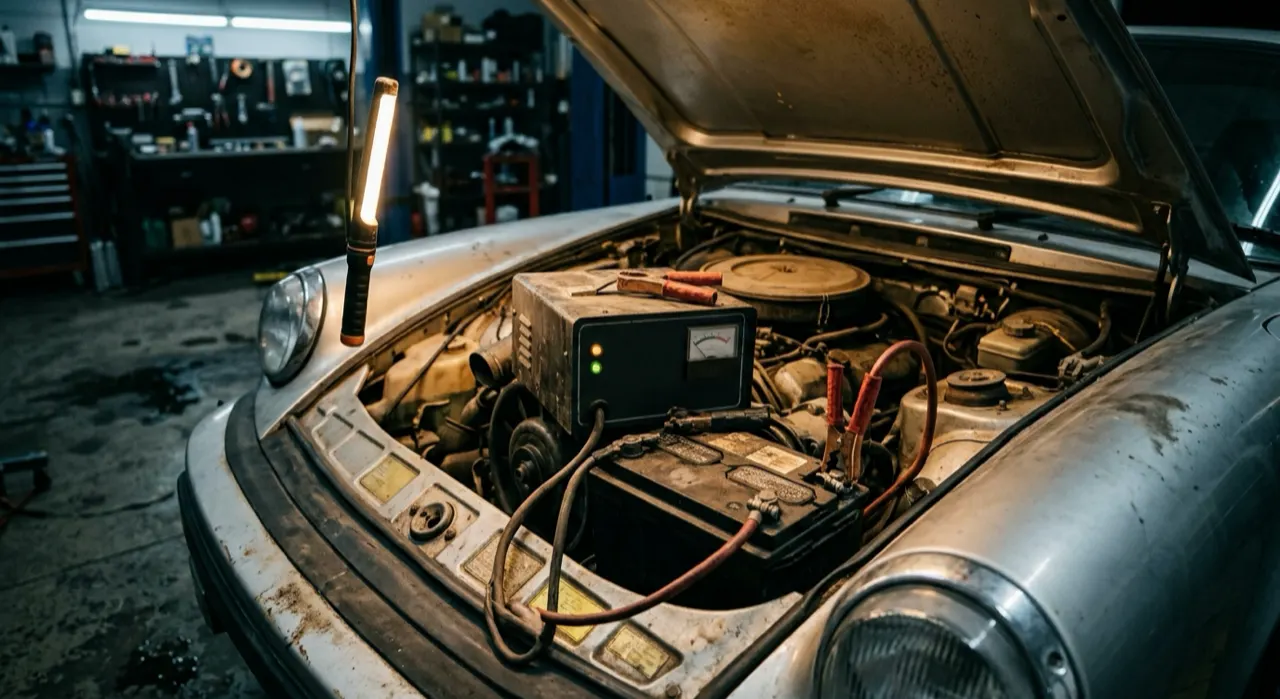
Winter storage is not a demanding job in the way that recovering a dead truck battery is demanding. It asks for one thing, done reliably for five months without supervision: bring the battery to full, then hold it at a correct float voltage and never exceed it. The Battery Tender Plus has been doing exactly that for long enough that its reliability record is measured in decades rather than review counts, and the review count is above twenty thousand.
The mechanics are simple and correct. It charges at 1.25 amps through a four-stage cycle, then drops to a true float around 13.2 volts and stays there, feeding in only what the battery self-discharges. That is the specification that matters. A maintainer that holds too high a voltage slowly gasses the battery over a winter; one that switches off entirely lets it drift down and sulfate. Holding steady is the whole product.
The practical details are what owners actually praise. The ring-terminal harness with a weatherproof quick-connect is the right way to install one on a stored vehicle — bolt the rings to the battery in the fall, route the pigtail somewhere reachable, and connecting the maintainer takes two seconds with the hood closed. It is spark-proof and reverse-polarity protected, so a fumbled connection in a dark garage does not become an event.
The honest limits. At 1.25 amps it is a maintainer and nothing else — charge the battery properly first with something like a 5 or 10 amp charger before handing it over for the winter. It has no temperature compensation, which matters in a genuinely freezing barn — that is what the NOCO GENIUS2 and CTEK further down are for. And it is a lead-acid unit; lithium batteries want the switchable Junior or a dedicated lithium charger.
Best Winter Storage Chargers 2026: The Ranked Field

Best for a car or truck parked from November to April
- 1.25A four-stage charge then true float
- Holds 13.2V indefinitely without cooking
- Ring harness with weatherproof quick-connect
- Spark-proof and reverse-polarity protected
Why buy it: the storage maintainer with the longest track record of any unit here — it reaches float and simply stays there for months, which is the entire job.
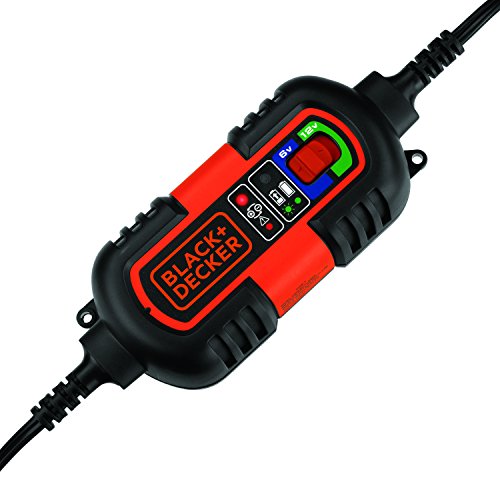
Best for a second vehicle you just need to keep alive
- 1.5A automatic 6V/12V maintainer
- Switches to float when charging completes
- Clamps and O-ring terminals in the box
- Small enough to hang on a hook
Why buy it: cheap enough to buy one for every vehicle in the driveway, and it does the one thing that matters — stops charging when the battery is full.
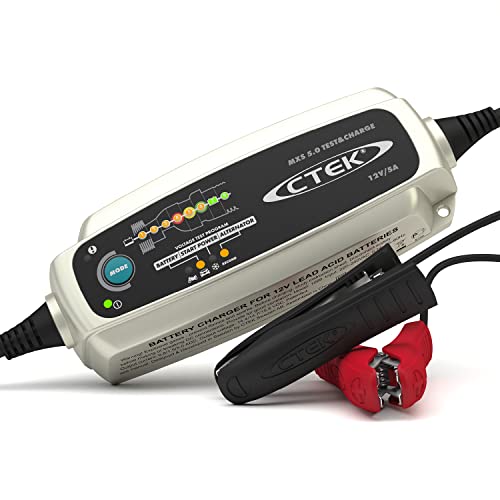
Best for unheated garages and collector cars
- Snowflake mode raises voltage in the cold
- Dedicated AGM absorption setting
- Built-in battery and alternator test
- Recond mode restricted to flooded batteries
Why buy it: the cold-weather program is the reason to buy it — a battery stored at 20°F wants a different voltage than one in a heated shop, and this is one of the few units that knows it.

Best for freezing barns and unheated storage
- 2A with integrated thermal compensation
- Separate AGM and lithium profiles
- 6V and 12V, down to sub-zero operation
- Repair mode kept on its own button
Why buy it: thermal compensation is the feature that matters for winter storage — it lifts float voltage as the garage gets colder so the battery stays genuinely full, not nearly full.
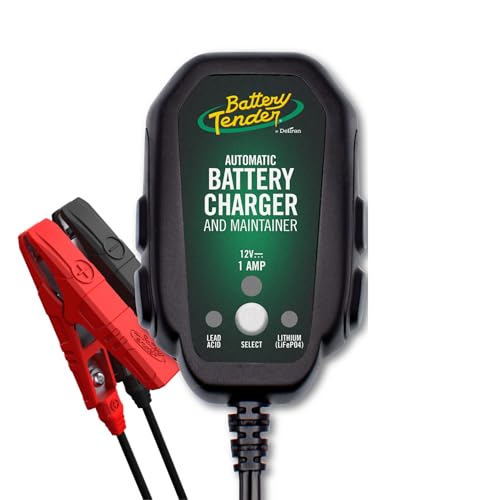
Best for motorcycles, ATVs, mowers and snowblowers
- 800mA — matched to small 8–14Ah batteries
- Switchable lead-acid and lithium modes
- Ring harness for permanent installation
- Compact enough to zip-tie to a frame
Why buy it: small batteries die from neglect long before they die from age, and 800 milliamps is the correct, gentle current for an 8 to 14 amp-hour powersports battery.

Best for storage lots, paddocks and barns with no outlet
- 5W panel with integrated charge controller
- Blocks reverse current after dark
- Ring-terminal harness and clip leads
- Weather-resistant frame and 12ft lead
Why buy it: the only option when there is no outlet — it will not recover a flat battery, but it offsets the parasitic drain that flattens one over a winter.
Prices are pulled from Amazon and were accurate as of Aug 22, 2026, 6:44 PM EDT. Product prices and availability are subject to change — the live price is shown on Amazon.

Why a Discharged Battery Never Fully Recovers
This is the mechanism behind every recommendation on this page. When a lead-acid battery discharges, lead sulfate forms on the plates. That is normal chemistry and charging reverses it — as long as it happens promptly. If the battery instead sits at a low state of charge for weeks, those soft sulfate deposits gradually recrystallize into a hard, stable form that a charger cannot convert back. The plate area they occupy is simply gone.
The practical threshold owners use is about 12.4 volts at rest. Above it, the battery is healthy and stable. Below it, sulfation is progressing, slowly at first and faster the lower it goes. A battery that spends a winter at 11.8 volts may never take a full charge again, and no amount of subsequent good treatment brings the capacity back. It is not a fault, and it is not covered by anything — it is just what happens.
Which is why the storage rule is so blunt: a battery that is kept full does not sulfate. A maintainer costs less than a tank of gas and it removes the single largest cause of battery death in seasonal vehicles. Everything else on this page is a detail by comparison.
What Cold Actually Does
Cold weather gets blamed for a lot it does not do. Freezing temperatures do not drain a battery — they slow the chemical reaction inside it, so a battery that delivers its rated cranking amps at 80°F might deliver about half that at 0°F. At the same time the engine oil is thicker and the engine is physically harder to turn, so the demand goes up exactly as the supply goes down.
The result is that cold reveals a weak battery rather than creating one. A battery at 70 percent health starts the car all summer and fails on the first hard frost, and the owner blames the cold. What was actually happening was months of undercharging from short trips, or a season of sitting at 12.2 volts.
There is one genuine cold-weather risk worth knowing: a discharged lead-acid battery can freeze. Fully charged electrolyte stays liquid well below -50°F, but a battery at 40 percent charge can freeze around 0°F, and freezing cracks plates and cases. For the driving side of this, cold weather battery care covers what happens once winter actually starts.
One more consequence of cold: correct float voltage rises slightly as temperature falls. A maintainer holding 13.2 volts in a 70°F shop is holding a battery genuinely full; the same 13.2 volts in a 20°F barn leaves it slightly short. That is exactly what temperature compensation on the GENIUS2 and the CTEK snowflake mode exist to correct, and it is the main reason to spend up if your storage is unheated.
The Storage Routine That Works
Do these in order and the battery will be identical in April to what it was in November. Charge it fully first with a real charger, not the maintainer — a maintainer facing a half-flat battery may never finish. Clean the terminals, because corrosion adds resistance and resistance means the maintainer reads the wrong voltage. Install a ring-terminal harness rather than clamping and unclamping every time. Set the correct chemistry — AGM and lithium settings exist for a reason. Leave it connected for the season, and glance at it once a month to confirm it is still in float rather than cycling, which would suggest the battery is failing.
If the vehicle has no power where it is stored, either remove the battery (charge it fully, keep it somewhere cool and dry, top it up every six to eight weeks) or use a solar maintainer. Solar offsets the parasitic drain; it does not recover anything, so the "charge it fully first" step becomes non-negotiable.

Chemistry Safety, Even at 1 Amp
Low current does not exempt you from getting the chemistry right. An AGM battery is sealed and pressure-regulated, and it wants a slightly different absorption and float voltage than flooded lead-acid; held too high for five months, it vents gas that can never be replaced and the capacity is gone. LiFePO4 is different again — it does not want to sit at a lead-acid float voltage indefinitely, and it needs a charger with an explicit lithium mode.
And the rule that governs everything in this hub applies to storage too: never apply a desulfation or repair pulse to an AGM or lithium battery. That pulse exists to shock hardened sulfate off flooded plates. On sealed AGM it forces venting. On lithium, charging on a lead-acid profile or pulsing the pack can damage cells or cause a fire. Chargers like the NOCO GENIUS series deliberately keep repair mode on a separate button so it cannot happen by accident — leave it there. The full treatment is in best AGM battery charger and best lithium battery charger.
Common Mistakes
Putting a maintainer on a half-flat battery. It is not a charger. Fill it first, then maintain it.
Using an old unregulated trickle charger unattended. No float stage means it never stops, which boils flooded batteries and ruins sealed ones.
Assuming a full battery in November is full in March. Self-discharge plus parasitic draw is a slow leak. Either maintain it or top it up every couple of months.
Ignoring a maintainer that keeps cycling. If it repeatedly drops out of float and charges again, the battery is losing charge internally. Test it — how to test a car battery and signs of a dying battery cover what to look for.
How We Rank
We have no lab and we do not bench-test chargers ourselves. We rank by aggregating owner ratings, review volume and the recurring themes owners report across multiple storage seasons, weighed against published specifications and manufacturer charging guidance. For winter storage the first filter is absolute: a unit must have a genuine automatic float stage, because the entire proposition is leaving it connected and unsupervised for months, and anything without one is disqualified regardless of price. After that we favor temperature compensation, since a float voltage that is correct in a heated shop is slightly low in a freezing barn. We require labeled AGM and lithium profiles where the unit claims to support them, and we mark down anything that applies a desulfation pulse automatically. Finally we weight multi-winter owner reports heavily, because a maintainer that fails silently in February is worse than no maintainer at all. Prices were current at the time of writing.
The Verdict
For a car or truck stored through a normal winter with power available, the Battery Tender Plus is the maintainer owners rate highest and the one we would buy — it reaches float and holds it, season after season. If you have three vehicles to look after, the BLACK+DECKER BM3B is cheap enough to buy several and does the essential job correctly. Anyone storing in an unheated garage or barn should choose on temperature compensation: the NOCO GENIUS2 is the value answer and the CTEK MXS 5.0 Test & Charge with its cold-weather program is the one collector-car owners tend to end up with. Motorcycles, ATVs, mowers and snowblowers want the gentler Battery Tender Junior, and if there is no outlet where the vehicle sleeps, the Battery Tender 5W solar panel is the only honest option.
Related reading: the battery chargers hub, best trickle charger, motorcycle chargers, RV chargers, chargers for boats, and how to use a battery maintainer for the step-by-step.
Quick Comparison
Battery Tender Plus (1.25A)
Best for a car or truck parked from November to April
Best Value
BLACK+DECKER BM3B (1.5A)
$29.99 · Check Price on Amazon
Best Premium
CTEK MXS 5.0 Test & Charge (4.3A)
$230.95 · Check Price on Amazon
Best for Cold Garages
NOCO GENIUS2 (2A)
$49.94 · Check Price on Amazon
Best for Powersports
Battery Tender Junior (800mA)
$39.95 · Check Price on Amazon
Best Without Shore Power
Battery Tender 5W Solar Panel Maintainer
Check Price on Amazon
Prices are pulled from Amazon and were accurate as of Aug 22, 2026, 6:44 PM EDT. Product prices and availability are subject to change — the live price is shown on Amazon.