
Affiliate Disclosure
Some links on this page are affiliate links. As an Amazon Associate, we earn from qualifying purchases — at no extra cost to you. We do not buy, test, or physically handle the products we cover; our rankings come from aggregated owner reviews, ratings and expert consensus. Commissions never change our verdicts. How we rank & full disclosure.
The short version: a 12V vacuum plugs into your car's own accessory socket, which means it never runs out of runtime and never needs an outlet — but it is also permanently capped by the fuse feeding that socket. Ranked across tens of thousands of owner reviews, our #1 is the Shop-Vac 12V Car Vacuum, the rare socket-powered unit from a brand with a suction reputation to lose. The THISWORX is the value pick and the most-reviewed vacuum in the entire category. The AstroAI pulls hardest.
This page is only about cigarette-socket corded units. Battery handhelds live in best cordless car vacuum, the wider pocket-size field in best portable car vacuum, and the general all-purpose ranking at best car vacuum.
Top Picks at a Glance

Why the Shop-Vac 12V Is Our #1 Socket Vacuum
Almost every 12V car vacuum on the market is the same handful of Shenzhen tooling wearing different logos. That is not a slur — the design works, it is cheap, and it has sold millions. But it does mean the differences between units are mostly the filter and the quality control, and neither of those shows up in a product photo. The Shop-Vac unit stands out because the name on the housing belongs to a company that has spent decades selling wet/dry vacuums, and there is a real reputational cost to shipping a bad filter.
What owners consistently report is the thing that separates good 12V units from bad ones: suction that survives the fifth use. Nearly every complaint in this category is some version of "it was great for a week". That is almost always the filter blinding on fine road dust. A two-stage stack — a washable outer sleeve over a pleated HEPA element — keeps the fine material off the pleats and buys you months instead of days. The supplied extended hose also matters more than the suction figure, because it lets you steer a small nozzle into a seat rail while the body of the vacuum sits on the seat rather than being wrestled sideways into a footwell.
The honest limits apply to every unit on this page, not just this one. Seven thousand pascals is respectable for a socket-powered machine and modest against a $60 corded AC handheld. It will not lift a year of ground-in grit out of carpet pile without a brush doing the agitation first. Sixteen feet of cord sounds generous until you route it around a B-pillar. And it is loud for its size, because small high-speed impellers always are. If you want more raw pull, you do not want a better 12V vacuum — you want a different power source.
The Best 12V Car Vacuums, Ranked
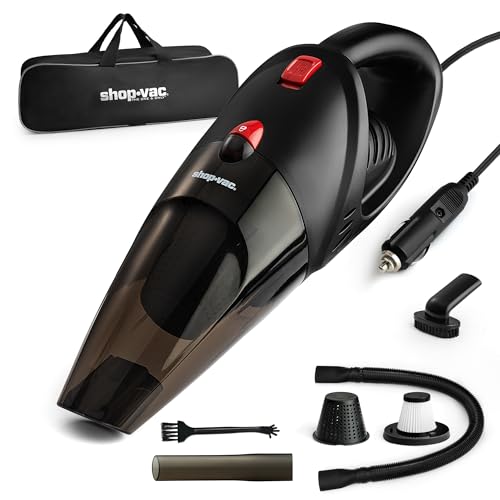
Best for a known name on a socket-powered vacuum
- 7,000 Pa rated suction from the 12V socket
- 16 ft cord reaches a full-size truck bed
- HEPA element plus washable outer filter
- Extended hose, crevice and brush tools in the bag
Why buy it: it is the rare 12V unit from a brand with a wet/dry reputation to protect, and owners consistently report the filter stack holding suction better than the no-name units it competes with.
Best for the cheapest 12V that genuinely works
- 16 ft cord covers any passenger vehicle
- Three attachments plus a carry bag
- Weighs about 2.4 lb
- Stainless HEPA filter, rinsable
Why buy it: a quarter of a million owners have bought this exact thing, and the honest verdict is that it does one job adequately for the price of a tank of gas.

Best for one socket tool that also sets your tire pressure
- Vacuum plus 150 PSI compressor in one body
- Digital dual-value pressure display
- 16.4 ft cord, LED work light
- Runs entirely off the 12V socket
Why buy it: if it lives in the trunk anyway, having it top up a soft tire as well as clear a footwell is a genuinely useful doubling-up rather than a gimmick.

Best for the strongest pull you will get from a cigarette socket
- 7,500 Pa from aluminum fan blades
- 560 ml transparent dust cup
- 16.4 ft cord and three attachments
- Weighs about 2.3 lb
Why buy it: metal impeller blades instead of molded plastic is the reason it holds its rated figure, and the big clear cup means you see when it is full instead of wondering why suction dropped.

Best for three-row SUVs and crew-cab pickups
- Long 12V lead front socket to third row
- Wet and dry pickup for small spills
- Two HEPA filters supplied
- Zip carry case fits under a seat
Why buy it: the reach is the point — a 12V vacuum that cannot get from the dash socket to the rearmost footwell is useless in exactly the vehicles that need it most.

Best for working footwells and under seats after dark
- LED nozzle light for unlit footwells
- 16 ft cord, three attachments, storage bag
- Revised motor over the original THISWORX
- Washable stainless filter
Why buy it: most car dirt hides where you cannot see it, and a lit nozzle turns a guessing game under the seat rails into something you can actually aim.
Prices are pulled from Amazon and were accurate as of Aug 22, 2026, 6:44 PM EDT. Product prices and availability are subject to change — the live price is shown on Amazon.
How to Choose a 12V Car Vacuum
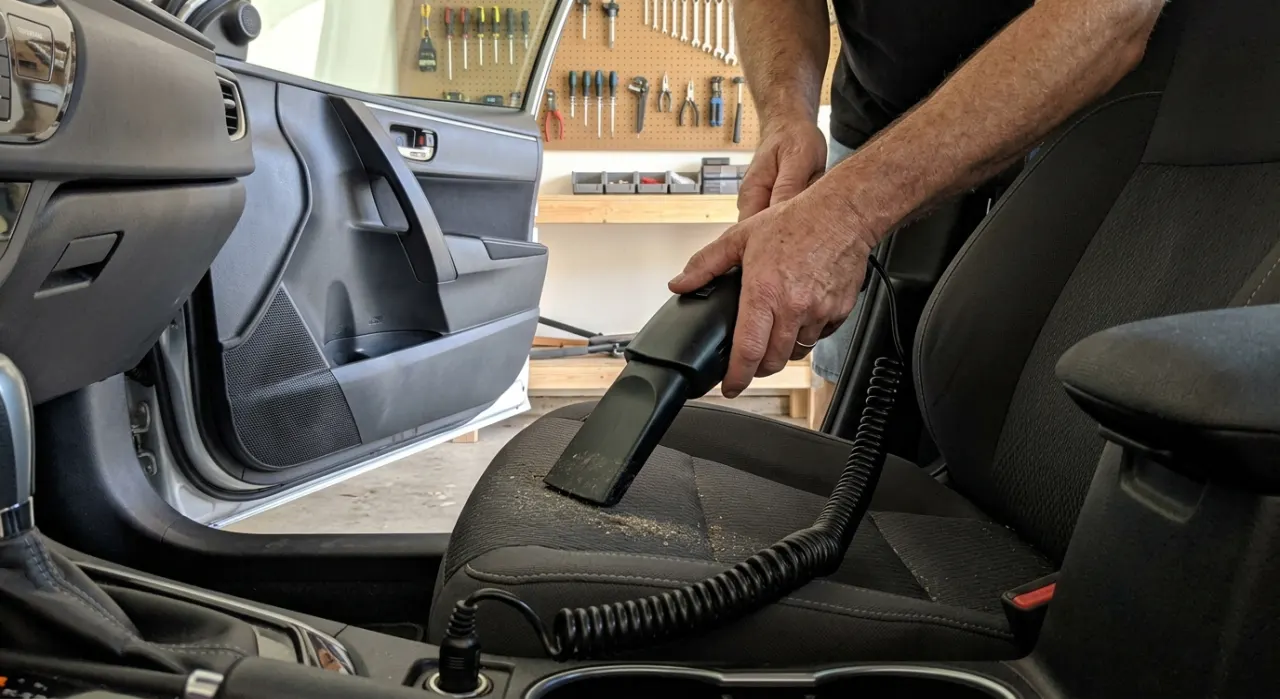
Start with cord length, because it is the specification most likely to make the vacuum useless. Measure from your front accessory socket to the rearmost footwell you intend to clean, then add slack for going around the seat. A 16-foot lead handles almost any passenger vehicle. A 10-foot lead does not reach the third row of a Suburban, and no amount of suction fixes that. If your only live socket is in the cargo area, check whether it stays powered with the ignition on accessory.
Then look hard at the filter design. This is the single biggest quality difference between two 12V vacuums that look identical. You want a rinsable element, ideally with a coarse pre-filter or a cyclonic pre-separator ahead of it. A single unprotected pleated cartridge will clog on road dust within a handful of cleans, and every owner who experiences that writes a review saying the motor got weak. The motor is fine. The filter is packed.
Attachments decide whether you can reach the dirt. The set worth having is a narrow crevice tool, a soft brush for vents and trim, and a flexible extension hose. The hose in particular converts the vacuum from an awkward brick you shove around into something you can aim one-handed. If your chosen unit does not include one, the aftermarket options are covered in best car vacuum attachments.
Finally, think about wet capability. A few 12V units advertise wet-and-dry pickup, which realistically means "will survive a small spilled drink" rather than anything resembling extraction. If liquid is a genuine part of your use case, this is the wrong category entirely — see best wet/dry vac for a car.
Specs Decoded: Pa, Amps and the Fuse That Limits Everything
Pa and kPa are sealed suction — how hard the machine pulls against a blocked nozzle. In 12V land the honest range is roughly 4,000 to 8,000 Pa, and anything claiming five figures is either measuring differently or making it up. Sealed suction predicts crevice-tool performance and tells you very little about clearing an open carpet, which is governed by airflow.
Amperage is the number nobody prints and the one that actually matters. Your socket is fused at 10 to 15 A. Multiply by 12 volts and you get the wattage ceiling: 120 to 180 W. Every unit here lives under that roof, which is why their performance clusters so tightly.
Motor speed is what these designs use to compensate for low power — a tiny impeller spinning very fast. That produces respectable sealed suction, poor airflow volume, and a lot of noise. It is the fundamental trade of the format.
Duty cycle is worth knowing about. Small 12V motors get hot. Most owner manuals quietly recommend a rest after 15 to 20 minutes of continuous running, and ignoring that is the most common cause of a unit failing early.
Common Mistakes with 12V Vacuums
Blowing the fuse and assuming the vacuum is dead. If it stops mid-clean and the socket goes dark, check the accessory fuse before anything else. Carry a spare — they cost pennies.
Cleaning with the engine off for an hour. Idle the engine for anything longer than a quick tidy. It protects the battery and holds socket voltage steady so the motor keeps its speed.
Never washing the filter. Rinse it, dry it fully for 24 hours, and refit. This is the fix for nine out of ten "it lost suction" complaints in this category.
Dragging the cord across the paint. A 16-foot lead whipping over a door sill or a fender leaves marks. Route it through an open window or lay a towel over the sill.
Expecting it to replace a real vacuum. A 12V unit is for maintenance and roadside messes. The seasonal deep clean wants a corded canister — see best shop vac for car detailing.
How We Rank
We do not run a lab, and we have not put these machines on a manometer or a dust rig. This ranking aggregates owner ratings and review volume across tens of thousands of buyers, weighted toward reviews written a few months into ownership, because week-one impressions in this category are uniformly positive and almost meaningless. Four criteria carry the most weight. Suction durability — whether the machine still pulls once the filter has met real road dust, which is where cheap units collapse. Cord reach, because a lead that will not span the vehicle makes everything else irrelevant. Filter design and washability, the strongest predictor of long-term satisfaction we can see in the review data. And build integrity at the plug and switch, since that is where reported failures concentrate. We cross-check claims against published specs and against what the 12V power budget physically allows. Prices were current at the time of writing.
The Verdict
If you want a socket-powered vacuum that will still be pulling properly next spring, buy the Shop-Vac 12V. If you want the cheapest thing that genuinely works and you accept its limits, the THISWORX has a quarter of a million owners saying it is fine. If you want the most suction the format allows, the AstroAI, and if you want it to inflate your tires too, its 4-in-1 V3 sibling. Just be clear-eyed about the ceiling: a cigarette socket is a 150-watt outlet, and no design overcomes that. When you need real power, step across to a corded detailing vacuum or read the honest budget breakdown in best budget car vacuum. And keep the grit out in the first place with decent floor mats.
12V vs Cordless Handhelds (Dyson, Fanttik, Black+Decker)
The honest alternative to a socket-powered vacuum is a cordless handheld, and the trade is power source, not price. A 12V unit never runs out but tethers you to the dash and caps at the fuse. A battery handheld — a Dyson V10, a Fanttik, a Black+Decker dustbuster or a Milwaukee on a power-tool platform — is free to reach the trunk and door pockets, and the better ones out-pull a 12V on full boost, but only for as long as the pack lasts. Owners consistently report choosing on their own honesty about runtime: if you clean a big or genuinely dirty interior in one go, 12V wins because it will not die mid-footwell; if you do quick, frequent tidies, a portable cordless gets used more simply because there is no cord to fight. Both are valid — buy for how you actually clean.
Beyond the Car: Boat, Home and Interior Cleanup
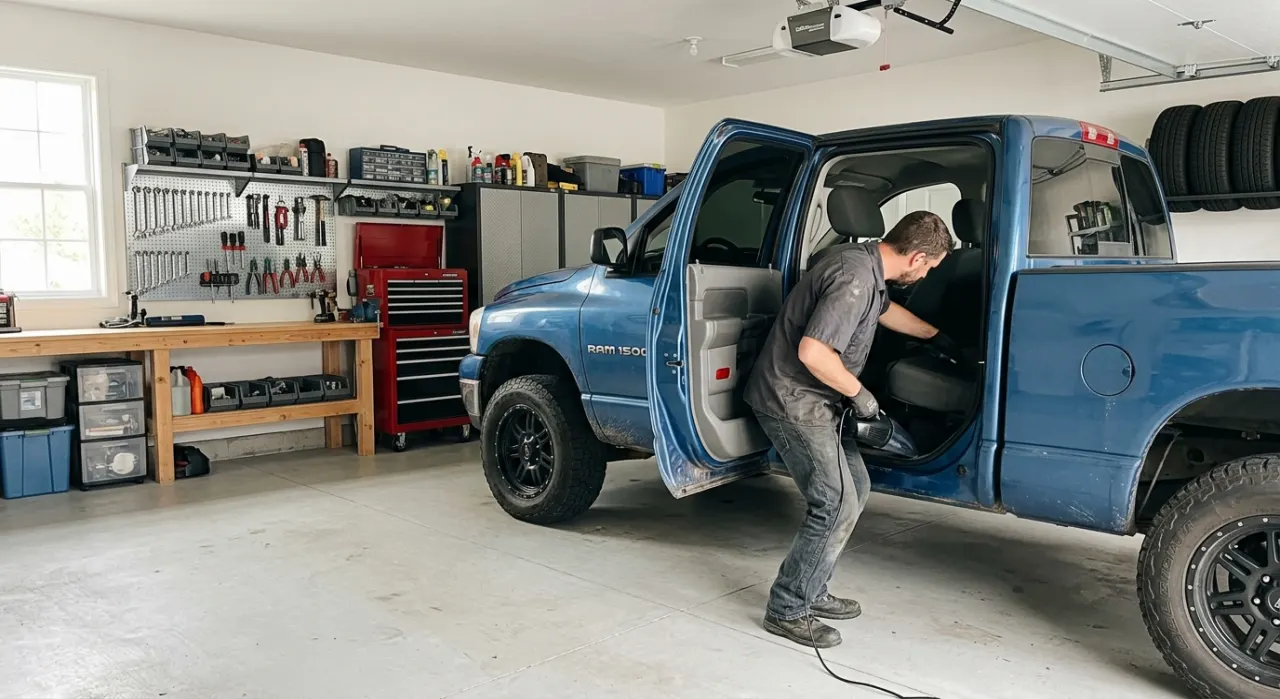
A 12V vacuum plugs into any accessory socket, which makes it more versatile than its car-cleaning name suggests. The same unit that clears your interior footwells runs off the 12-volt outlet on a boat, a camper or a truck, so a single mini vacuum handles the powersports fleet as well as the daily driver. Owners report keeping one permanently in the boat for sand and crumbs, and another in the car, precisely because it needs no wall outlet near the water or the driveway. It will not replace a corded machine for a whole-home clean — the fuse ceiling still applies — but for on-the-water and roadside messes where mains power is nowhere in reach, a compact 12V unit is often the only practical tool.
Finding a More Powerful Portable Vacuum Kit
Shoppers who land here often cross-shop a socket unit against a powerful cordless kit, and it is worth knowing what that money buys before you decide. The popular step up is a portable battery vacuum such as the Fanttik V10 Apex, which pairs a high-RPM brushless motor with a case of attachments; detailing experts frequently point buyers to it and to the Black+Decker range when raw pull matters more than unlimited runtime. What owners consistently find is a genuine trade: the V10 Apex out-suctions any 12V unit on boost but works in bursts, while a socket vacuum keeps going all afternoon at a lower ceiling. If you want a portable, cordless machine and are willing to manage battery life, a premium handheld kit is the upgrade; if uninterrupted runtime is the point, stay with 12V and spend the difference on better attachments.
Quick Comparison
Shop-Vac 12V Car Vacuum (7000Pa, 16 ft Cord)
Best for a known name on a socket-powered vacuum
Best Premium
AstroAI 4-in-1 V3 Car Vacuum with 150 PSI Tire Inflator
$35.99 · Check Price on Amazon
Best Suction
AstroAI Portable Car Vacuum (12V, 7500Pa)
Check Price on Amazon
Best Cord Reach
HOTOR Corded Car Vacuum Cleaner (DC 12V)
Check Price on Amazon
Best for Dark Interiors
ThisWorx Car Vacuum Cleaner 2.0 (16 ft Cord, LED)
$20.99 · Check Price on Amazon
Prices are pulled from Amazon and were accurate as of Aug 22, 2026, 6:44 PM EDT. Product prices and availability are subject to change — the live price is shown on Amazon.