
Affiliate Disclosure
Some links on this page are affiliate links. As an Amazon Associate, we earn from qualifying purchases — at no extra cost to you. We do not buy, test, or physically handle the products we cover; our rankings come from aggregated owner reviews, ratings and expert consensus. Commissions never change our verdicts. How we rank & full disclosure.
Short version: Water spots are mineral deposits, not dirt, which is why they survive a wash and even a clay bar. When hard water evaporates on your paint or glass, it leaves the dissolved minerals behind as a bonded ring. A water spot remover uses a controlled mild acid to dissolve those minerals so you can wipe them off. If they've been baking in the sun long enough to etch the surface, though, chemistry alone won't fix it and you're into polishing territory.
What water spots actually are
Tap water, sprinkler water, and hose water all carry dissolved minerals, mostly calcium and magnesium. That's what hard water means. When a droplet lands on your paint and evaporates before you dry it, the water leaves but the minerals stay, dried into a chalky ring exactly where the droplet sat. Multiply that by hundreds of droplets after a wash you didn't dry, or a night parked under a sprinkler, and you get that scattered, cloudy spotting.
The key insight is that these are bonded mineral deposits, not surface grime. Washing floats off loose dirt, but it can't dissolve a mineral that's chemically stuck to your clear coat. Even a clay bar, which pulls off raised bonded contaminants beautifully, often slides right over a flat mineral stain. That's why water spots feel like they're impossible to remove with normal methods. They need a different tool: mild acid. For the bigger picture of why some contamination resists normal cleaning, our what is paint decontamination explainer sets the stage.
The three severities of water spots
Not all water spots are equal, and knowing which type you have tells you whether a remover will work:
- Surface deposits. Fresh, sitting on top of the paint or glass. These are the easy ones, and a water spot remover or even diluted vinegar dissolves them cleanly.
- Bonded deposits. Older spots that have chemically bonded more firmly but haven't yet damaged the surface. A dedicated water spot remover, possibly with a second application, handles these.
- Etched spots. The worst case. Hard water that sat and baked in the sun long enough for the minerals to actually etch a ring into the clear coat or glass. A remover won't touch these because there's no deposit left to dissolve; the damage is a physical crater. These need machine polishing on paint or glass polish on windows, and severe etching can be permanent.
The lesson here is time. The longer a water spot sits, especially in the sun, the more it moves down this list from removable to etched. Catch them early and they wipe off. Ignore them for months and you may be polishing.
How water spot removers work
Water spot removers use a controlled mild acid to chemically break down the alkaline mineral deposit, converting it into something you can wipe or rinse away. It's the same principle as vinegar on a limescale-crusted faucet, just formulated to be safe on automotive surfaces when used correctly. Here's how to use one:
- Wash the car first so you're treating spots, not spots plus dirt.
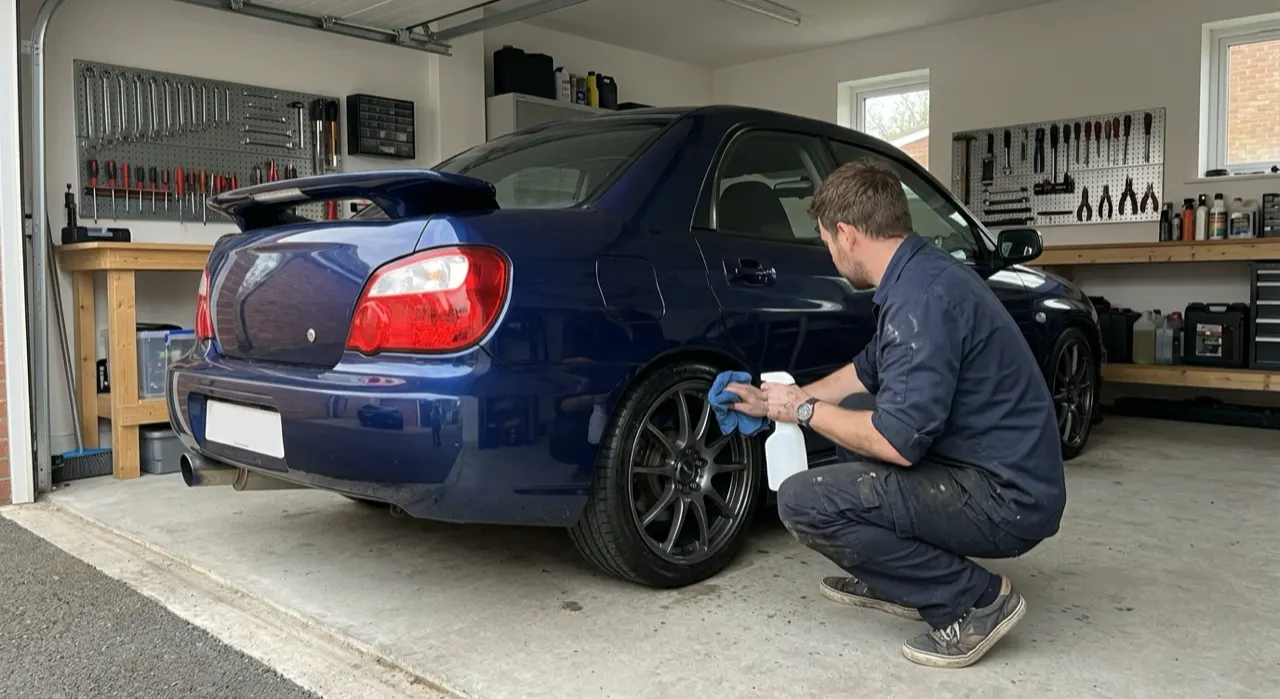
- Work in the shade on a cool surface. Acid plus sun plus heat is how you cause new damage. Never do this on hot paint in direct sun.
- Apply to the affected area, either sprayed on or worked in with a damp microfiber, depending on the product.
- Let it dwell briefly. Follow the label. You want enough time to dissolve the mineral but not so long the acid sits and does harm. This is usually a short window, not minutes.
- Wipe or agitate gently, then rinse thoroughly. The spots should lift as the minerals break down.
- Rinse completely. Any acid residue left to dry is asking for trouble. Flush the area well.
For light spots on glass, diluted white vinegar is a legitimate cheap first attempt. On paint, I'd reach for a purpose-made remover, since it's formulated for the job and less of a gamble than kitchen vinegar.
Glass versus paint
Glass and paint both get water spots, but they behave differently. Glass is harder and more resistant, so mineral spots on your windshield and windows often respond well to a remover or vinegar, and mild glass polish handles what's left. But glass can also etch, and etched glass rings are stubborn.
Paint is softer and more vulnerable to both the minerals and the acid you use to remove them. Be gentler on paint: keep dwell times short, work in shade, and rinse fast. And be extra careful if your car is coated, because acids can degrade a ceramic coating. Check the product's coating compatibility before you use it on a coated car.
Where it fits in decontamination
Water spot removal is a targeted step, not always necessary, but critical when spots are present. In a full decontamination it slots in like this:
- Wash to clear loose dirt.
- Iron remover for embedded fallout. See our iron remover guide.
- Bug and tar remover for petroleum and protein deposits.
- Clay bar to lift bonded contaminants, using our clay bar walkthrough.
- Water spot remover for any mineral spotting that survived the wash and clay. That's this step.
- Protect, or if coating, wipe down and coat.
Water spots are especially important to clear before a coating, because a coating locks them in for years just like any other contamination. Our decon before ceramic guide flags this exact trap.
Prevention beats removal
The best water spot remover is not needing one. Spots are entirely preventable with a couple of habits:
- Dry the car promptly after washing. Water can't leave mineral spots if it never evaporates on the paint. A good drying towel and a shaded spot handle this.
- Don't wash in direct sun. Water evaporates before you can dry it, spotting as you go.
- Keep sprinklers off the car. Overnight sprinkler spray is a top cause of stubborn baked-in spots, since it dries in the morning sun undisturbed.
- Keep a hydrophobic layer on the paint. A sealant or coating sheets water off before it can pool and dry, cutting spotting dramatically.
A few good habits mean you rarely have to reach for the acid at all. When you do need decon gear, though, buy it once and buy it right: we analyzed the ratings and reviews for the popular clay kits and decon products, and the ones that earned their place are in our top picks. It's also worth reading the full paint decontamination hub to see where spot removal fits alongside iron removal and claying.
The bottom line
Water spots frustrate people because they defy normal cleaning, but once you understand they're bonded minerals rather than dirt, the fix makes sense: a mild acid to dissolve what a wash and clay can't. Catch them while they're surface deposits and a water spot remover, or even vinegar on glass, wipes them away. Let them bake into an etch and you're polishing instead. Work in the shade, rinse well, mind your coating, and better yet, dry your car promptly so you rarely see them in the first place. It's the last decon step that separates almost-clean paint from truly clean paint.
Recommended Decontamination & Drying Gear
We aggregate owner ratings rather than testing ourselves. Dedicated water-spot removers vary by region, so these are the well-reviewed decontamination and drying tools that clear bonded contamination and stop new spots forming.

Best for the embedded fallout that sits alongside water spotting
- Dissolves bonded iron the wash and clay leave behind
- Colour-change formula shows it working
- A core decon step before you seal or coat
Why buy it: the enthusiast benchmark for chemical decontamination — pull the iron out before mineral spots and coatings lock it in.

Best for drying fast so hard water never evaporates into spots
- Large, thirsty microfiber that dries in a pass or two
- The single best habit against new water spots
- Cheap insurance versus polishing out an etch
Why buy it: the honest truth is the best water-spot remover is not needing one — dry promptly and you rarely see spotting at all.

Best for shearing off bonded contaminants a wash cannot
- Clay plus lubricant in one box
- Removes the raised contamination clay is made for
- Pairs with a remover for flat mineral stains
Why buy it: the most-owned clay kit going — the claying step that gets paint truly smooth before you tackle any remaining spots.
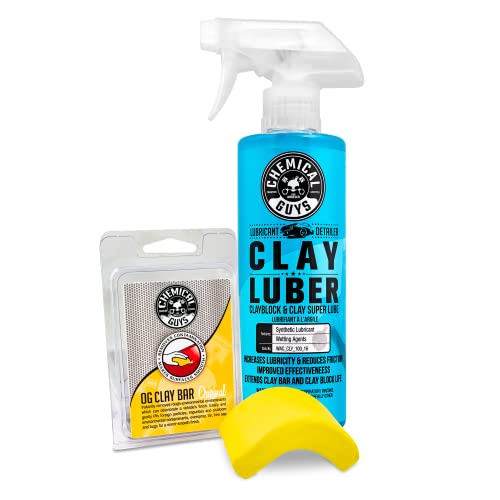
Best for a generous clay-and-lube set for the whole car
- Plenty of lubricant for safe claying
- Forgiving for first-time clay users
- Widely owned with strong feedback
Why buy it: a beginner-friendly claying kit with enough lube to work safely across every panel without marring.

Best for a trusted, hard-to-get-wrong claying kit
- Includes clay, lubricant and a finishing wax
- Straightforward for newcomers to decon
- Reliable results from a mainstream brand
Why buy it: a dependable claying kit that finishes the mechanical side of decon before you spot-treat any mineral marks.
Prices are pulled from Amazon and were accurate as of Aug 22, 2026, 6:54 PM EDT. Product prices and availability are subject to change — the live price is shown on Amazon.