

Affiliate Disclosure
Some links on this page are affiliate links. As an Amazon Associate, we earn from qualifying purchases — at no extra cost to you. We do not buy, test, or physically handle the products we cover; our rankings come from aggregated owner reviews, ratings and expert consensus. Commissions never change our verdicts. How we rank & full disclosure.
The short version: an SUV is a harder job for a wiper blade than a sedan, in three specific ways. The driver-side blade is longer, so keeping pressure even across it is genuinely difficult. The body is taller and often carries a roof rack, so airflow across the glass is more turbulent at speed. And there is a third blade on the back that almost nobody replaces. Ranked across aggregated owner ratings and review volume, our #1 pick is the Bosch ICON. The value play is the Rain-X Latitude. And do not leave without the rear blade.
Before you order. Wiper blades are a fitment part. Every blade here is sold in a range of lengths, most vehicles use two different lengths front to front, and arms use different connectors — J-hook, pinch tab, bayonet or side pin. The ASIN on each card is a representative size, not a universal fit. Confirm the correct length and connector for your exact year, make and model in wiper blade size by car first. On an SUV you are looking up three numbers, not two.
Top Picks at a Glance
Our #1 Pick: The Bosch ICON
The reason the ICON leads an SUV list rather than just a general one comes down to what happens to a wiper blade as it gets longer. A conventional frame blade transmits arm pressure through a tree of pivoting yokes — one bridge splits into two, two into four, four into eight — and each claw at the end of that tree is a discrete contact point. On a 19-inch blade the gaps between those points are small. On a 26 or 28-inch blade they are much wider, and as soon as the joints stiffen with age, the blade stops conforming and starts riding on its ends. On a big SUV windshield that shows up as a wide unwiped band sitting exactly at eye level.
A beam has no tree and no claws. The spring steel core is stamped with more curvature than the glass, so pressing it flat loads the entire wiping edge simultaneously and keeps loading it as the windshield curve changes across the sweep. That advantage scales with length, which is precisely why the ICON is a stronger recommendation on a 4Runner or an Explorer than it is on a Civic.
The second SUV-specific benefit is aerodynamic. A tall vehicle pushes a large, turbulent column of air up and over the windshield, and a roof rack or crossbars make it worse. A tall frame blade catches that airflow and lifts; the ICON sits low and its shell converts airflow into downforce. Owners who drive a lot of interstate miles in wet weather mention this consistently — the wipe stays clean at 75 mph instead of degrading with speed.
Its honest limitation is price. Around $32 a blade means roughly $64 for the front pair before you have touched the rear, and a full-size SUV needing a 28-inch driver blade will pay a little more again. If that is too much, the Rain-X Latitude at rank two is the same structural idea for a third less, with a slightly shorter service life.
Best Wiper Blades for SUVs 2026: The Ranked Field

Best for the long driver-side blade most SUVs use
- Tensioned beam holds even pressure across 26"
- ClearMax 365 compound resists UV hardening
- No exposed frame to pack with slush
- Sold in lengths from 13" to 28"
Why buy it: the blade that solves the specific SUV problem — the longer the blade, the harder it is to keep pressure even from end to end, and a full-length tensioned beam does it where a jointed frame starts skipping through the middle of its sweep.
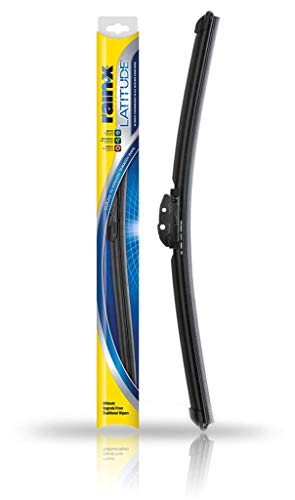
Best for family SUVs on a sensible budget
- Contoured beam for full-length contact
- Advanced synthetic rubber compound
- Universal adapter pre-installed
- Aerodynamic profile reduces wind lift
Why buy it: the most-reviewed beam blade in America and a strong fit for large SUV glass — the contour holds contact across the wide middle band where a tired frame blade leaves a permanent smear.

Best for matched pairs on mid-size crossovers
- Hybrid frame sealed inside an aero shell
- Smart-Flex arms follow windshield curve
- EZ-Lok connector, no adapters needed
- Matched driver and passenger pair
Why buy it: the premium answer for the many crossovers that use the same length on both sides — the flex arms hold full contact on the deep curve of modern SUV glass, and the shell keeps slush out of the mechanism in winter.
Best for tall vehicles at interstate speed
- Rated for wind speeds over 135 mph
- Memory-curve steel beam distributes load
- HighGlide treated squeegee runs quieter
- Pre-installed adapter for common arms
Why buy it: the blade built around aerodynamic load, which matters more on an SUV than people expect — a tall body and a roof rack push a lot of turbulent air across the glass, and owners who tow report this one staying planted.

Best for the tailgate blade almost everyone forgets
- Bosch OE Specialty rear application blade
- Graphite-coated natural rubber squeegee
- Built for a specific rear arm design
- One of the most widely fitted rear numbers
Why buy it: the half of the job most SUV owners skip — the rear window collects more road spray than the windshield does, and a smeared tailgate is exactly what you cannot afford when reversing out of a space with kids behind you.
Best for replacing both fronts in one order
- Two matched beam blades in one box
- Pre-installed J-hook adapter
- Graphite-coated natural rubber squeegee
- Sold in dozens of size pairings
Why buy it: the practical way to buy for an SUV, because the two front blades are almost never the same length — ordering a matched pair in the right pairing removes the most common ordering mistake in the category.
Prices are pulled from Amazon and were accurate as of Aug 22, 2026, 6:44 PM EDT. Product prices and availability are subject to change — the live price is shown on Amazon.
Do Not Forget the Rear Wiper
This is the section most SUV wiper articles skip, and it is the one that costs owners the most. Almost every SUV, crossover and wagon has a rear wiper, because a near-vertical tailgate generates a low-pressure zone that actively pulls road spray, dust and salt film onto the rear glass. That is why the back window is filthy after a highway run in the wet even though the windshield stayed clear.
Three things to understand before you buy one. It is a different part. Rear blades are much shorter — usually 10 to 16 inches against 22 to 28 up front — and they attach with their own mechanism, frequently a model-specific clip rather than the near-universal J-hook found on the front of American cars. A front blade will not fit a rear arm, and forcing an adapter on will leave you with a blade too long for the sweep. Buy by application code. Bosch sells rear blades as H-numbers, TRICO as lettered Exact Fit codes, and each code corresponds to one arm design. Check the washer too. Rear washer nozzles clog more often than front ones, and half of "the rear wiper is shot" complaints are really a dry blade dragging across dirty glass.
The full rear field, including the beam option worth having if you get real winters, is ranked in best rear wiper blade.
How to Choose Blades for an SUV
Start by writing down three numbers. Driver length, passenger length, rear length. They are almost never the same, and on many crossovers the driver and passenger sides differ by four to six inches. Look them up rather than measuring by eye.
Pick a beam for the fronts. The longer the blade, the bigger the advantage, for the geometric reasons above. The full design argument is in beam vs conventional wiper blades, and the ranked beam field is in best beam wiper blades.
Then adjust for climate. Hot and sunny kills squeegees through UV rather than use, so a silicone element from best silicone wiper blades pays for itself in the Southwest. Real winters mean a beam or a boot-style blade, covered in best winter wiper blades. If your SUV is really a work vehicle with a flat, tall windshield, compare against best wiper blades for trucks.
Buy a set where you can. A matched two-blade set in the correct pairing, like the AERO Voyager, removes the single most common ordering error and usually costs less than two singles.
Common Mistakes on SUVs
Buying two blades of the same length. The number one error in this category. Asymmetric front lengths are the norm on SUVs, not the exception.
Ignoring the rear until it fails. A rear blade ages from UV whether you use it or not, and it sits fully exposed on the tailgate. Replace it on the same schedule as the fronts.
Blaming the blades for a filmed windshield. Large glass collects a large amount of road film. New blades dragged across it will still smear. Clean it properly first using how to clean a windshield streak-free.
Running the reservoir dry. SUVs use more washer fluid than cars simply because there is more glass and a rear washer competing for it. Keep it topped with the right seasonal formula from best windshield washer fluid.
How We Rank
We do not run blades on an SUV through a season, and we will not imply that we do. We rank by aggregating owner ratings and review volume across the largest listings in the category, reading the specific complaints and endorsements buyers repeat over time, and comparing published construction specs against mechanic and installer consensus. Four factors carry the weight for SUVs specifically. Performance at length — how the design holds pressure across 24 to 28 inches, where frame blades fail first. Wind-lift resistance — behavior on a tall body at interstate speed, which is where wet-weather complaints on SUVs cluster. Size and pairing availability — whether the correct asymmetric pairing is actually sold, because a great blade you cannot get in your length is not a recommendation. And durability against UV, since large windshields on vehicles that live outside take a lot of sun. Prices were current at the time of writing.
The Verdict
For most SUVs and crossovers, the Bosch ICON in the correct driver and passenger lengths is the pick that holds a clean full-length wipe the longest, and the Rain-X Latitude gets you most of the way there for meaningfully less. Buyers who tow or live on the interstate should look at the TRICO Force. Whichever you choose, add the rear blade to the same order — it is under fifteen dollars and it is the one you will notice the next time you reverse in the rain. Look up all three lengths in wiper blade size by car, fit them in five minutes with how to change wiper blades, and if you want the whole visibility picture, the hub is at wiper blades and washer fluid.
Quick Comparison
Bosch ICON 26A Premium Beam Wiper Blade (26")
Best for the long driver-side blade most SUVs use
Best Value
Rain-X 5079281-1 Latitude Beam Wiper Blade (26")
Check Price on Amazon
Best Premium
Michelin Stealth Ultra 19-2222SUBA Twin Pack (22" + 22")
Check Price on Amazon
Best for Towing & Highway
TRICO Force 25-260 Beam Wiper Blade (26")
Check Price on Amazon
Best Rear Wiper for SUVs
BOSCH H353 Rear Wiper Blade (14" / 3397004631)
$15.41 · Check Price on Amazon
Best Two-Blade Set
AERO Voyager Premium Beam Wiper Blades (26" + 16" Set)
Check Price on Amazon
Prices are pulled from Amazon and were accurate as of Aug 22, 2026, 6:44 PM EDT. Product prices and availability are subject to change — the live price is shown on Amazon.