
Affiliate Disclosure
Some links on this page are affiliate links. As an Amazon Associate, we earn from qualifying purchases — at no extra cost to you. We do not buy, test, or physically handle the products we cover; our rankings come from aggregated owner reviews, ratings and expert consensus. Commissions never change our verdicts. How we rank & full disclosure.
Straight answer first: if you drive a modern car every day, you do not need an ethanol treatment. Every gasoline vehicle sold in the US for roughly the last twenty years is designed, warranted and tested to run on E10. The fuel lines, seals, pump and injectors are specified for alcohol content. Fuel that gets burned within a week or two never has time to develop the problems these bottles prevent. Buying one every tank is a small permanent tax on your fuel bill in exchange for nothing you will ever notice.
Where ethanol genuinely bites is fuel that sits. A boat used six weekends a summer. A mower whose tank is full from October to April. A generator that runs twice a year. A classic that comes out when the weather is good. A flex-fuel truck parked for a season. In those cases the chemistry is real and the failures are common and expensive — a carburetor rebuild costs more than a decade of treatment. Ranked across aggregated owner reviews, our #1 pick is STA-BIL 360 Protection, because it protects the metal above the fuel line as well as the fuel itself. Below is the ranked field, what ethanol actually does, and how to decide whether this is your problem. For the wider category, see the fuel system cleaners & additives hub.
Top Picks at a Glance
Our #1 Pick: STA-BIL 360 Protection
STA-BIL 360 Protection — sold more recently as In-Season Protection, same formula — tops this list because it addresses a part of the problem most competitors ignore. Ethanol-related damage does not only happen in the fuel. A tank that is half full spends months with humid air above the fuel line, and the bare metal up there corrodes first: tank walls, fittings, the top of a fuel pump assembly. The "360" in the name refers to a vapor-phase inhibitor that rises out of the fuel and coats those surfaces. For seasonal equipment that habitually sits half full — which is most of it — that is the difference between a tank that is fine in spring and one that is shedding rust into the pickup.
The rest of the package is what you would expect and what you want: detergency to keep injectors and jets clean, moisture control to keep small amounts of water dispersed rather than pooling, and oxidation resistance so the fuel does not turn to varnish. One 32 oz bottle treats up to 160 gallons, which is enough for several seasons of a mower, a generator and a couple of gas cans.
Across roughly nine thousand owner reviews the pattern reported by the people who genuinely need this — boat owners, generator owners, seasonal equipment users — is consistent: equipment that starts in spring, carburetors that stay clean, and fewer of the small-engine failures that had become an annual ritual. As with the rest of this category, owners who treated a daily-driven car mostly report nothing, and say so. That is the correct outcome and it is worth trusting.
Ethanol Treatments 2026: The Ranked Field

Best for seasonal equipment and anything that sits with ethanol fuel in it
- Vapor-phase corrosion protection above the fuel line
- Cleans injectors while protecting against ethanol damage
- One 32 oz bottle treats up to 160 gallons
- Designed for in-season use, not just winter layup
Why buy it: the only treatment here that protects the metal above the fuel as well as the fuel itself — which matters, because on a half-empty tank that is where corrosion actually starts.
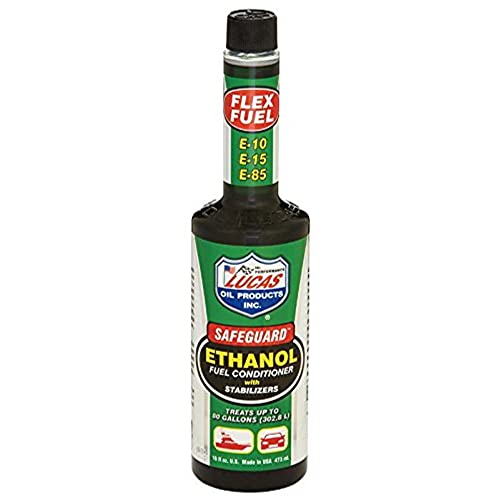
Best for small engines and equipment on a tight budget
- Formulated specifically around ethanol-blended fuel
- Stabilizes fuel and controls moisture
- Adds lubricity lost to alcohol content
- Low treat cost per gallon
Why buy it: a purpose-built ethanol product at a price that makes it easy to keep a bottle in the shed. Nothing exotic, but it targets the right three problems.

Best for long-term storage where the fuel must still be good in a year
- Treats up to 512 gallons from one 16 oz bottle
- Reputation for restoring partly degraded fuel
- Widely used in marine and generator applications
- Very low cost per treated gallon despite the price
Why buy it: expensive on the shelf and one of the cheapest here per treated gallon. It is the bottle owners reach for when the fuel genuinely has to survive a year rather than a season.
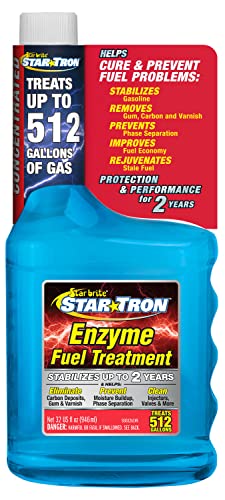
Best for boats, where phase separation and water are the real enemies
- Enzyme formulation that disperses water into the fuel
- Breaks down existing gum and varnish
- One 32 oz bottle treats up to 512 gallons
- The default treatment across the marine world
Why buy it: the marine standard, and for good reason. A boat tank breathes humid air all season, and dispersing that moisture rather than letting it pool is exactly the right approach on the water.

Best for mowers, trimmers, chainsaws, generators and snow blowers
- Concentrated small-engine dosing
- Sized so the bottle is used before it expires
- Same enzyme chemistry as the marine formula
- Easy measuring for one- and two-gallon cans
Why buy it: the format that matters more than the chemistry. A right-sized bottle you treat every gas can with beats a big jug you use twice and forget about.

Best for parking something for the off-season and forgetting about it
- Keeps fuel fresh for up to 24 months
- One 32 oz bottle treats up to 80 gallons
- The most-reviewed stabilizer in the country
- Add before storage and run the engine to circulate
Why buy it: the most-bought bottle in the category and a genuinely dependable one. It is a stabilizer first rather than a full ethanol package, which is exactly right if storage is your only problem.
Prices are pulled from Amazon and were accurate as of Aug 22, 2026, 6:54 PM EDT. Product prices and availability are subject to change — the live price is shown on Amazon.
What Ethanol Actually Does
Three separate mechanisms, often confused with each other.
1. It absorbs water. Ethanol is hygroscopic, meaning it pulls moisture out of the air — and a fuel tank breathes through its vent as temperatures rise and fall. E10 can hold a small amount of water in solution harmlessly. Past that point comes phase separation: the mixture splits into a gasoline layer on top and a corrosive water-alcohol layer at the bottom, which is precisely where your fuel pickup sits. A separated tank will not run an engine, and no additive re-mixes it. This is the failure that ruins boats.
2. It is a mild solvent. Older rubber fuel lines, cork floats, some fiberglass tanks and certain gasket materials were never specified for alcohol, and ethanol slowly attacks them. The debris ends up in a carburetor or an injector. This is why classic car and vintage boat owners take the issue seriously, and why "ethanol-safe" replacement fuel line exists.
3. It shortens shelf life. Ethanol-blended gasoline oxidizes faster than pure gasoline. Within three to six months, depending on temperature and how much air is in the tank, it starts dropping gum and varnish into exactly the small passages that are hardest to clean. That is why the mower that ran fine in October will not start in April.
Notice what all three have in common: time. None of these is a meaningful threat to fuel that gets burned in two weeks.
Who Actually Needs This
You do not need it if your car is a modern daily driver on E10 and you empty a tank every week or two. Save the money.
You do need it if any of the following apply. Small engines and seasonal equipment — mowers, trimmers, chainsaws, snow blowers, generators — where a fifteen-dollar bottle prevents a two-hundred-dollar carburetor rebuild, and where the equipment often sits full for six months. Boats, which combine humid air, a vented tank and long idle periods into the worst possible case; this is why the marine world treats every tank without argument. Stored vehicles of any kind, from a classic to a second car driven twice a month. Older vehicles with pre-ethanol fuel system components, where the solvent effect is the real risk rather than the water. And flex-fuel vehicles running E85 that are going to sit, since E85 absorbs water considerably more readily than E10.
Two things no additive fixes. If your engine is not rated for E15, the answer is to not put E15 in it — no treatment makes an unrated fuel system compatible, and small engines, marine engines and older cars are explicitly excluded by their manufacturers. And if a tank has already phase-separated, the fix is to drain and properly dispose of the fuel. Anything implying otherwise is overselling.
Using It So It Actually Works
Treat the fuel before it sits, not after. Every product here is preventive. Adding treatment to gasoline that has already been in a mower since last autumn does very little; adding it the day you fill the can does a great deal.
Run the engine for five to ten minutes after treating. This is the step people skip and it is the one that matters most on small engines. Treated fuel sitting in the tank does nothing for the carburetor bowl and jets, which are the parts that actually varnish shut. The engine has to run long enough to pull treated fuel all the way through.
Store the tank full, not half empty. Less air in the tank means less moisture to absorb and less surface for corrosion. On equipment you cannot fill, the alternative is to run it dry — but pick one and commit, because half a tank is the worst of both.
Buy a bottle sized for how much fuel you actually treat. A 32 oz jug that treats 512 gallons is superb value on paper and useless in practice if you own a mower and a gas can. Treatment only works when it is used every time, so the small-engine format is often the better buy even though the math looks worse.
Do not stack products. An ethanol treatment, a stabilizer and a fuel system cleaner in the same can of gas is not three times better. If storage is the whole problem, a dedicated stabilizer is enough — the ranked field for that is in best fuel stabilizer.
If It Is Already Gummed Up
Prevention is a different product from cure, and this page is about prevention. If the mower will not start, the carburetor bowl is full of green varnish and the jets are blocked, no amount of ethanol treatment in the tank will recover it. That is a cleaning job — a spray or a dip solution, and often a disassembly — and the ranked field for that is in best carb cleaner. On a fuel-injected vehicle that sat with untreated ethanol fuel, the equivalent cleanup is a concentrated PEA treatment through the tank and, sometimes, a fuel filter; that ranking lives in best fuel system cleaner.
And if the car has been sitting long enough that you are also worried about what happened in the crankcase, that is a separate conversation with its own risks — see best engine sludge treatment and the oil change hub.
How We Rank
We do not run a lab and we have not measured water content in treated fuel over a season. We rank by aggregating owner ratings and review volume, then weighing four things. What chemistry the bottle actually brings — water dispersal, oxidation resistance, vapor-phase corrosion protection above the fuel line, and lubricity — because "ethanol treatment" is a marketing category rather than a defined formulation. Treat rate and real cost per gallon. Format, which matters more here than anywhere else on this site: a product only works if it is used every time, and a correctly sized bottle for a gas can beats a jug that gets used twice. And who is reporting results — we weight reviews from boat, generator and small-engine owners far above reviews from daily drivers, because the daily drivers never had the problem. Prices were current at the time of writing.
The Verdict
If you own equipment that sits, buy STA-BIL 360 Protection: it covers the fuel and the metal above it, and one bottle lasts several seasons across a mower, a generator and a couple of gas cans. On a budget, Lucas Safeguard targets the same three problems for ten dollars. Boat owners should follow the marine consensus and run Star Tron. If you only ever treat a couple of gallons at a time, the Star Tron Small Engine bottle is the one you will actually use. If the fuel has to survive a full year, PRI-G is worth the shelf price, and if all you are doing is parking something for winter, STA-BIL Storage is the simple, proven answer.
And if you came here about your daily driver: you are fine. Put the money into fuel from a good station and a gas treatment at your next oil change if you want to do something — though we are honest on that page too about how little most modern cars need even that.
Quick Comparison
STA-BIL 360 Protection / In-Season Fuel System Treatment (32 oz)
Best for seasonal equipment and anything that sits with ethanol fuel in it
Best Value
Lucas Oil 10576 Safeguard Ethanol Fuel Conditioner (16 oz)
$11.98 · Check Price on Amazon
Best Premium
PRI-G Gasoline Treatment (16 oz)
$39.99 · Check Price on Amazon
Best for Boats and Marine
STAR BRITE Star Tron Enzyme Fuel Treatment (32 oz, 093032)
$32.80 · Check Price on Amazon
Best for Small Engines
STAR BRITE Star Tron Enzyme Fuel Treatment Small Engine Formula (8 oz, 14308)
Check Price on Amazon
Best for Winter Layup
STA-BIL Storage Fuel Stabilizer (32 oz, 22214)
$12.48 · Check Price on Amazon
Prices are pulled from Amazon and were accurate as of Aug 22, 2026, 6:54 PM EDT. Product prices and availability are subject to change — the live price is shown on Amazon.