
Affiliate Disclosure
Some links on this page are affiliate links. As an Amazon Associate, we earn from qualifying purchases — at no extra cost to you. We do not buy, test, or physically handle the products we cover; our rankings come from aggregated owner reviews, ratings and expert consensus. Commissions never change our verdicts. How we rank & full disclosure.
The short version: a wiper blade does not have to be worn out to fail you in rain. It only has to lose contact somewhere along its length — and the moment it does, you get a smeared band of water sitting exactly where oncoming headlights hit it. Ranked across aggregated owner ratings and review volume, our #1 pick for rain is the Bosch ICON, a tensioned beam that holds pressure end to end. Want two blades for the price of one premium? The AERO Voyager set. Want the glass itself to shed water? The Rain-X Latitude Water Repellency blade.
Before you order. Wiper blades are a fitment part. Every blade here is sold in a range of lengths, most vehicles use two different lengths front to front, and arms use different connectors — J-hook, pinch tab, bayonet or side pin. The ASIN on each card is a representative size, not a universal fit. Confirm the correct length and connector for your exact year, make and model in wiper blade size by car first. Ordering the wrong size is a far more expensive mistake than buying the cheaper blade.
Top Picks at a Glance
Our #1 Pick: The Bosch ICON
Rain exposes one specific weakness in a wiper blade, and it is not the rubber. It is pressure distribution. A conventional frame blade pushes down through six or eight pivoting claws, which means the force reaching the glass is concentrated at a handful of points and tapers off between them. When the frame joints stiffen with age — and they all do — the blade stops conforming to a curved windshield and starts riding on its ends. In dry weather you would never notice. In a downpour you get a wide, permanently wet band across the middle of your view.
The ICON removes that failure mode structurally. There is no frame and there are no claws, just a single pre-curved tensioned spring sealed inside a rubber shell. The spring loads the entire wiping edge against the glass at once, and it keeps doing that as the windshield curve changes across the sweep. That is why the recurring theme in ICON owner reviews is not "it wipes well" but "it stopped leaving that streak" — a specific complaint about a specific geometry problem.
The second thing the ICON gets right for rain is aerodynamics. At interstate speed, air moving up the windshield generates real lift under a tall frame blade, and the faster you go, the harder the airflow works to peel the squeegee off the glass. The ICON sits low and its shell is shaped to convert that airflow into downforce rather than lift. Owners who drive a lot of highway miles in wet climates — the Pacific Northwest, the Gulf Coast, the Southeast in summer — mention this consistently.
Its honest limitation is price. At roughly $32 a blade, a pair runs about $64, which is more than three times a set of basic conventional blades that will also clear water on the day you fit them. What you are paying for is how long the wipe stays clean. Bosch claims up to 40% longer life than other premium blades, and while we cannot verify a manufacturer figure, the aggregate review data is notably light on the six-month-and-chattering complaints that dominate cheaper listings. If you want the same beam geometry for less, the Bosch Clear Advantage at rank six is the same idea at a lower price point.
Best Wiper Blades for Rain 2026: The Ranked Field

Best for clean, quiet wiping in sustained heavy rain
- Tensioned beam applies even pressure end to end
- ClearMax 365 compound resists UV hardening
- Low-profile shape resists wind lift at speed
- Sold in lengths from 13" to 28"
Why buy it: the blade owners reach for when the wipers have to run on high for an hour straight — even pressure across the full length means no unwiped band down the middle of the glass, which is the exact failure that makes a tired blade dangerous at night in the rain.
Best for replacing both front blades for the price of one premium
- Two matched beam blades in one box
- Pre-installed J-hook adapter
- Graphite-coated natural rubber squeegee
- Sold in dozens of size pairings
Why buy it: the honest value answer for rain — a matched pair of beam blades for roughly what one premium blade costs, and owners consistently report a clean sheeting wipe that holds up for a full season.

Best for staying quiet and clean through a long wet season
- Silicone squeegee with graphite coating
- Rated from -20°F to +194°F
- Beam profile with no exposed frame
- Claimed 2x life of natural rubber
Why buy it: silicone shrugs off the UV and heat cycling that turns a rubber edge hard and chattery, so the wipe quality you get in October is close to the wipe quality you still get the following April.
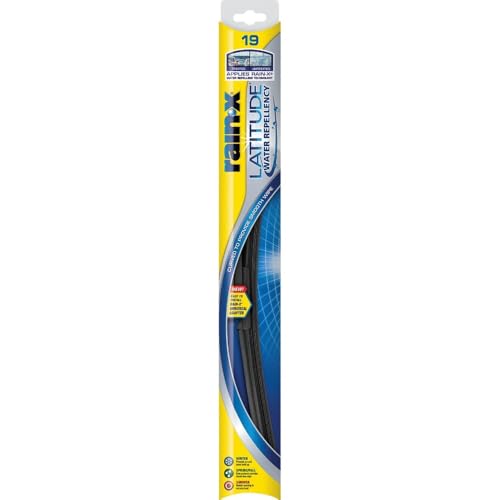
Best for making water bead and roll off between wipes
- Squeegee transfers Rain-X repellent onto the glass
- Contoured beam for full-length contact
- Universal adapter fits most J-hook arms
- Sold in lengths from 14" to 28"
Why buy it: the one blade in this field that actively changes the glass rather than just clearing it — the repellent laid down by the squeegee makes water bead and shed between passes, which is a genuine visibility gain in a downpour.
Best for interstate rain where wind lift ruins the wipe
- Rated for wind speeds over 135 mph
- Memory-curve steel beam distributes load
- HighGlide treated squeegee runs quieter
- Pre-installed adapter for common arms
Why buy it: the blade built specifically around aerodynamic load — at 70 mph in rain, airflow tries to peel a blade off the glass, and owners who drive a lot of interstate miles report this one staying planted where lighter blades start skipping.

Best for beam performance without the ICON price
- Frameless beam with an aerodynamic spoiler
- Dual rubber compound wiping edge
- Tension spring arcs to the windshield curve
- Available from 13" to 28"
Why buy it: the cheapest way into real beam behavior from a brand with a track record — you give up some of the ICON longevity, but the wet-weather wipe on day one is close enough that most owners never notice the difference.
Prices are pulled from Amazon and were accurate as of Aug 22, 2026, 6:44 PM EDT. Product prices and availability are subject to change — the live price is shown on Amazon.
How to Choose a Rain Blade
Start with the design, not the brand. For wet weather, a beam blade beats a conventional frame blade for the reasons above, and it is not close. If your car currently wears conventional blades, switching to any well-rated beam is a bigger upgrade than switching between two premium brands. The full field is ranked in best windshield wiper blades, and the design argument is laid out in detail in beam vs conventional wiper blades.
Then match the compound to your climate. Natural rubber wipes beautifully and dies from UV. Silicone costs more, wipes slightly differently at first, and holds its edge far longer under sun and heat. If you live somewhere that is both wet and hot — Florida, Houston, the Carolinas in August — silicone is the better economic choice, and the field is ranked in best silicone wiper blades.
Finally, consider speed. If most of your rain driving happens on the interstate, wind-lift resistance matters more than an extra tenth of a star. The TRICO Force is explicitly engineered for it, and a low-profile beam like the ICON is nearly as good. If your rain driving is city speeds, ignore this factor entirely.
The Specs That Actually Matter in Rain
Pressure points. Manufacturers rarely publish this, but the number of contact points is the single most useful thing to know. A beam has effectively continuous contact. A conventional frame has four, six or eight discrete points. More contact means less chance of a wet band forming as the blade ages.
Squeegee coating. Graphite and silicone coatings both reduce friction so the blade glides rather than judders. That matters more in rain than people assume, because judder is what tears a wiping edge and creates the micro-serrations that leave streaks.
Spoiler or shell shape. Anything that turns airflow into downforce. On a beam blade the shell usually does this by itself; on a hybrid it is a separate molded spoiler.
Length accuracy. Fitting a blade an inch longer than spec because it was in stock is a real mistake — it can foul the A-pillar trim or the opposite blade at the top of the sweep. Use the size lookup.
Common Mistakes That Ruin Wet-Weather Visibility
Blaming the blade for a dirty windshield. This is the most common one by a wide margin. A greasy film of road grime and old wax will smear under any blade. Clean the glass first with the method in how to clean a windshield streak-free, and only then judge the rubber.
Running the wipers on a nearly dry windshield. Light drizzle plus intermittent wipers is one of the harshest things you can do to a squeegee — there is not enough water to lubricate the pass, so the edge drags, judders and wears. Give it a shot of washer fluid; the seasonal picks are in best windshield washer fluid.
Expecting a blade to replace a coating. A water-repellency blade tops up a light film. It does not do what a properly applied glass coating does. If you want water flying off the windshield above 45 mph without the wipers running at all, that is windshield water repellent territory over in the glass hub, and it is a different product doing a different job.
Replacing only the driver-side blade. They age together. Replace them as a pair, which is exactly why a matched set like the AERO Voyager is such good value.
How We Rank
We do not run blades on a test car through a wet season, and we will not imply that we do. We rank rain blades by aggregating owner ratings and review volume across the largest listings in the category, reading the themes buyers repeat over time, and weighing that against published construction specs and the consensus among mechanics and installers. Four factors carry the weight here. Contact quality — whether the design maintains full-length pressure on curved glass, and whether owners report streak-free sweeps or a persistent wet band. High-speed stability — how the blade behaves when airflow is trying to lift it, which is where wet-weather complaints cluster. Edge durability — how many months owners get before chatter and streaking return. And value, judged as cost per month of clean wiping rather than sticker price. Rain performance is one of the few things every buyer can evaluate honestly on their own windshield, which makes aggregate review data in this category unusually reliable. Prices were current at the time of writing.
The Verdict
For most drivers in most American rain, the Bosch ICON is the blade that holds a clean, full-length wipe the longest, and it does it without asking you to change anything else about the car. If you want both front blades replaced for around twenty dollars, the AERO Voyager set is the value play, and it is genuinely good rather than merely cheap. If your climate is wet and hot, spend the extra on the Rain-X Silicone Endura and buy less often. Confirm your lengths and connector in wiper blade size by car, fit them yourself in five minutes with how to change wiper blades, and if winter is the harder half of your year, read best winter wiper blades before you buy twice.
Quick Comparison
Bosch ICON 26A Premium Beam Wiper Blade (26")
Best for clean, quiet wiping in sustained heavy rain
Best Premium
Rain-X 830126 Silicone Endura Wiper Blade (26")
$26.48 · Check Price on Amazon
Best Water-Repellent Blade
Rain-X 5079276-2 Latitude Water Repellency Wiper Blade (19")
$19.86 · Check Price on Amazon
Best for Highway Speed
TRICO Force 25-260 Beam Wiper Blade (26")
Check Price on Amazon
Best Budget Beam
BOSCH 22CA Clear Advantage Beam Wiper Blade (22")
$15.79 · Check Price on Amazon
Prices are pulled from Amazon and were accurate as of Aug 22, 2026, 6:44 PM EDT. Product prices and availability are subject to change — the live price is shown on Amazon.