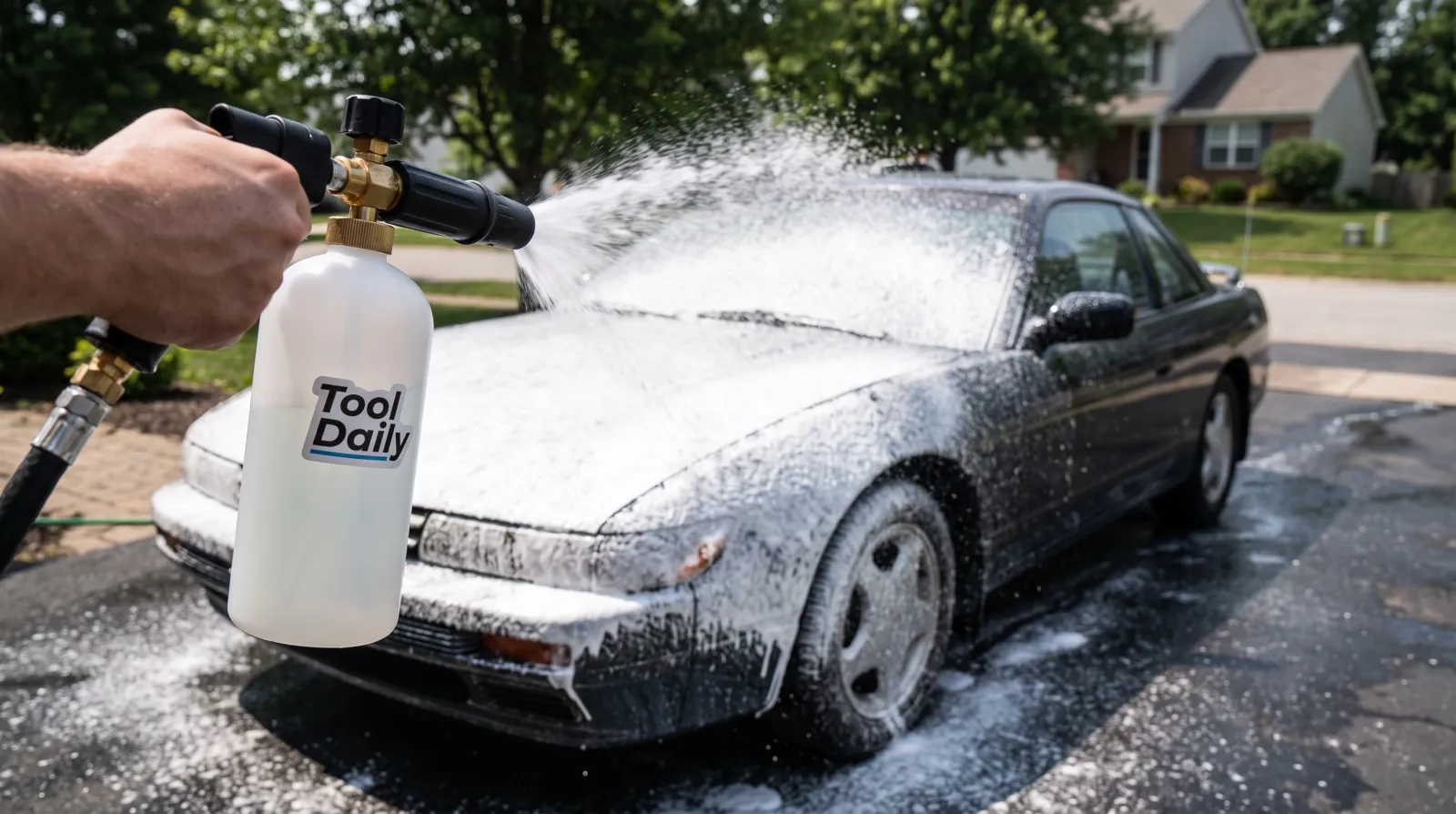
Short version: a foam cannon lays a thick blanket of soap over your car before you touch it, softening and floating off loose grit so your wash mitt has far less abrasive dirt to drag around. That’s not just satisfying to watch — it’s one of the easiest ways to cut down on swirl marks. This hub covers how to dial in thick foam, the cannons and soaps worth buying, and how to fix a cannon that won’t foam.
Foaming is a pre-wash step — it comes before the contact wash. You’ll need a pressure washer to run one properly.
How a Foam Cannon Works
A foam cannon mixes soap from its bottle with water from your pressure washer and forces the mix through a small orifice and a mesh, aerating it into thick foam. The pressure washer’s flow is what makes the foam thick and clinging — which is why a hose-fed foam gun can’t match it. An adjustable cannon lets you tune the soap ratio and spray pattern to get that shaving-cream blanket that sticks to vertical panels long enough to work.
Getting Thick, Clinging Foam
Three things decide foam thickness: a dedicated high-foam soap, the right dilution ratio, and enough pressure washer PSI and flow. Get those right and technique is easy — spray bottom-to-top for coverage, let it dwell a few minutes (never let it dry), then rinse top-to-bottom. The full method is in how to use a foam cannon, and the exact ratios are in the dilution cheat sheet.
Choosing a Cannon
Most cannons attach with a standard 1/4-inch quick-connect that fits the common pressure washers. What separates a great cannon from a cheap one is the foam quality, adjustment range and build. Our best foam cannon test ranks the field; if you’re matching one to a specific washer, start with best foam cannon for a pressure washer. Only have a garden hose? Read foam cannon vs foam gun first.
When It Won’t Foam
Weak, watery foam almost always comes down to soap choice, dilution, or not enough pressure — occasionally a clogged orifice. The not foaming troubleshooting guide walks through all eight common causes in order, and the best foam cannon soap test names the soaps that reliably blanket a car.
Soap or Cannon: What Actually Controls Foam Thickness
New buyers assume a thicker-foaming cannon is the whole answer, but the soap and your dilution matter just as much — often more. A premium $80 cannon fed weak, wrong soap will make thin, watery foam, while a $20 cannon paired with a proper high-foaming snow-foam soap at the right ratio produces the thick, clinging blanket you're after. That's why our advice is to buy a capable mid-priced cannon and spend the savings on good foam cannon soap. The third factor is your pressure washer's flow and pressure — a cannon needs roughly 1,000+ PSI and adequate GPM to aerate the mix properly. Get all three right — cannon, soap, and enough pressure — and thick foam is easy; get any one wrong and no amount of knob-twiddling fixes it. The exact ratios and knob settings are in our dilution ratio cheat sheet.
Does Foaming Actually Protect Your Paint?
It's fair to ask whether a foam cannon is genuinely useful or just satisfying to watch. The honest answer is both. A thick foam pre-soak clings to the paint and gives the soap time to soften and encapsulate loose grit and road film, so a good portion of it slides or rinses away before your wash mitt ever touches the surface. Less grit under the mitt means fewer of the fine scratches and swirls that come from careless washing — so a foam pre-wash is a legitimate paint-protection step, not just theatre. What it is not is a replacement for the contact wash: foam alone won't remove bonded dirt, brake dust or bug splatter. Think of it as the step that makes the two-bucket wash that follows both safer and easier. For heavier grime, some detailers also use a stronger snow-foam as a dedicated pre-wash before the maintenance foam.
Fitment: Will a Cannon Work With Your Setup?
The most common pre-purchase worry is whether a cannon will fit. The vast majority of consumer foam cannons use a standard 1/4-inch quick-connect plug that fits nearly every electric and gas pressure washer, so for most people it clicks straight on. The main exceptions are certain Karcher units with a proprietary bayonet mount, which need a cheap adapter. What you cannot do is run a true foam cannon off a garden hose — it needs a pressure washer's flow to foam; a hose calls for a foam gun instead. If you're matching a cannon to a specific washer, our best foam cannon for a pressure washer guide breaks down fitment and PSI needs by setup.
Where to Start
Grab a proven cannon from our best foam cannon picks, pair it with a high-foam soap, and read how to use it. The topical map below links every part of the foam-wash process.
Affiliate Disclosure
Some links on this page are affiliate links. If you buy through them we may earn a small commission at no extra cost to you. It never changes our verdicts — we only recommend gear we would run on our own cars. Read the full disclosure.