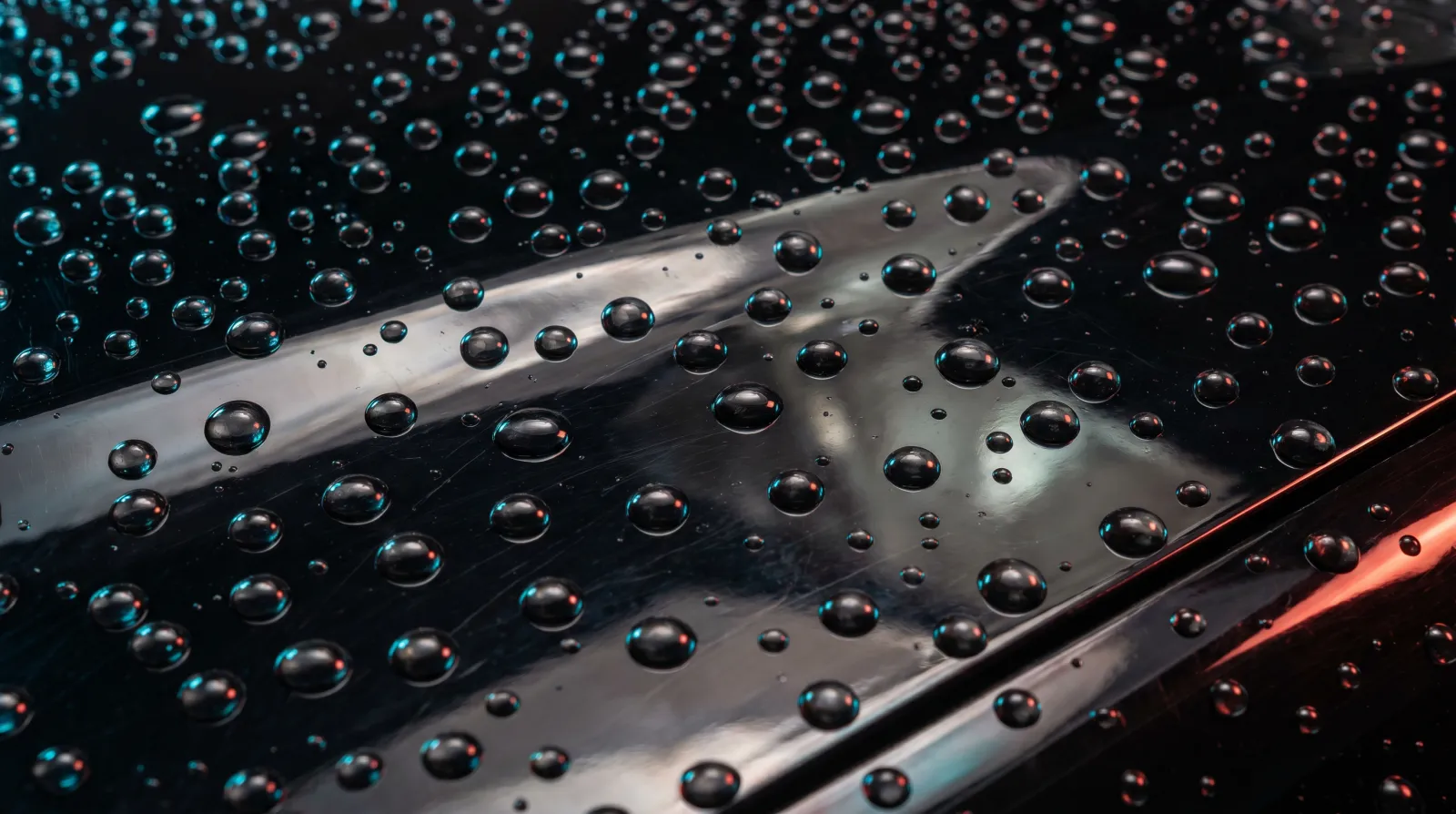
Every detailing forum has someone quoting contact angles and cross-linking polymers like they wrote a PhD thesis on a Sunday afternoon. Most of it lands somewhere between confusing and weaponised marketing. This page cuts through that. If you want to know what is actually happening — chemically — when a ceramic coating bonds to your clear coat, you're in the right place. No textbook. Just the real mechanism, explained the way a mate with a chemistry background and a garage full of JDM gear would explain it.
Start Here: What Is SiO2 and Why Does It Matter?
The active ingredient in almost every consumer and professional ceramic coating is silicon dioxide, abbreviated SiO2 — the same compound as quartz, glass and beach sand, just in a radically different form. In a coating bottle, SiO2 is suspended as nano-particles: particles measured in nanometres, small enough to flow into the microscopic peaks and valleys of your clear coat and fill them. When those nano-particles cure, they form an ultra-thin glassy matrix over your paint — the matrix that delivers hardness, chemical resistance and the hydrophobic behaviour everyone talks about.
Some premium formulas blend in additional compounds:
- Silicon carbide (SiC) — harder than SiO2 alone, used in high-end coatings to push scratch resistance further.
- Titanium dioxide (TiO2) — adds a mild photocatalytic self-cleaning effect when activated by UV light (the honest version of that claim is below).
The base chemistry of SiO2 is also covered on our ceramic coating pillar page if you want the full overview first.
Why a Ceramic Coating Bonds — and Wax Does Not
A traditional carnauba or synthetic wax sits on top of your clear coat. It sticks via Van der Waals forces — weak intermolecular attractions — which is why it washes off, degrades in UV and needs reapplying every few months. It isn't bonded to anything. It's just resting there.
A ceramic coating does something fundamentally different. The SiO2 nano-particles undergo a chemical reaction with the hydroxyl groups on the surface of your clear coat. That reaction forms a covalent bond — atoms sharing electrons, not just sitting near each other — as strong as the clear coat itself. The process is called cross-linking: the SiO2 molecules form a three-dimensional network as they cure, each node bonded to its neighbours and to the substrate below. Think rebar in concrete versus a mat laid on the ground. One is structural. The other blows away.
Cross-Linking and Curing: What Happens in Your Garage
When you wipe a ceramic coating onto a clean, prepped panel and let it sit, the solvents in the carrier flash off first, concentrating the SiO2 at the surface. Then, driven by moisture in the air and the latent heat of the panel, the cross-linking reaction progresses. Within the first few hours the coating achieves an initial set — hard enough not to smear, but still curing at depth. Full cross-linking typically takes 24–72 hours, with some professional coatings hardening for up to a week. During this window the coating is vulnerable to water and disturbance, which is why every manufacturer specifies a cure period before the first wash (see our curing time guide).
The finished layer is genuinely semi-permanent — it doesn't wash off, peel under normal conditions, or degrade from road grime. It does have a finite service life because UV and abrasion gradually erode the outer surface. For how long you can realistically expect a coating to last, see our durability guide.
Surface Energy, Contact Angle, and Why Water Beads
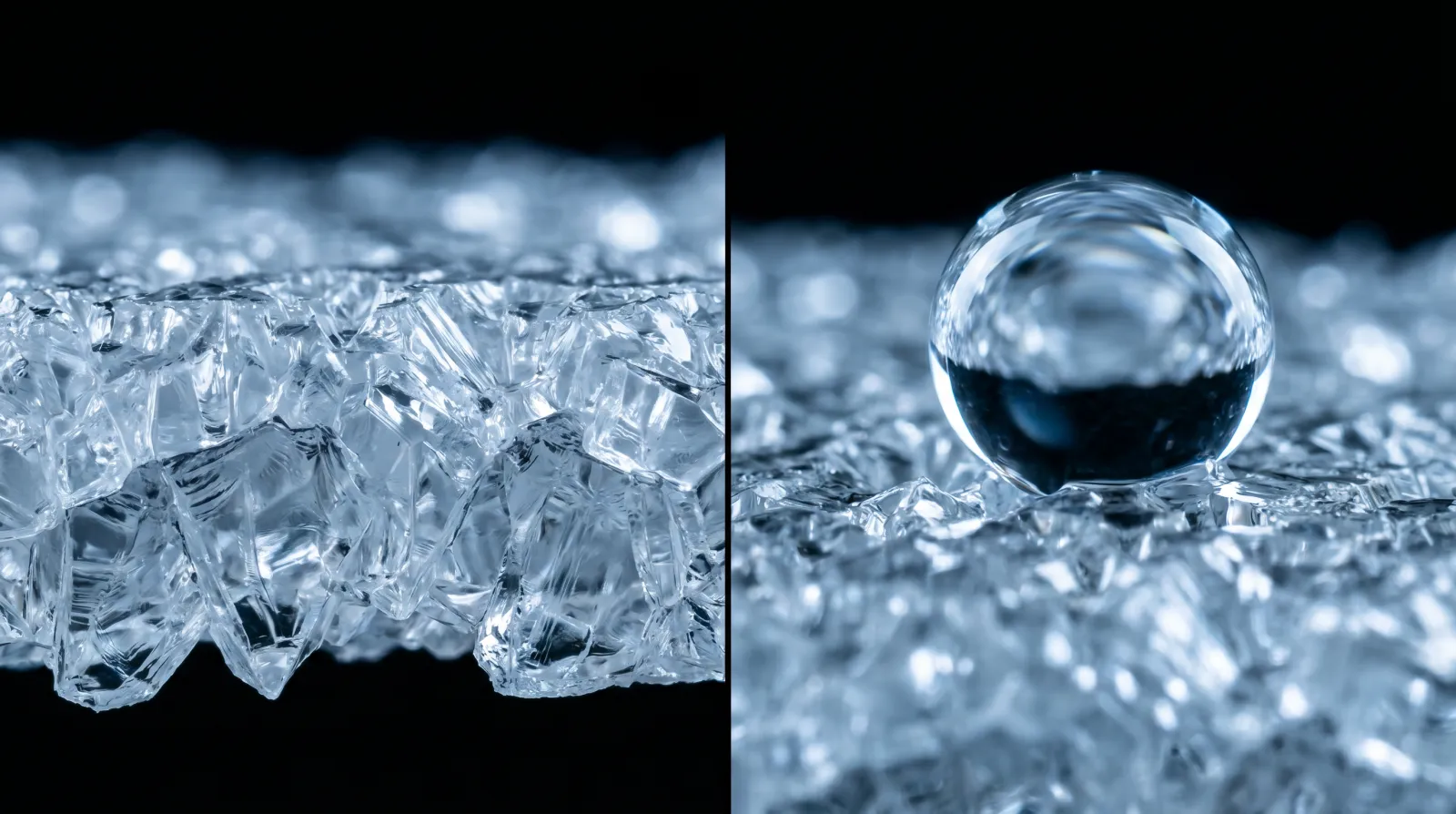
Every surface has a property called surface energy: how strongly it wants to attract other molecules. High-surface-energy materials (bare metal, uncoated paint) attract water strongly — water spreads out flat. Low-surface-energy materials repel water, so it minimises its contact area by forming spherical droplets. Cured SiO2 is inherently low surface energy. When water hits a coated panel it can't wet the surface properly and pulls itself into tight beads.
The measure of this is the contact angle: the angle at the edge of a droplet sitting on the surface. A flat puddle is near 0 degrees; a perfect sphere would be 180. A quality ceramic coating typically achieves 100–120 degrees — tight, high-sitting beads that roll off at the slightest movement. This is the property called hydrophobicity, and it's the reason coated cars sheet water off at highway speeds.
Beading vs Sheeting: Not the Same Thing
- Beading — water forms distinct, high-contact-angle droplets. Visually impressive, but beads that sit on a flat panel without rolling off can concentrate minerals as they dry, leaving water spots.
- Sheeting — water is repelled and flows off in sheets. Lower contact angle, but the water leaves the surface faster and is less prone to spotting on flat sections.
Premium coatings are formulated to do both depending on panel angle and water volume. Neither pure beading nor pure sheeting is objectively superior — it depends on how and where you drive.
The "Self-Cleaning Effect": What It Really Means
Two mechanisms are at play. Hydrophobic self-cleaning: because water beads and sheets off efficiently, it carries loose contaminants — light dust, pollen, road film — with it as it drains. On a coated car that gets rain or a quick hose-down, contamination builds up much more slowly than on bare paint. Real and useful. Photocatalytic self-cleaning (TiO2): titanium dioxide, hit by UV, produces reactive species that break down organic contaminants. Chemically true, but the TiO2 content in automotive coatings is low and the effect on brake dust, bird droppings and sap is minimal without physical washing. The honest version: a coating dramatically reduces the effort to keep a car clean — it does not eliminate washing.
The Sacrificial Layer: Protection Without Drama
One of the most practically important concepts is that the coating functions as a sacrificial layer. Your clear coat is the structural, irreplaceable outer layer of your paint — once damaged, the only fix is a repaint. A ceramic coating sits between your clear coat and everything the world throws at it: UV, bird droppings, fallout, light swirls from washing. It takes those hits, and can be decontaminated, lightly polished and eventually replaced at end of service life without touching the clear coat underneath. The hardness ratings (including the much-discussed 9H claim) relate to how well the coating resists penetration from hard particles — see our piece on 9H hardness explained for what those numbers actually mean.
Why the Chemistry Makes Ceramic Coatings Different — Not Magic
The covalent bond to the clear coat, the cross-linked SiO2 matrix, the low surface energy, the hydrophobicity, the sacrificial layer — these are genuine, measurable properties. Ceramic coatings do what they claim at the chemical level. What they do not do is eliminate maintenance, prevent all scratches, or last forever without degradation. The science supports the performance; the marketing often overstates it. Understanding the mechanism means you can evaluate products, interpret claims and maintain your coating correctly — more valuable than believing the hype. Head back to our ceramic coating hub to explore product comparisons, application guides and durability data.
Affiliate Disclosure
Some links on this page are affiliate links. If you buy through them we may earn a small commission at no extra cost to you. It never changes our verdicts — we only recommend gear we would run on our own cars. Read the full disclosure.