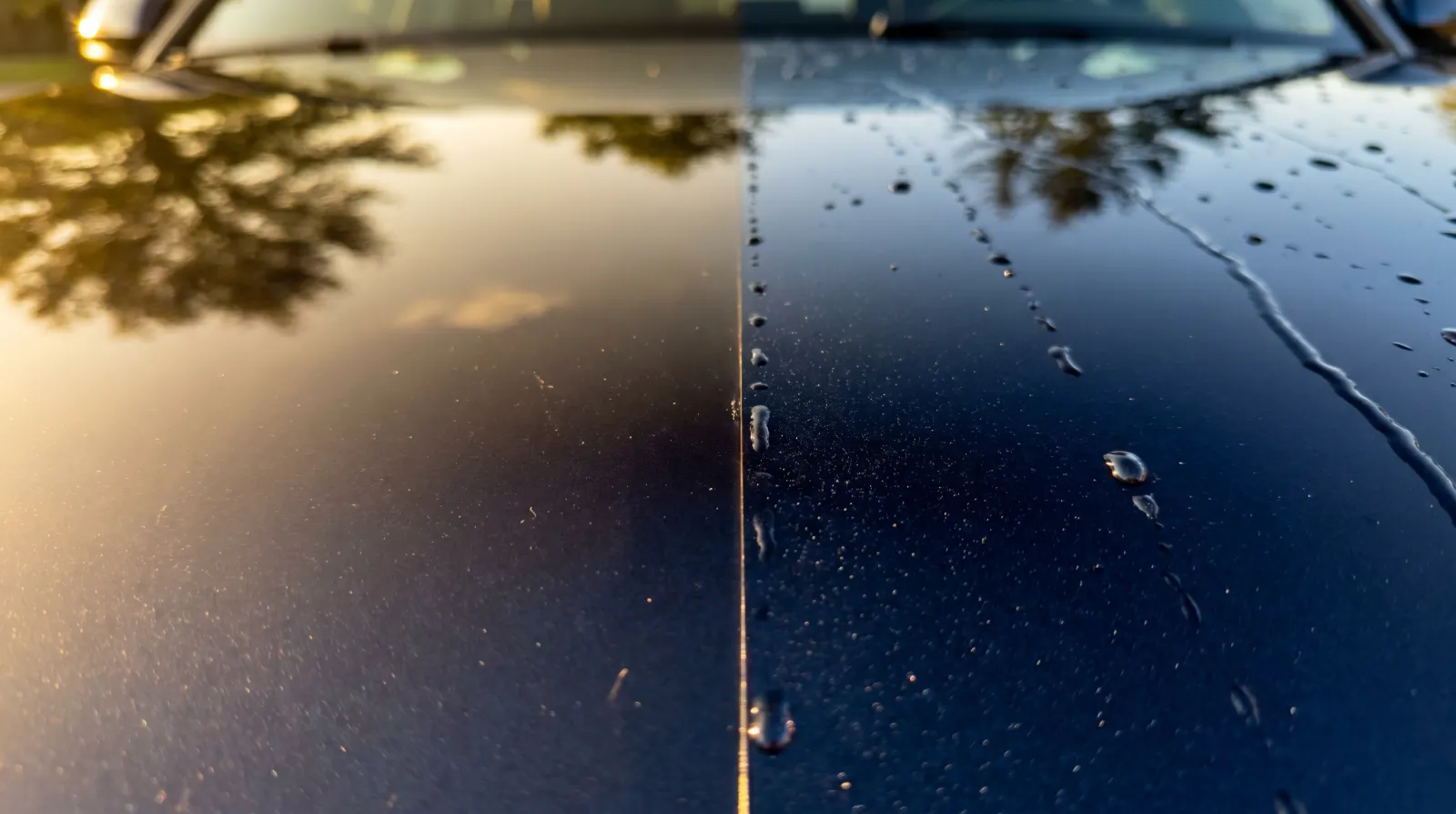
You've seen the videos. Someone sprays water on a bonnet, it sheets off like a repelled monsoon, and the comments erupt: "bro just use wax lol." Then the next guy dunks a panel in brake cleaner and the coating survives. Everyone's got an opinion.
Here's the thing: wax and ceramic coatings are not the same product trying to do the same job. They sit in different price brackets, demand different effort, and deliver different results over different timeframes. This page breaks it down straight so you can pick the right protection for your car, your schedule and your wallet.
Part of our wax vs sealant vs PPF comparison and the ceramic coating hub.
What Each Product Actually Is
Carnauba wax is a natural wax from the leaves of a Brazilian palm. Blended with solvents and oils into a workable paste, it sits on top of your clear coat as a thin sacrificial layer. It never bonds chemically — it just rests there, filling microscopic scratches and laying down a warm, organic gloss. That warmth, the "depth" you can almost reach into, is why concours judges and old-school detailers still swear by it.
Ceramic coatings are liquid polymer products, usually silicon dioxide (SiO2) based, that cross-link with your clear coat as they cure. Instead of sitting on the surface, they bond at a molecular level and harden into a semi-permanent layer — harder, slicker and far more resistant to environmental damage than bare paint or wax. That's the foundational difference: wax is a temporary sacrificial coat; ceramic is a durable chemical bond.
Head-to-Head: The Numbers That Matter
| Attribute | Carnauba Wax | Ceramic Coating |
|---|---|---|
| Durability | 4–8 weeks (daily); up to 3–4 months ideal | 1–5+ years by tier and maintenance |
| Gloss character | Warm, deep, organic "wet" look | Glass-like, reflective, high-clarity |
| Hydrophobicity | Moderate; contact angle drops as wax degrades | High; 100–110°+ held for months |
| UV resistance | Basic; oxidises and thins rapidly | Strong; SiO2 shields the clear coat |
| Chemical resistance | Low; bird drops and detergents strip it fast | High; resists acids and alkaline cleaners |
| Application effort | Low–moderate; apply, haze, buff | High; full decon + correction + careful levelling |
| Frequency | Every 1–3 months | Once, with optional annual top-ups |
| Cost (DIY) | $15–$60 per tin, ongoing | $50–$150 kit; $500–$2,000+ pro |
| Scratch resistance | None; wax is soft | Improved swirl resistance; not scratch-proof |
| Reversibility | Fully reversible; strip with IPA | Semi-permanent; needs abrasive polishing |
Gloss: Warm vs Glass-Like
This is where personal preference legitimately splits the two camps. Carnauba produces a "warm" gloss — on black, deep red and racing green it adds a depth that feels almost three-dimensional, slightly softening hard reflections. Ceramic produces a sharper, more glass-like finish; reflections are crisper, almost lacquered. On lighter colours and metallics this often looks stunning; on some classics it can look almost too clinical. Neither is objectively better — if gloss character matters to you, research before committing to a multi-year coating.
Hydrophobicity: More Than Cool Beading
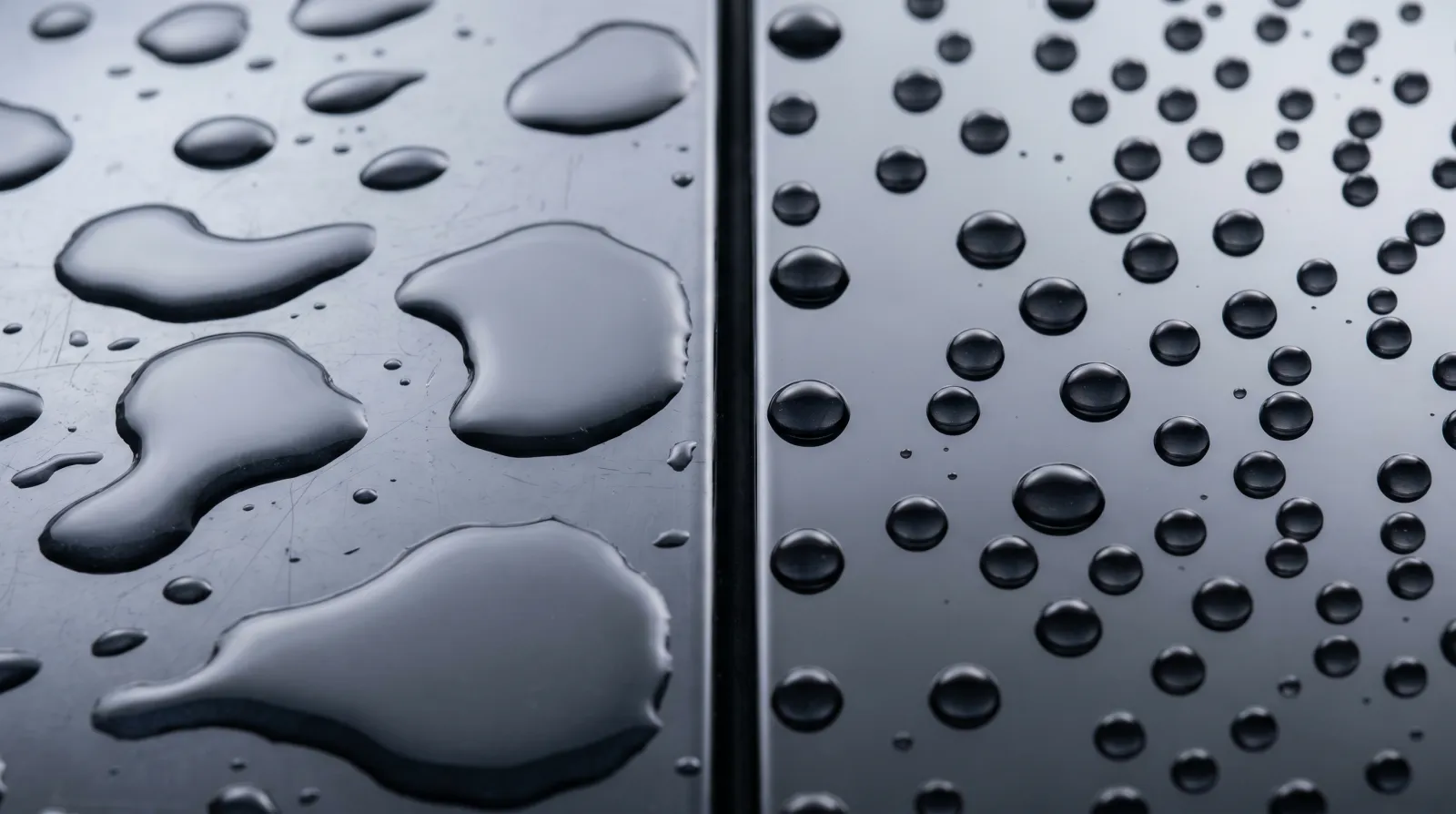
Water beading is the most photographed property, but the metric that matters is contact angle — the angle a droplet sits at against the surface. Higher angle, faster sheeting, more contamination carried away. Fresh carnauba can hit 70–80 degrees, but it degrades quickly under UV and heat; after a few weeks on a daily those beads flatten and the self-cleaning effect drops. A properly cured ceramic coating holds 100–110 degrees or above for extended periods — water doesn't just bead, it sheets when the car moves. That's meaningful: contamination has less chance to bond and cause damage, and it actively reduces weekly cleaning effort.
Can You Wax Over a Ceramic Coating?
No. And it's probably the most common mistake new coating owners make. Wax over a cured ceramic does essentially nothing protective and can cause problems: the slick, chemically resistant surface gives wax almost nothing to bond to, so it sits loosely, smears, and can leave haze that's hard to remove without compounding into your coating. Worse, it clogs the coating's surface microstructure and reduces hydrophobic performance. To top up an existing coating, use a ceramic-compatible SiO2 spray booster instead — our maintenance guide covers the products and routine.
UV and Chemical Resistance: Where Ceramic Clearly Wins
Wax oxidises — that's the design; the wax layer sacrifices itself to UV so your clear coat doesn't. The problem is that in strong sun this happens fast: a light-coloured car parked outside in summer can strip a wax layer to near uselessness in three to four weeks. Ceramic coatings, being inorganic silicon dioxide, don't oxidise the same way — the SiO2 layer stays stable and keeps shielding the clear coat season after season. Combined with high resistance to acidic bird drops and alkaline wash chemicals, this is where the durability premium genuinely pays off on daily-driven cars.
Who Should Pick Wax
- Classic and show car owners who want the warm gloss and wax before each show
- Renters or short-term owners who won't keep the car long enough to amortise a coating
- Tight budgets that can commit to re-applying every six to eight weeks
- Detailing enthusiasts who enjoy the application ritual
- Cars with paint in rough condition not yet properly polished — wax over unpolished paint is fine; ceramic locks in every swirl permanently
Who Should Pick Ceramic Coating
- Daily drivers exposed to sun, rain, bird drops and fallout — the durability gap pays off fastest here
- Owners who hate washing and waxing but want protected, glossy paint
- Long-term keepers planning three-plus years of ownership
- Anyone wanting genuine chemical and UV resistance rather than a constantly refreshed sacrificial layer
- Owners who've already had the paint machine-polished and want to lock in that result
Does Ceramic Coating Replace Wax?
Yes, entirely. There's no maintenance benefit to adding wax over a cured ceramic — it actively undermines performance. Once you have a coating, your toolkit switches to pH-neutral wash soap, a ceramic spray booster for top-ups, and an iron-fallout remover for periodic decontamination. For how ceramic compares against synthetic sealants and PPF, see the wax vs sealant vs PPF guide; for everything after the coating goes on, the maintenance guide covers wash routines and top-up schedules.
Affiliate Disclosure
Some links on this page are affiliate links. If you buy through them we may earn a small commission at no extra cost to you. It never changes our verdicts — we only recommend gear we would run on our own cars. Read the full disclosure.