Every car comes with a jack from the factory. Most people assume that because it came with the car, it must be fine to use for any job. That assumption has put people in hospital. The jack stuffed under your spare tyre is an emergency tool built for one specific task — and the moment you crawl under a vehicle sitting on it, you are gambling with your life.
This guide breaks down every common jack type, explains exactly what each one is designed for, and helps you choose the right tool before you lift a wheel. If you want the short answer on which floor jack to buy for your garage, head over to our best trolley jack guide. If you want the full step-by-step lift procedure, see how to jack up a car safely. This page is about understanding the tools themselves.
The Short Version: Four Jacks, Four Different Jobs
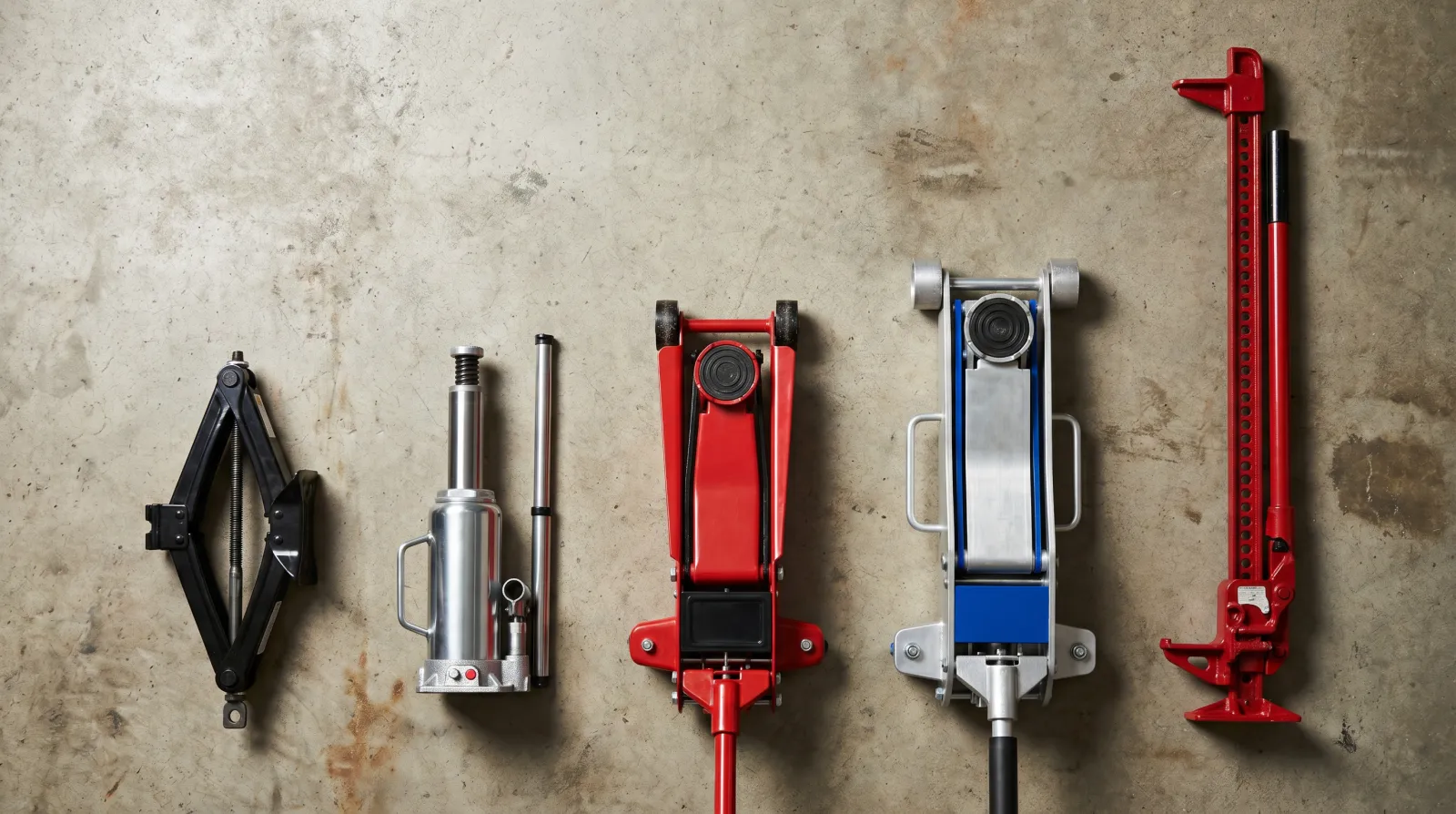
Before going deep on each type, here is the landscape at a glance. There are four jacks you will realistically encounter as a DIY mechanic. Two of them can be used to position a car so you can work under it (with jack stands in place). Two of them cannot — at least not safely.
| Jack Type | Mechanism | Typical Lift Height | Footprint / Stability | Safe to Work Under? | Best Use Case |
|---|---|---|---|---|---|
| Scissor Jack | Screw-drive mechanical | 100–380 mm | Very small, inherently unstable | No — ever | Emergency tyre change only |
| Bottle Jack | Hydraulic (vertical ram) | 150–500 mm+ | Small base, can tip sideways | No — only with stands | High-lift jobs, trucks, off-road |
| Trolley / Floor Jack | Hydraulic (horizontal pump) | 85–500 mm | Wide, low, very stable | No — only with stands | Everyday DIY garage work |
| Low-Profile Floor Jack | Hydraulic (horizontal pump) | 65–380 mm | Wide, flat, very stable | No — only with stands | Lowered and modified cars |
| Hi-Lift / Farm Jack | Mechanical ratchet | Up to 1,500 mm | Narrow base, high tip-over risk | No — off-road recovery tool only | Off-road recovery, extreme lift |
The rule that applies to every single row in that table: a jack is a lifting device, not a support device. Once the car is at height, jack stands go under rated jacking points before you or any part of your body goes under the car. No exceptions. See our complete guide on jacking up a car safely for the full procedure.
Scissor Jack: The Emergency Spare
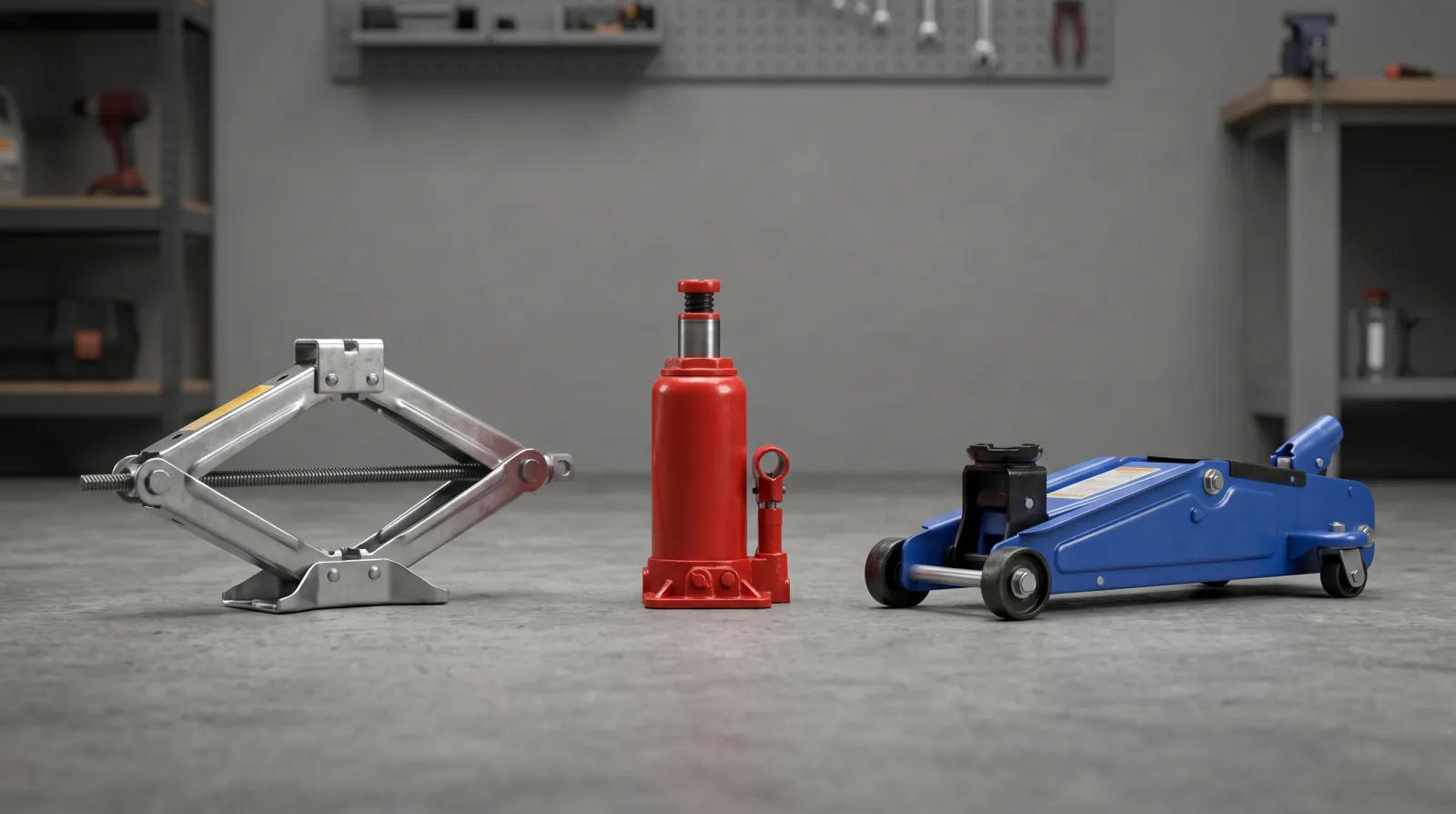
The scissor jack is the diamond-shaped folding jack that lives in your boot next to the spare tyre. It works through a simple screw mechanism — you rotate a handle or bar to expand or collapse the X-shaped arms, which raises or lowers the saddle. No hydraulics, no moving fluid, just a threaded rod and metal arms.
It is brilliantly engineered for exactly one job: getting a flat tyre swapped on the side of a road so you can drive to a tyre shop. At that task it is compact, lightweight, and adequate. Nothing more.
Why you must never use a scissor jack as a work support:
- The base footprint is tiny — typically 100 mm x 100 mm or less. On any surface that is not perfectly flat concrete, it can shift or tip.
- The scissor mechanism is designed for vertical load only. Any lateral force — from you bumping the car, a tyre rolling slightly, or even vibration from a tool — can cause it to collapse sideways instantaneously.
- Factory scissor jacks are not rated for sustained load under working conditions. The ratings printed on them apply to the brief, controlled emergency-swap scenario.
- When a scissor jack fails, it gives no warning. There is no creak, no lean, no time to react. The car drops.
Keep it in your boot. Use it to swap a flat. Drive to a proper tyre shop. That is the entire job description.
Bottle Jack: The High-Lift Hydraulic
A bottle jack looks exactly like what it is named after — a cylindrical body shaped roughly like a bottle, with a hydraulic ram that extends vertically from the top. You pump a handle to build pressure in the fluid, which pushes the ram upward. A release valve lowers it back down.
The key advantages of a bottle jack are lift height and weight capacity relative to price. A decent 10-tonne bottle jack costs less than $80 and can handle the front axle of a light truck or four-wheel drive with ease. Some bottle jack models can lift to 500 mm or beyond, which makes them genuinely useful for vehicles with high ground clearance.
The limitation is the base. Because the bottle jack body must be compact to fit under a vehicle, the footprint is small — similar in width to a standard drink bottle. That narrow base, combined with a tall lift height, creates a tip-over risk. On a soft surface like gravel or dirt, a bottle jack can sink unevenly, increasing that risk further.
For a standard-height car on flat concrete, a bottle jack works fine — as long as you locate it precisely on a rated jacking point, and as always, jack stands go in place before you do anything else under the car. For anything where a low entry height matters, or where you want the widest possible margin of stability for everyday garage work, the trolley jack is the better choice.
The jack saddle: The saddle is the contact point at the top of any jack — the cup or pad that touches the vehicle. On a bottle jack the saddle is often a plain steel post with a small flat top. It is worth checking that your saddle is seating cleanly and centrally on the jacking point before you pump. A saddle that slips off a pinch weld mid-lift is a fast way to crease bodywork or worse.
Trolley Jack (Floor Jack): The DIY Workhorse
The trolley jack — also called a floor jack — is the standard tool for home garage work. It operates on the same hydraulic principle as a bottle jack, but the pump cylinder lies horizontally rather than vertically. This allows the jack head to start very low (as little as 85 mm in a standard model) while the long handle gives you leverage and keeps your hands away from the vehicle.
The trolley format offers several practical advantages:
- Wide wheelbase and low centre of gravity: A trolley jack is far more stable than a bottle jack at working height because the weight is distributed across a rectangular frame on four castors.
- Easy positioning: You can roll it precisely into place rather than lifting and placing it. This matters when you are trying to hit a specific jacking point under a sill.
- One-handed pump: The long handle means you are not stooped over the work, and a single pump per stroke builds pressure quickly.
- Controlled descent: The release valve on most quality trolley jacks allows fine-grained lowering, which helps you set the car down squarely onto stands.
For the vast majority of DIY jobs — oil changes, brake work, suspension components, wheel removal — a good 2.5-tonne or 3-tonne trolley jack is everything you need. Our best trolley jack roundup covers specific models worth owning across different budget brackets.
Low-Profile Floor Jack: For Lowered Cars
If your car sits lower than standard — even factory sport models can be surprisingly low — a standard trolley jack with an 85 mm minimum height may not clear the front splitter, lower lip, or side skirts to reach a jacking point. This is where the low-profile floor jack earns its place.
A low-profile jack is essentially a trolley jack with a flattened body and a minimum lift height starting around 65 mm, with some models going as low as 55 mm. The tradeoff is usually a slightly lower maximum lift height and a higher price for equivalent quality. For a modified JDM car that sits on aftermarket coilovers, or any factory model with a front air dam that drops close to the ground, a low-profile jack is not optional — it is the only tool that gets you to the jacking point without damaging bodywork.
Check your car’s minimum ground clearance before buying. Measure from the floor to the lowest rigid point on the underside at the front jacking area. That number tells you the minimum entry height your jack must clear.
Hi-Lift / Farm Jack: Off-Road Recovery, Not Workshop Use
The hi-lift jack — sometimes called a farm jack — is a tall ratchet-style jack capable of lifting to 1,200–1,500 mm. It is designed for off-road recovery: getting a bogged four-wheel drive off soft ground, lifting a wheel that has dropped into a rut, or levering a vehicle sideways.
It has a very narrow base, a high tip-over risk, and is notoriously unforgiving if the ratchet mechanism is not engaged correctly. It is not a workshop tool. It is mentioned here because people occasionally ask whether they can use one for regular vehicle lifting. The answer is no — not because it lacks lift capacity, but because the risk profile is completely wrong for controlled garage work.
Choosing the Right Jack for Your Situation
For most people doing their own maintenance at home, the decision tree is short:
- Standard-height car, daily garage work: 2.5–3 tonne trolley jack. This is the answer for the overwhelming majority of DIY mechanics.
- Lowered or modified car: Low-profile trolley jack with a minimum entry height of 65 mm or lower.
- Truck, SUV, or four-wheel drive with high clearance: Either a 3-tonne trolley jack with adequate maximum lift height, or a bottle jack if you need extra lift and compact storage.
- Emergency roadside flat tyre: The scissor jack that came with your car. Nothing else is necessary, and nothing else fits where it needs to fit.
Whatever jack you are using to lift the car, the procedure after that does not change: rated jack stands go under the vehicle’s designated support points before you do any work. The jack is removed from the load, or at minimum kept in place as a backup with stands carrying the weight. If that procedure is not already second nature, the jacking up a car hub is the place to start before touching a wrench.
A Note on Jack Ratings and Wear
Every jack has a rated capacity stamped or labelled on it. That rating assumes the jack is in good condition. A trolley jack that has never been serviced, has a weeping hydraulic seal, or has been stored with water contamination in the fluid is not a jack you should trust. Check for:
- Slow or uneven rise when pumping
- Creep — the car slowly sinking when the jack should be holding
- Oil weeping from around the ram or pump cylinder
- Bent saddle or cracked welds on the frame
Any of these means the jack is out of service until it is repaired or replaced. No DIY job is worth the alternative.
Affiliate Disclosure
Some links on this page are affiliate links. If you buy through them we may earn a small commission at no extra cost to you. It never changes our verdicts — we only recommend gear we would run on our own cars. Read the full disclosure.