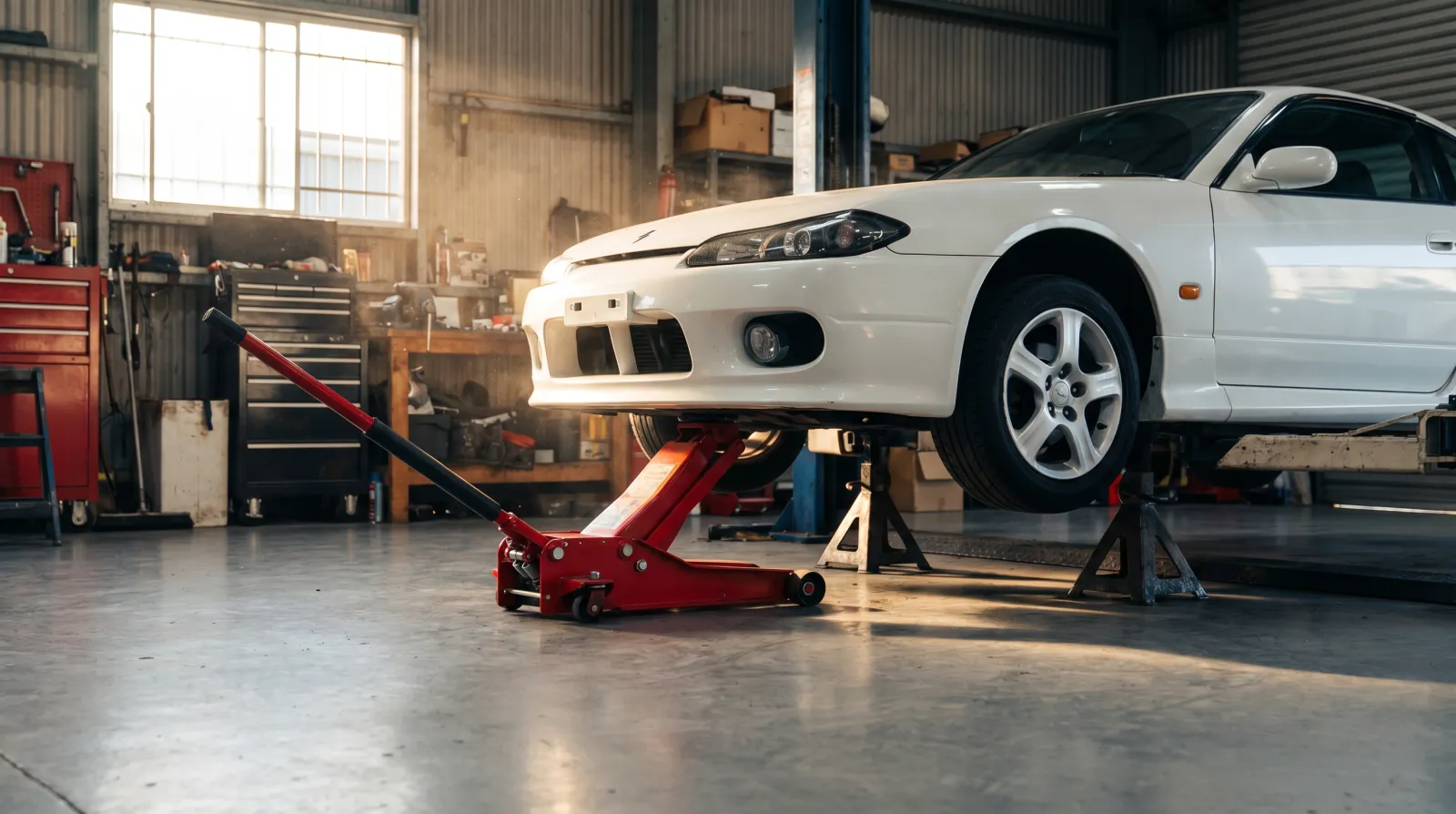
Short version: getting under a car safely needs cheap gear and three non-negotiable rules — level concrete, the right lift points, and two rated axle stands (never a jack alone). This is the job where DIYers actually get hurt, so we don't soften it. Below is the gear, where to lift, the full safe step-by-step, and the mistakes that crush people. Always confirm your jack points against your own owner's manual — every car is different.
What "Jacking Up a Car" Actually Means
There are two jobs here, and conflating them is what gets people hurt. A jack lifts the car; a stand holds it. You'll meet several jack types — the trolley (floor) jack that does the DIY work, the scissor jack in your boot (an emergency tyre-change tool, never a work support), and the bottle jack (hydraulic, high lift, small base). The thing that actually keeps the car up while you're under it is a pair of axle stands. Full rundown in types of jacks.
Why Safety Is the Whole Game
This is the one job in home mechanics where the failure mode is a car falling on you. Hydraulic jacks have seals, and seals fail — a jack that held a car yesterday can drop it today. So the rules aren't fussy box-ticking: two rated stands at proper points, level concrete only, wheels chocked, and a firm push/wobble test before you go under. We make the full case in do you really need jack stands, and the pre-flight list lives in wheel chocks & safety.
The Gear You Need (and What to Skip)
The buy-once kit: a trolley jack rated above your car's weight (a low-profile one if your car sits low), two axle stands rated to match, at least two wheel chocks, and a slotted jack pad/puck to protect pinch welds. Match the tonnage to your kerb weight/GVM — 2T for most cars, 3T for SUVs/utes. Ramps are a faster alternative for a pure oil change. Our picks: best trolley jacks and best jack stands, and the ramps-vs-stands call is in jack stands vs ramps.
Finding Your Car's Jack Points
Lift on the manufacturer's jack points — the reinforced pinch welds (use a slotted puck so you don't crush the seam), the subframe/cross-member at the front, and the rear axle or differential at the back. The owner's manual has a diagram. Never lift on the floor pan, the oil pan/sump, plastic, or a control arm. Detail in where are the jack points, with vehicle-specific guidance in jacking points by car type.
The Full Safe Lifting Step-by-Step
- Park on flat, solid, level concrete.
- Apply the parking brake; manual in gear, auto in Park.
- Chock the wheels on the end staying on the ground (both sides of the tyre).
- Position the jack saddle directly under the correct jack point.
- Pump slowly and lift — only as high as the job needs. Watch the saddle; if it slips or you hear cracking, stop and reset.
- Set two axle stands to height at the rated support points, bases flat on the ground.
- Crack the release valve and lower the car evenly onto both stands.
- Do the push/wobble test — shove the car hard from several directions. Any movement, get it back on the jack and reset.
- Leave the jack lightly in contact as a backup catch, then go under.
Step-by-step detail and photos in how to jack up a car.
Lowering It Back Down Safely
Reverse the order: clear all tools from under the car, pump the jack until it takes the weight off the stands, remove both stands, then crack the release valve slowly and lower evenly to the ground. Confirm all four tyres are down before removing the jack and chocks.
Lifting Lowered & JDM Cars
If your car is slammed on coilovers, a standard jack won't fit under the lip. You'll want a low-profile jack (saddle from ~85–90 mm) and often a set of lead-on wedges or ramps to gain clearance first — without scraping the front lip. The full technique is in lifting a lowered car.
Common Mistakes That Get People Hurt
The ones that kill: going under on the jack alone; using bricks, blocks or a scissor jack as a support; jacking on grass or a slope; lifting on the wrong point and crushing the pinch weld; exceeding the tonnage rating; and using a single stand. All of them, and how to avoid them, in common jacking mistakes.
You're Up — Now What?
Car safely on stands and push-tested? You're ready for the job that brought you here — most likely an oil change. Lifting safely is the prerequisite skill for nearly everything under the car; get it right and the rest is easy. The topical map below links every part of the process.
Affiliate Disclosure
Some links on this page are affiliate links. If you buy through them we may earn a small commission at no extra cost to you. It never changes our verdicts — we only recommend gear we would run on our own cars. Read the full disclosure.