You've got two options that sound vaguely similar, cost serious money, and get marketed interchangeably by shops that want to sell you the expensive one. Let's fix that.
Ceramic coating and PPF (paint protection film) are not the same product doing the same job. They protect paint in fundamentally different ways, at different price points, against different threats. Understanding which does what is the difference between spending wisely and wasting money.
This page is part of our ceramic coating hub and sits alongside our wax vs sealant vs PPF comparison. For the cost breakdown specifically, head to the ceramic coating cost guide. Here we're going deep on the PPF matchup.
What Each Product Actually Is
Ceramic Coating
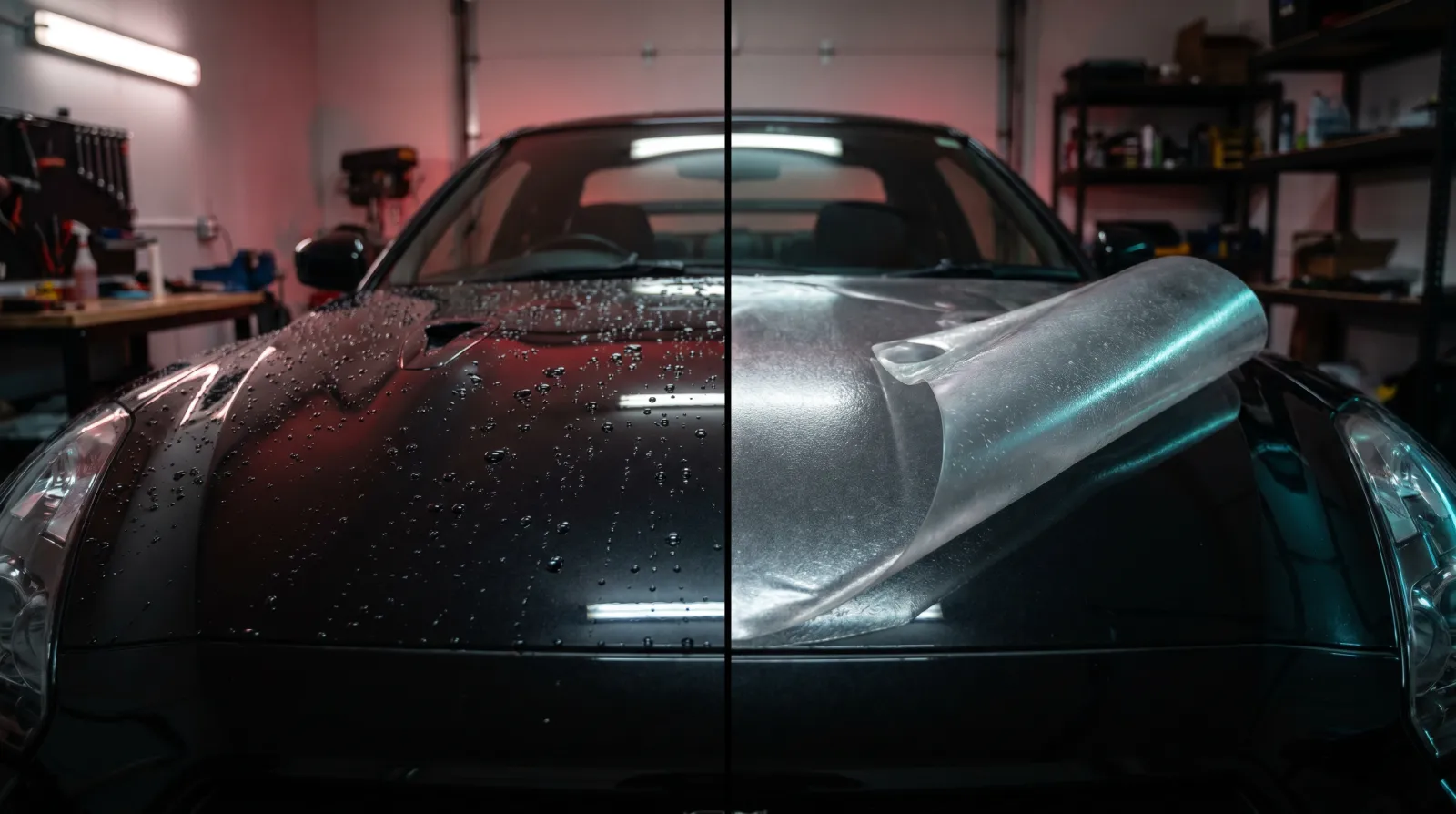
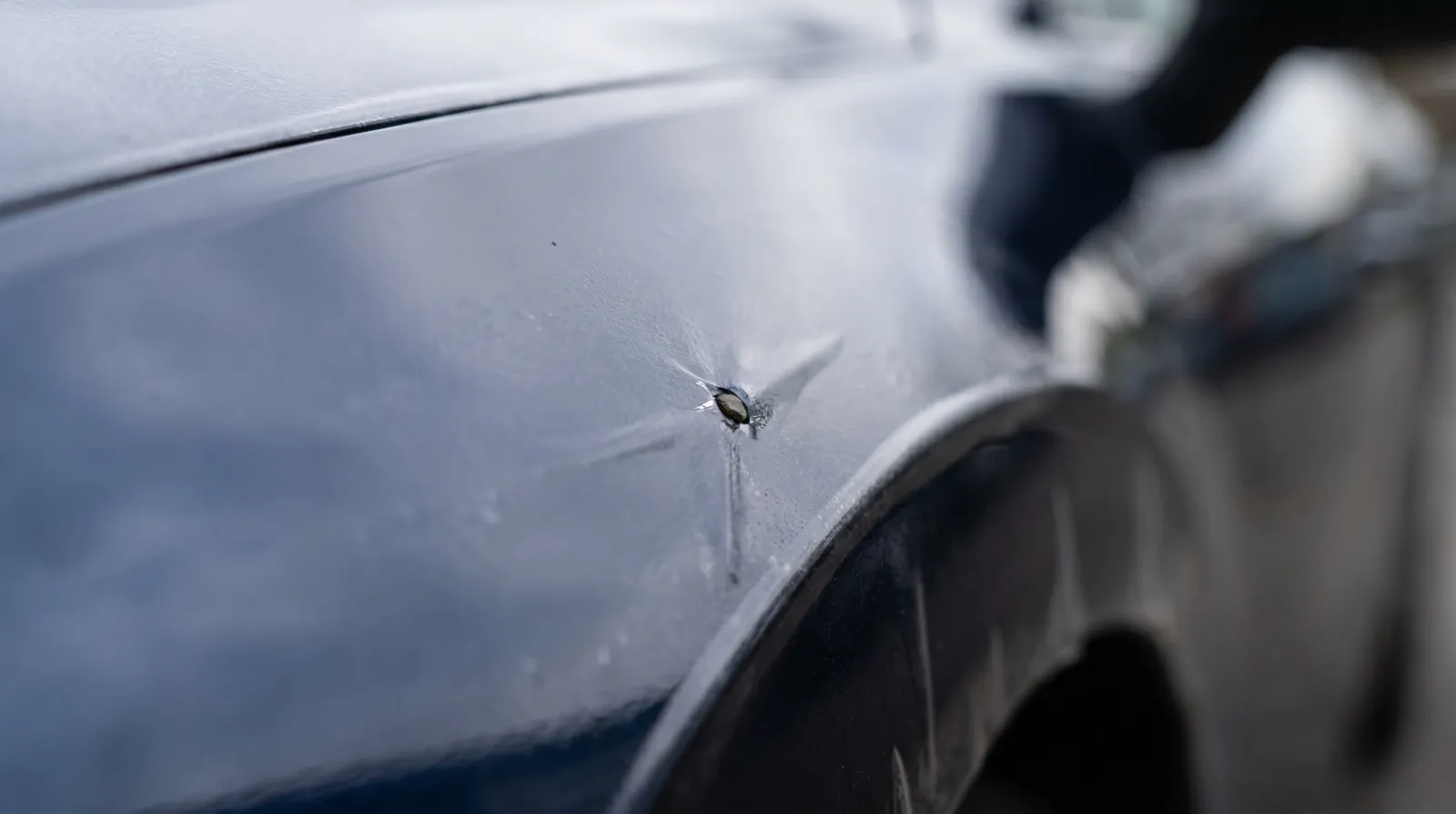
A ceramic coating is a liquid polymer — typically silicon dioxide (SiO2) or silicon carbide — that chemically bonds to your clear coat. Once cured, it forms a hard, semi-permanent layer that is hydrophobic, UV-resistant and far more durable than wax. It does not add meaningful physical thickness. Its job is surface-level protection: water, contaminants, light scratches, UV fade, chemical etching. What it cannot do is stop a rock chip — a stone at highway speed carries kinetic energy a nanometre-thin layer can't absorb.
PPF (Paint Protection Film / Clear Bra)
PPF is a physical film — thermoplastic urethane (TPU) — applied as a sheet, usually 6–10 mil thick, over the paint. Modern PPF includes a self-healing topcoat: heat causes the elastomeric top layer to "flow" back and fill light swirls and minor scratches. Premium films (XPEL, SunTek, 3M Scotchgard Pro) are optically clear and virtually invisible. PPF's core job is impact absorption — thick enough to catch stone chips, gravel and road debris before they reach your paint.
The Spec Sheet
| Attribute | Ceramic Coating | PPF |
|---|---|---|
| Material | SiO2 / silicon carbide polymer | Thermoplastic urethane (TPU) |
| Thickness | ~1–5 microns (sub-mil) | 6–10 mil (150–250 microns) |
| Rock-chip protection | None meaningful | Excellent |
| Self-healing | No | Yes (premium films, heat-activated) |
| Hydrophobicity | Excellent (100°+) | Good (topcoat-dependent) |
| Gloss enhancement | High ("wet look" depth) | Moderate (gloss) or matte (satin PPF) |
| Chemical resistance | Excellent | Moderate (topcoat-dependent) |
| Durability | 2–7 years | 5–10 years (premium) |
| Removable | No (must be polished off) | Yes (professionally, without damage) |
| DIY-friendly | Partially | No (professional install) |
| Full-car cost (approx.) | $800–$3,000+ | $3,000–$10,000+ (full wrap) |
| Partial front-end | N/A (not done in zones) | $900–$2,500 |
The Real-World Threat Model
This is the question most people skip, and the one that determines which product you need.
Highway driving and rock chips
If you do regular freeway kilometres, stone chips are your main enemy. PPF is the only real answer — nothing else absorbs a piece of gravel at 110 km/h. Ceramic coating won't save you; only the physical mass of TPU catches that chip before it craters your clear coat.
Bird droppings, industrial fallout, UV
Chemical threats are where ceramic coating earns its keep. Bird-dropping etching happens fast on unprotected paint, especially in summer heat, and ceramic's chemical resistance slows or stops it. UV fading of the clear coat is also significantly reduced.
Wash-induced swirls and light scratches
Self-healing PPF handles light scratches well if they're shallow enough to trigger topcoat recovery. Ceramic helps indirectly — its slick surface reduces wash friction. Neither substitutes for proper two-bucket technique.
Partial Front-End PPF vs Full Wrap
Most road chips hit the front: bonnet, front bumper, mirrors, and the leading edges of front guards. A partial front-end PPF package covering these zones runs roughly $900–$2,500 installed and gives you ~80% of the chip-protection benefit at 30–40% of full-wrap cost. Full wrap makes sense for new cars you'll keep long-term, collector vehicles, or any car where original paint carries real resale value. For a daily driver, partial front-end PPF plus a good ceramic coating over the rest is the most rational spend.
Stacking Ceramic Over PPF: The Best of Both
You don't have to choose. Applying a ceramic coating over PPF is widely accepted and genuinely effective: the PPF handles physical threats (chips, impacts, abrasion); the ceramic improves the film's surface hydrophobicity, makes it easier to clean, adds gloss depth, and gives the topcoat better chemical resistance. Some films actually last longer with a ceramic layer over them. The order is non-negotiable: PPF first, ceramic second. The film goes on the paint; the coating goes on the film. Stacking both is the premium option — expect $4,000–$12,000+ for a full-vehicle PPF-plus-ceramic job — but for a high-value car it's hard to argue against.
Do You Actually Need Both?
It depends on your car, your driving and your budget. You probably want PPF as the priority if you do significant highway kilometres, your original paint has resale or sentimental value, or you want self-healing on high-contact areas. You probably want ceramic as the priority if your car lives mostly in the city, chemical contamination and ease of washing matter more than chip defence, or budget rules out partial PPF right now. You want both stacked if you have a new or high-value car you're keeping long-term and want the most comprehensive protection available.
Installer Selection: Where the Money Goes
Both products live and die by installation quality. Poorly installed PPF lifts at the edges, traps moisture and delaminates; a ceramic coating over contaminated or uncorrected paint just locks in swirls under glass. Don't cheap out to save $200 — find a detailer who is XPEL-, SunTek- or Gyeon-certified, ask to see their portfolio, and check reviews specifically mentioning film installation. Paint correction should happen before either product goes on. If the installer doesn't mention it as part of prep, that's your cue to walk.
The Verdict
PPF is better at physical protection; ceramic coating is better at surface-level defence, gloss and ease of maintenance. Neither replaces the other. For most drivers, a partial front-end PPF install plus ceramic coating over the full car is the intelligent middle ground — maximum protection where damage actually happens, with the hydrophobic and gloss benefits of ceramic everywhere else. Before you commit, it's worth knowing how long ceramic coating actually lasts in the real world, and if you're weighing the cheaper route, our wax vs ceramic coating breakdown covers that call. For the cost breakdown, see our cost guide; for how PPF, ceramic, wax and sealant all stack up, the full comparison has you covered.
Affiliate Disclosure
Some links on this page are affiliate links. If you buy through them we may earn a small commission at no extra cost to you. It never changes our verdicts — we only recommend gear we would run on our own cars. Read the full disclosure.