Ceramic coating has a marketing problem. Somewhere between the first legitimate SiO2 formulas hitting the detailing market and the current wave of "spray-on ceramic" bottles crowding auto-parts shelves, the truth got buried under a landslide of hype. Enthusiasts read the claims, spend real money, and then feel ripped off when their coated paint picks up a swirl mark from a dodgy car wash.
That rip-off feeling is almost always the fault of the myth, not the product. Ceramic coatings are genuinely excellent — when you understand what they actually do. This page sets the record straight on the most common myths. For the full technical background, start with our ceramic coating overview. To understand the hardness rating specifically, the 9H hardness explained guide is worth reading before you shop.
Myth 1: Ceramic Coating Is Scratch-Proof — That 9H Rating Proves It
This one does the most damage because "9H" sounds scientific and definitive. Here's what it actually means: the cured coating resists being scratched by a pencil with a 9H graphite grade. That's a scale designed for pencil leads, not road debris or car-wash brushes. A 9H pencil won't scratch a properly cured coating; a fingernail, a branch tip or an automatic car-wash bristle will. Rock chips absolutely will. The coating adds meaningful scratch resistance over bare clear coat — think of it as a sacrificial layer that takes damage which would otherwise go straight into your clear coat — but resistance is not immunity. PPF is the product that actually absorbs rock chips and self-heals.
Myth 2: Ceramic Coating Is Self-Cleaning — You Never Have to Wash Again
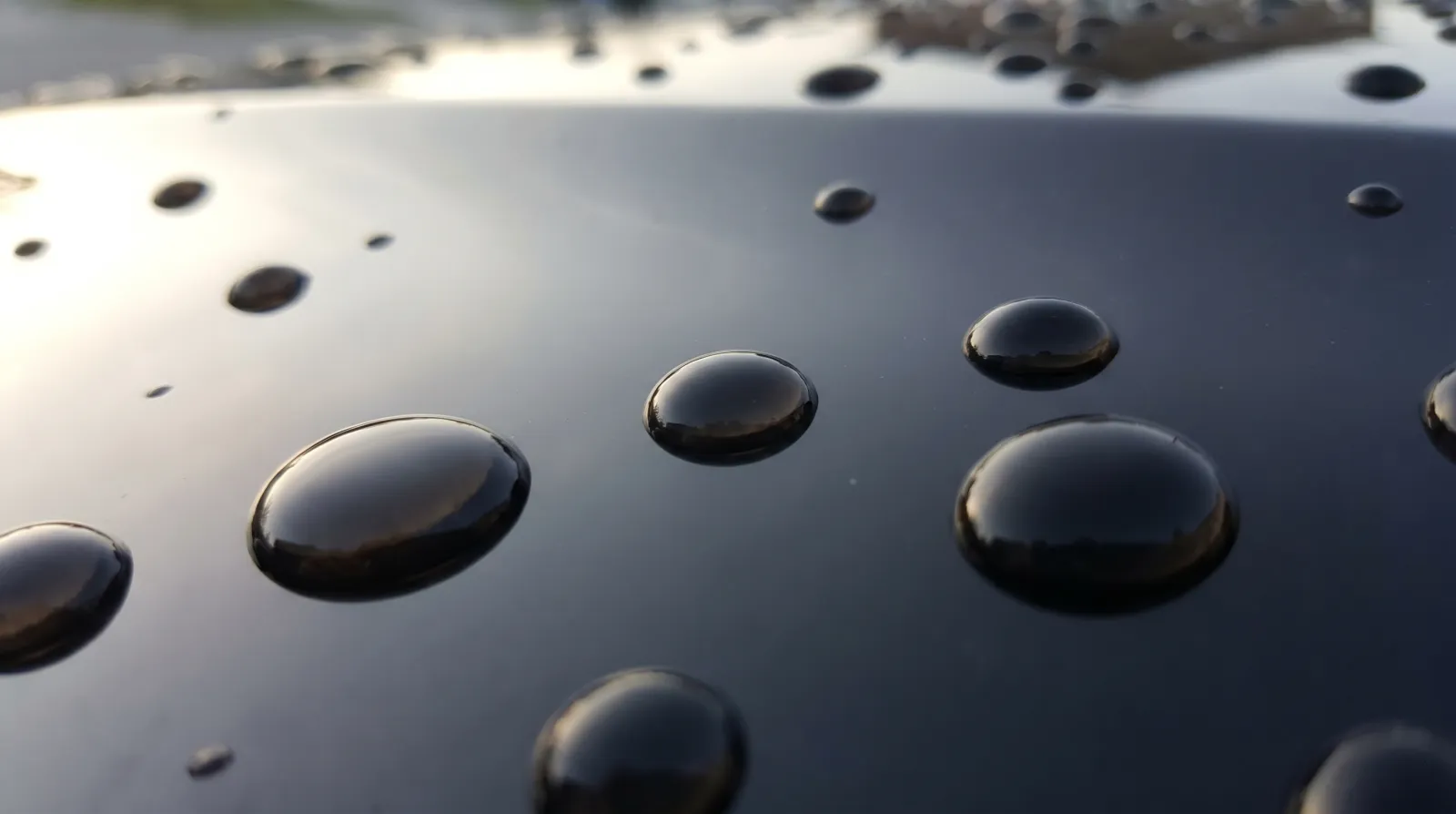
This has a grain of chemistry that gets wildly exaggerated. A quality coating creates a surface with high hydrophobicity — a contact angle typically 100° to 115°+. Water beads into tight spheres and rolls off, picking up loose contaminants as it goes (the lotus effect). In practice: your car stays cleaner longer between washes, and when you do wash it the job is faster because contamination bonds less aggressively. What it does not mean: your car cleans itself. Bird droppings, fallout, sap and brake dust still stick — just less permanently. Leave bird droppings on a coated car long enough and the uric acid will etch the coating just as it would bare clear coat; it just takes longer. See our maintenance guide for the full picture.
Myth 3: Ceramic Coating Lasts Forever
Nothing on your car lasts forever. A professional-grade coating properly applied to properly prepared paint lasts two to five years under normal conditions; top-tier formulas push toward seven. Consumer-grade DIY products are honestly rated at one to three years. What degrades it is UV radiation, chemical exposure, abrasion from improper washing, and time — the SiO2 matrix slowly becomes less hydrophobic as its surface structure breaks down. You'll know a coating is reaching end of life when water stops beading and starts sheeting. "Lasts forever" is a sales claim; two to five years of meaningfully better protection than wax is the honest answer — and genuinely good value. (More in our durability guide.)
Myth 4: Ceramic Coating Fills Swirl Marks and Hides Paint Defects
Ceramic coating does not fill scratches, hide swirl marks or correct paint. It does the opposite — it locks whatever finish is underneath in place and magnifies it under direct light. A proper coating job requires a wash, decontamination and almost always a machine polish to remove existing swirls before the coating goes on. Apply over swirled paint and you'll have perfectly preserved, hydrophobic, very shiny swirled paint. This is one of the main reasons professional application costs what it does — you're paying for paint-correction time as much as the coating itself. If a detailer quotes a coating with no mention of correction and your paint has visible swirling, ask questions.
Myth 5: Any Spray-On Ceramic Product Is a Real Ceramic Coating
You'll find dozens of products with "ceramic" on the label in a spray bottle. Some are fine maintenance products; very few are actual ceramic coatings in any meaningful technical sense. A true coating forms a semi-permanent covalent bond with the clear coat through cross-linking, curing into a hard, glassy layer that can't be washed off — which requires careful prep, controlled application and a proper cure time. Most spray "ceramic" products contain a small amount of SiO2 in a quick-detailer or sealant base; they sit on top, wash off like a conventional product, and offer nowhere near the durability or contact-angle performance of a real coating. If a product can be applied in two minutes in a car park with no surface prep and wiped straight off, it's a spray sealant — judge by cure time, prep requirements and realistic durability claims. (See our spray vs bottle guide.)
Myth 6: You Can Apply Ceramic Coating Over Dirty or Oily Paint
This gets DIY applicators in the most trouble. Ceramic coating bonds to whatever surface chemistry it encounters. If that surface has contamination — old wax residue, panel-wipe oil, water spots, iron particles, silicone — the coating bonds to that instead of the clear coat. The result is poor adhesion, early failure, high spots, streaking, and a coating that peels or hazes. The preparation sequence is non-negotiable: wash, decontaminate with iron remover, clay bar, panel wipe with an IPA solution to strip all oils, then apply immediately in a shaded environment within the right temperature and humidity window. Skipping any step is not a shortcut — it's a way to waste the cost of the coating.
Myth 7: More Layers Means Unlimited Durability
Layering is a genuine technique — many professional coatings are designed for two or three layers to increase thickness and longevity. But there's a ceiling, and it arrives quickly. Most formulas become saturated after two to three layers; additional layers don't bond properly because the chemistry has already reached maximum cross-linking density. You end up with a thick coating that's structurally compromised rather than a thin coating that's properly bonded — haze, high spots and delamination are common results. Follow the manufacturer's specification for layer count. More is not better; thicker is not stronger if the additional material isn't properly bonded. (See our layering and toppers guide.)
So Is Ceramic Coating Worth It?
Yes — with honest expectations. A properly applied coating on properly prepared paint gives genuine, measurable benefits: stronger UV resistance than wax, a hydrophobic surface that sheds water and contamination, improved chemical resistance, and a gloss depth wax can't match. It is not magic armour. It is the best paint-protection product available, used correctly. The people who feel ripped off are almost always people who believed one of the myths above. Now you know the difference.
Affiliate Disclosure
Some links on this page are affiliate links. If you buy through them we may earn a small commission at no extra cost to you. It never changes our verdicts — we only recommend gear we would run on our own cars. Read the full disclosure.