Affiliate Disclosure
Some links on this page are affiliate links. As an Amazon Associate, we earn from qualifying purchases — at no extra cost to you. We do not buy, test, or physically handle the products we cover; our rankings come from aggregated owner reviews, ratings and expert consensus. Commissions never change our verdicts. How we rank & full disclosure.
Short version: using a portable tire inflator is genuinely simple — connect it to the valve, set your target pressure, and let it run until it shuts off — but a few small habits make the difference between a good fill and a frustrating one. Check pressure cold, aim for the door-jamb number (not the sidewall max), seat the hose fitting properly so it doesn't leak, and work one tire at a time so a small pump doesn't overheat. Do that and you'll air up all four tires in a couple of minutes flat.
A portable inflator is one of the most useful tools you can keep in the trunk, but plenty of people buy one and then wrestle with it on the side of the road because no one ever showed them the routine. Here's the whole thing, start to finish, so the first time you use it in anger it just works.
Before You Start: Two Numbers to Know
Get these right and everything else is easy. First, know your target pressure. It's on the sticker inside the driver's door jamb (or in the owner's manual), listed in PSI — often something like 32 to 36 for a typical car. Do not use the big number molded into the tire's sidewall; that's the tire's maximum safe pressure, not the pressure your car wants. We explain why this trips up so many people in the correct tire pressure guide.
Second, know your current pressure, ideally with a trusted tire pressure gauge rather than the sometimes-optimistic readout on a cheap inflator. And check it cold — before you've driven more than a mile — because driving warms the tires and inflates the reading. If a tire reads a few PSI low, you just need a top-up. If it's dramatically low or flat, look for a nail or damage before you inflate, because you may need to plug it first.
Step-by-Step: Airing Up a Tire
Here's the routine that works with essentially every portable inflator, cordless or 12V:
- Park safely and set up. On the roadside, get well off the traffic lane, engage the parking brake, and switch on hazards. Position the inflator so its hose comfortably reaches the valve without stretching.
- Power it. For a 12V unit, plug it into the cigarette socket — and start the engine (or be ready to) so you don't drain the battery on a longer fill. For a cordless unit, make sure it's charged; keeping it topped up is the price of the no-cords convenience.
- Remove the valve cap from the tire and pocket it so it doesn't roll away.
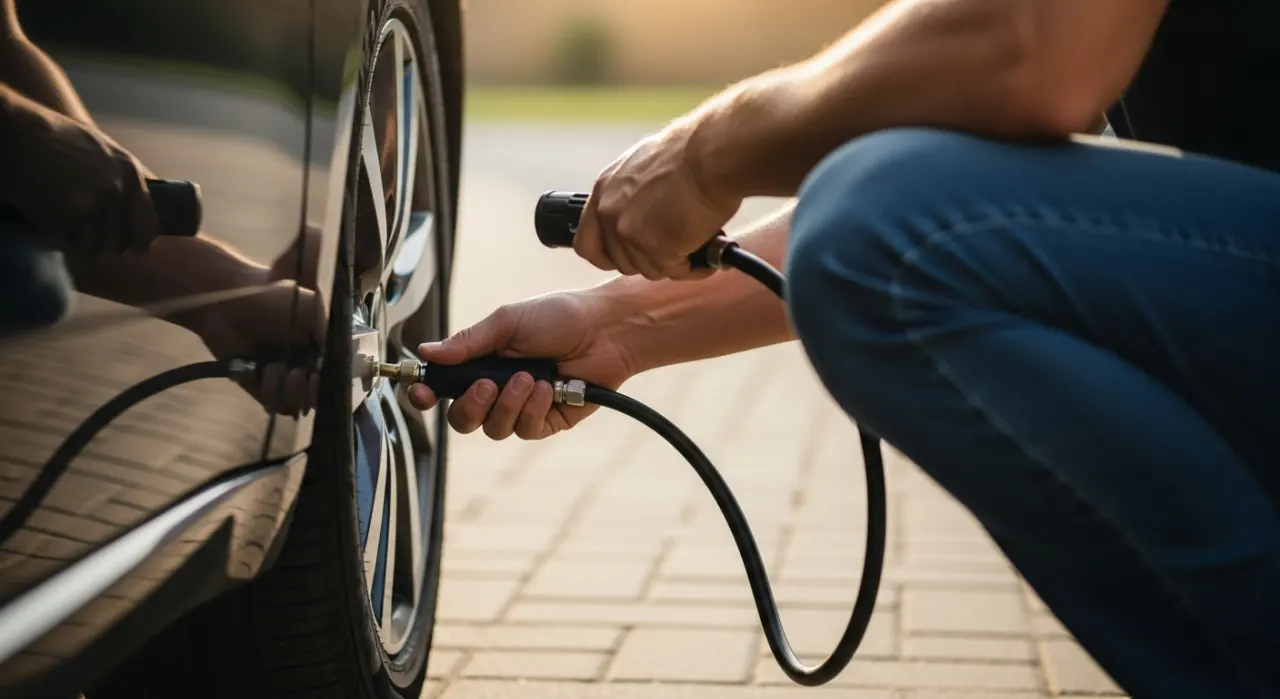
- Connect the hose fitting squarely onto the valve stem and lock it — most inflators have a lever or a screw-on chuck. This is the step people get wrong: if it's not fully seated, air leaks out as fast as it goes in. A quick hiss test tells you if the seal is good.
- Set your target pressure. On a digital inflator, dial in the door-jamb number; the auto shut-off will stop the pump exactly there. On a basic unit without presets, watch the gauge and stop manually.
- Run it. Start the inflator and let it work. A small top-up finishes in seconds; a very low tire takes a couple of minutes. Watch or listen for the auto shut-off.
- Disconnect and re-check. Remove the fitting, then confirm the pressure with your handheld gauge — inflator gauges can read a little off. Add or bleed a touch if needed, and replace the valve cap.
- Repeat for the other tires, giving a compact 12V pump a short rest between big fills so it doesn't overheat.
Common Mistakes to Avoid
Overinflating to the sidewall number. The single most common error. That figure is a maximum; inflating to it gives a harsh ride and wears out the center of the tread. Always use the door-jamb pressure.
Filling hot tires to the cold spec. If you inflate warm tires to the target, they'll be low once cool. Either check and fill cold, or add 3–4 PSI when hot and re-check later.
Leaving the fitting loose. A poorly seated chuck leaks and makes the pump seem broken. Seat it squarely and lock it before you blame the inflator.
Running a small pump nonstop. Compact 12V compressors can overheat on a big or fully flat tire if run in one long burst. Work one tire at a time and pause to cool if the motor gets hot — this is normal, not a defect.
Trusting the inflator's gauge alone. Built-in gauges are convenient but not always precise. Confirm the final pressure with a dedicated gauge for accuracy.
What If the Tire Is Actually Flat?
A portable inflator is built to reinflate a soft or slowly-leaking tire, not to fix damage. If a tire is fully flat, first find out why. A nail or screw in the tread is the common cause, and the roadside fix is to plug it and then inflate — the plug seals the hole so the air you add stays in. That's exactly the job of a tire repair kit paired with your inflator, and the full method is in how to plug a flat tire. But if the tire has a sidewall puncture, a gash, or was driven on while flat, don't just pump it up and drive — it may be unsafe, and it needs professional inspection or replacement.
Which Inflator Makes This Easiest
Any inflator will do this job, but a couple of features make it painless: auto shut-off so you can set the pressure and walk away, a readable backlit gauge for night-time flats, and enough output for your tire size. Cordless units add the freedom of no cords; 12V units add unlimited runtime and a lower price. We rank the standouts, with the trade-offs spelled out, in best portable tire inflator, and if you're stuck between the two power types, cordless vs 12V inflators settles it. For everything else that keeps your tires healthy, head back to the tire inflators & tire tools hub.